
Control Line: Racing
Bill Lee
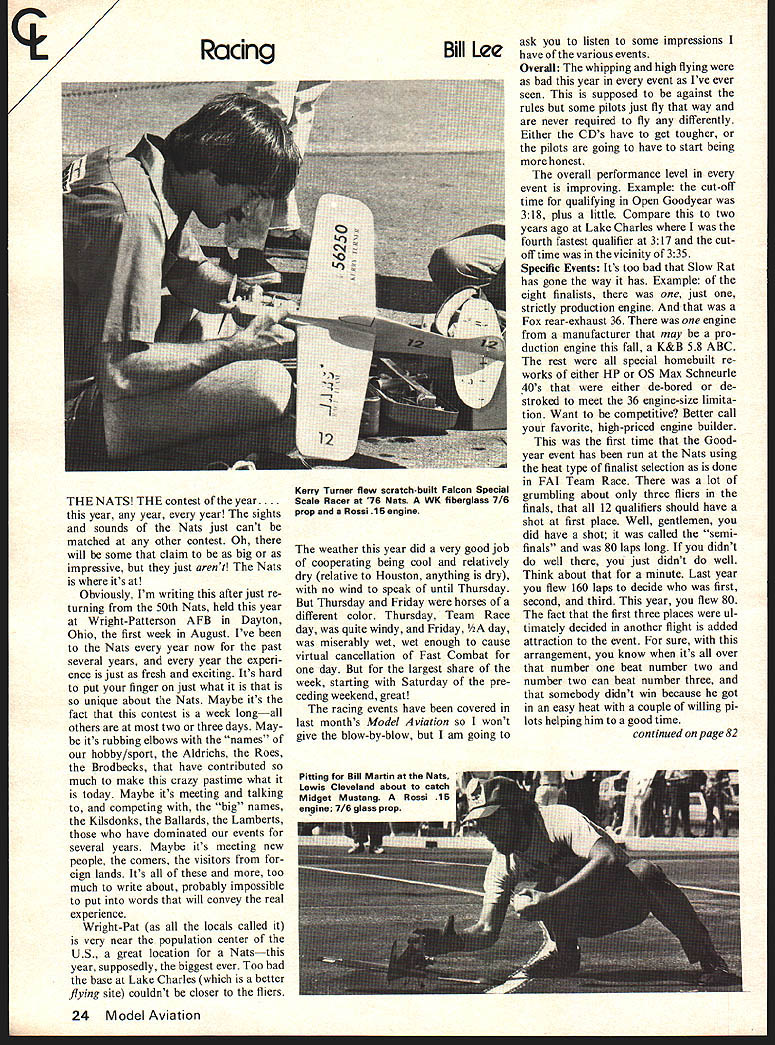
THE NATS! THE contest of the year... this year, and year, every year! The sights and sounds of the Nats just can't be matched at any other contest. Oh, there will be some that claim to be as big or as impressive, but they just aren't! The Nats is where it's at!
Obviously, I'm writing this after just returning from the 50th Nats, held this year at Wright-Patterson AFB in Dayton, Ohio, the first week in August. I've been to the Nats every year now for the past several years, and every year the experience is just as fresh and exciting. It's hard to put your finger on just what it is that is so unique about the Nats. Maybe it's the fact that this contest is a week long—all others are at most two or three days. Maybe it's rubbing elbows with the "names" of our hobby/sport, the Aldrichs, the Roes, the Brodbecks, that have contributed so much to make this crazy pastime what it is today. Maybe it's meeting and talking to, and competing with, the "big" names, the Kilsdonks, the Ballards, the Lamberts, those who have dominated our events for several years. Maybe it's meeting new people, the comers, the visitors from foreign lands. It's all of these and more, too much to write about, probably impossible to put into words that will convey the real experience.
Wright-Pat (as all the locals called it) is very near the population center of the U.S., a great location for a Nats—this year, supposedly, the biggest ever. Too bad the base at Lake Charles (which is a better flying site) couldn't be closer to the fliers.
The weather this year did a very good job of cooperating—being cool and relatively dry (relative to Houston, anything is dry), with no wind to speak of until Thursday. But Thursday and Friday were horses of a different color. Thursday, Team Race day, was quite windy, and Friday, 1/2 day, was miserably wet, wet enough to cause virtual cancellation of Fast Combat for one day. But for the largest share of the week, starting with Saturday of the preceding weekend, great!
Overall: The whipping and high flying were as bad this year in every event as I've ever seen. This is supposed to be against the rules but some pilots just fly that way and are never required to fly any differently. Either the CD's have to get tougher, or the pilots are going to have to start being more honest.
The overall performance level in every event is improving. Example: the cut-off time for qualifying in Open Goodyear was 3:18, plus a little. Compare this to two years ago at Lake Charles where I was the fourth fastest qualifier at 3:17 and the cut-off time was in the vicinity of 3:35.
Specific Events: It's too bad that Slow Rat has gone the way it has. Example: of the eight finalists, there was one, just one, strictly production engine. And that was a Fox rear-exhaust 36. There was one engine from a manufacturer that may be a production engine this fall, a K&B 5.8 ABC. The rest were all special homebuilt reworks of either HP or OS Max Schneurle 40's that were either de-bored or de-stroked to meet the 36 engine-size limitation. Want to be competitive? Better call your favorite, high-priced engine builder.
This was the first time that the Goodyear event has been run at the Nats using the heat type of finalist selection as is done in FAI Team Race. There was a lot of grumbling about only three fliers in the finals when all 12 qualifiers should have shot first place. Well, gentlemen, we did have a shot; it was called the "semi-finals" and was 80 laps long. If you didn't do well there, you just didn't do well. Think about that for a minute. Last year you flew 160 laps to decide who was first, second, and third. This year, you flew 80. The fact that the first three places were ultimately decided in another flight is added attraction to the event. For sure, with this arrangement, you know when it's all over that the number one beat number two and number two can beat number three, and that somebody didn't win because he got lucky with a couple of willing pilots helping him have a good time. O.K., occasionally an unfortunate accident happens—like this year, the collision that decided it all—but overall, this arrangement will make the winner truly the winner and not someone with a lucky heat! I do agree that a 160-lap semi-finals with two required qualifying heats, best time only, would be an improvement. Look at the way Team Race is run. It surely eliminates a lot of luck in selecting the three best teams; it replaces that luck with a lot of hard work and skill.
It's only fitting that Bud and Doug Harris should win Senior Goodyear with, what I believe, is an all-time record low time of 5:56.6. Here is a team made up of a couple of the nice guys in our hobby, their attempt in Open was a disaster, but Doug's Senior entry really made up for it. Nobody puts more hard work into an event than the Harris family.
I was timing various segments of Bud's winning flight in Senior Goodyear. Several times I clocked him at 15 to 16 flat. I timed eight laps with a pit stop included on each of his three pit stops. They timed out at 28, 28, and 27 seconds. (This is pretty good pitting, 11- and 12-sec. pit stops.) If you add it up: 17 eight-lap segments at 16.0 sec. each—272 sec.; pit stop, eight-lap segments total to—83 sec. Total: 355 sec.
This is 5:55 which is pretty close to his actual time of 5:56.6. Repeat: the only way to time pit stops is for one-half mile with a stop included, vs. one-half mile at speed. The difference is what your pit stop cost you.
I saw somewhere recently, maybe in one of the newsletters that come to me by way of AMA, that Bill Pardue's Southeastern Championships was the "Rat Nats." Well, I won't say that isn't close to the truth, particularly in light of the dominance of the event by the Southeast in recent years. But this year's "Rat Nats" was still in Dayton! Still dominated by the Southeastern fliers but won by Ronnie Esman of Houston, Tex., with basically stock equipment and superb pit stops. The rest of the Texas Rat fliers? Well, we looked as bad this year as we did last year!
FAI Team Race is getting better all the time. This year saw 25 teams entered with 20 teams actually processing to fly! This has to be the best turn out at the Nats in a long time! Times were not super great, at least by European standards, but there were several teams in the mid-four-minute range in the qualifying, and the event was won by a U.S. team of Larry Jolly and Jed Kusik in a good time at the 8:30 mark. I actually flew my first-ever competition in TR! Did get a qualifying time, not a great time for sure, but nevertheless, I did finish a race. I'll relate the story of my efforts during the Nats week in TR at a later time.
I found the guys in Team Race, as a whole, to be very open and friendly, always willing to help a beginner, make suggestions, come up with needed pieces to help out the newcomer. I want to thank a lot of people who helped me out but, if I started naming names, I'd forget someone. So, to all, thanks.
One final note on the Nats: If it is ever held at, or near, Wright-Patt, don't miss it at any cost. And if you get the chance, don't miss the Air Force Museum. Plan on the better part of one day to spend there, and even with that much time, plan on missing a lot. You have to see a B-36 up close to really understand how big that thing really is.
Racing Advisory Committee
By this time you probably have read a summary of the rules changes proposed by the Racing Advisory Committee. There were several other proposals presented to the RAC by RAC members and other interested people that did not get a majority backing in a ballot of RAC members. I've mentioned several here in my column in past months. If you're interested in what didn't pass the RAC, drop me a line. I'll send you a copy of the material the RAC had. In the meantime, the next step in the rules-making process is for the Control Line Contest Board to take a preliminary vote to solidify the basic rules change proposals. Then, we get another chance at them, starting at about the first of next year to make cross proposals to the basic proposals. Note that the RAC proposals automatically pass the first CLCB vote so you can be thinking of cross proposals to them now. I'll say again as I've said before, contribute or don't crab about what comes about.
Control Line Racing Special Interest Group
A group of interested Control Line Racing fliers have started the ball rolling toward forming an organization of racing fliers along the lines of PAMPA or MACA. During the Nats, the Racing Advisory Committee had a meeting on the field after Rat had been run and invited any interested racing fliers to attend. It was proposed at that time to form a group to allow the racing fliers to get more and better racing at all levels of competition. Two fellows from Maryland have volunteered to head up the thing and even to produce a newsletter. Let me quote from a letter from Russ Sandusky, one of the lucky (?) two who have volunteered.
"The organization's main purpose is to increase enjoyment and competition in all amateur racing events, to allow each member to voice his opinions to the Control Line Contest Board, to exchange ideas, to encourage support, and to increase racing competition.
"The newsletter format will be as follows: 1) Report contest results and pending events, 2) Exchange ideas, 3) Rules proposals, 4) Personal opinions of the membership.
"Each member will be mailed, and should return, a ballot regarding all rules. By either a simple majority or two-thirds, we will seek action by the CLCB."
I would like to suggest that all racing fliers become a member of this organization (name to be voted decided). Russ feels that $5 would be sufficient to cover the cost of the newsletter and mailing. Let's see if we can get interested racing fliers can get this thing going. Addresses are: Russ Sandusky, 1122 Playa Circle, Joppa, MD 21085; Dave Tisdale, 725 Baughschmidt Dr., Baltimore, MD 21221.
W. R. Lee, 3522 Tamarisk Lane, Missouri City, TX 77459.
Transcribed from original scans by AI. Minor OCR errors may remain.

