
Control Line: Racing
John Ballard
10102 Kimblewick Dr. Louisville, KY 40223
Halon fire extinguishers
I have received several letters requesting information on the Halon-filled fire extinguishers which are being used very successfully to put out alcohol fires in the pits—fires which plague almost all CL Racing events, but most notably in Slow Rat and Sport Race.
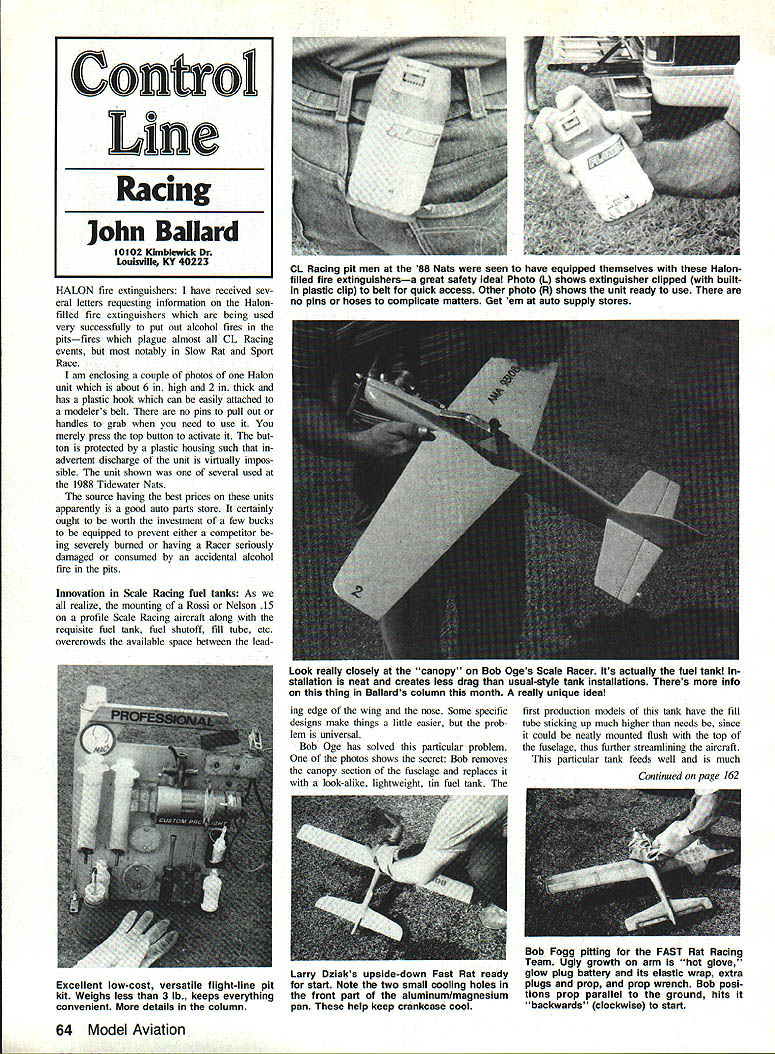
I am enclosing a couple of photos of one Halon unit which is about 6 in. high and 2 in. thick and has a plastic hook which can be easily attached to a modeler's belt. There are no pins to pull out or handles to grab when you need to use it. You merely press the top button to activate it. The button is protected by a plastic housing such that inadvertent discharge of the unit is virtually impossible. The unit shown was one of several used at the 1988 Tidewater Nats.
The source having the best prices on these units apparently is a good auto parts store. It certainly ought to be worth the investment of a few bucks to be equipped to prevent either a competitor being severely burned or having a Racer seriously damaged or consumed by an accidental alcohol fire in the pits.
Innovation in Scale Racing fuel tanks
As we all realize, the mounting of a Rossi or Nelson .15 on a profile Scale Racing aircraft along with the requisite fuel tank, fuel shutoff, fill tube, etc., overcrowds the available space between the leading edge of the wing and the nose. Some specific designs make things a little easier, but the problem is universal.
Bob Oge has solved this particular problem. One of the photos shows the secret: Bob removes the canopy section of the fuselage and replaces it with a look-alike, lightweight tin fuel tank. The first production models of this tank have the fill tube sticking up much higher than need be, since it could be neatly mounted flush with the top of the fuselage, thus further streamlining the aircraft. This particular tank feeds well and is much more streamlined than the standard cylindrical or rectangular tanks which are generally used on Scale Racers. Bob plans later modifications to further streamline the fill tube as well as the exit tubes on the canopy section.
Quickie Rat kit
I have had several requests as to whether such an item is available. This extremely popular Southwestern event has been growing in the last few years, and I am happy to report that a kit manufacturer has agreed to produce the Barracuda airframe designed by Bill Bischeff. The kit's wood and workmanship are excellent.
For more information on these kits contact Custom Models, Inc., 5515 Bridgelion Dr., Arlington, TX 76018. The phone number is (817) 467-9211. Anyone who is interested in flying this fun racing event can eliminate a large amount of labor by acquiring the Barracuda in kit form.
Rat engine overheating problems
Hot, humid Midwestern summer days certainly give rise to overheating problems with the cowl and 40-size Fast Rat engines. The most serious overheating problem seems to be in the crankcase area, which results in the softening of the fiberglass propellers and necessitates using either a dense-weave carbon-fiber prop or using a notched prop drive hub to hold the prop in place. Since the fiberglass softens and the prop slips on the shaft, the loss of grip of the prop is an imminent problem.
All present competitive Fast Rat models utilize either a full-length or half-length cast aluminum/magnesium metal pan. After many attempts to add extra cooling ducts to the upper cowling, we have found that two small, 1/8-in. holes in the front area of the pan allow enough air to circulate in the crankcase area to give adequate cooling and minimize the crankcase overheating problems. I have tried this on both of my pans, and have been able to eliminate the notched thrust hub, as the propellers no longer melt from an overheated crankshaft.
Functional pit kit
I have recently seen an excellent pit kit which is very light and not as bulky as most units. It consists of a rectangular piece of 1/4-in.-thick wood approximately 18 x 12 in. in size with the necessary starting-line items attached, such as:
- fuel strainer
- spring
- power wrench
- glow-plug battery (with an elastic wrap to secure it)
Using a thin piece of wood and arranging the items as compactly as possible, both sides of the unit can be used. The other side is suitable for storage of tools and incidental items. There is a small T-shaped bracket mounted on the bottom of the wood slab to keep the unit erect when set on the ground. Since it is not a flight box, it can be easily carried around a flight circle without items becoming misplaced in the bottom of the box. I have included a photo of this unit, and you can get the general gist and build one for yourself in about an hour.
That's all for this time. As always I solicit your comments, photos, and ideas.
Transcribed from original scans by AI. Minor OCR errors may remain.

