
Control Line: Racing
John Ballard 10102 Kimblewick Dr. Louisville, KY 40223
Alternative magnesium speed pan
For many years Formula "40" enthusiasts and the wider CL racing community have relied on Harter's magnesium/aluminum pan. Historically an excellent unit, the pan has become problematic as engine crankcases and front shaft housings have grown. Fitting newer engines often requires extensive grinding of the pan, which weakens the front structure. This is compounded when the landing gear is installed as a one-wheel unit, with two 1/8-in. holes drilled through one side of the pan just behind the engine mounting lugs, further weakening the area. It is virtually impossible to satisfactorily mount an OS .40 or a Picco .40 in an unmodified Harter's pan without seriously compromising the front portion of the unit.
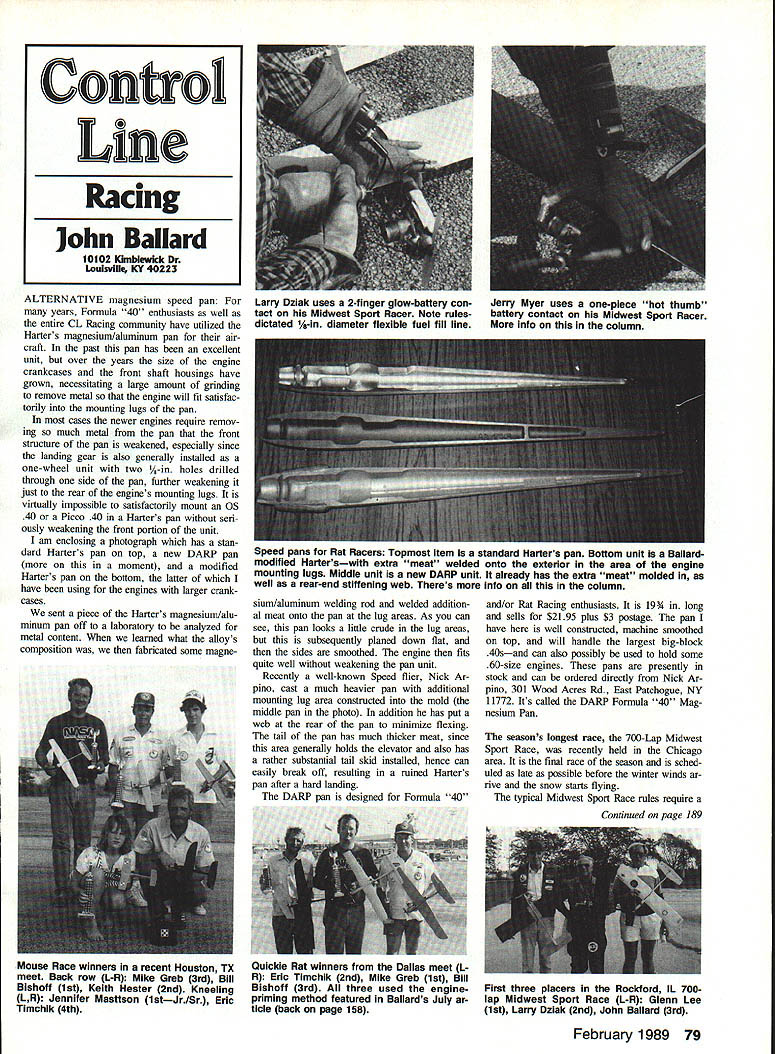
I am enclosing a photograph that shows:
- a standard Harter's pan (top),
- the new DARP pan (middle),
- a modified Harter's pan (bottom) that I have been using for larger-crankcase engines.
I sent a piece of the Harter's pan to a laboratory for alloy analysis. Using the resulting composition data, I fabricated magnesium/aluminum welding rod and welded additional material onto the pan at the lug areas. The welded sections look crude at first, but they are planed flat and the sides smoothed so the engine fits well without weakening the pan.
Recently, well-known speed flier Nick Arpino cast a much heavier pan with additional mounting-lug area incorporated into the mold (the middle pan in the photo). He also added a web at the rear of the pan to minimize flexing. The tail of the pan has much thicker material since this area typically supports the elevator and a substantial tail skid, both of which can break off in hard landings and ruin a Harter's pan.
DARP pan specifications and ordering
- Designed for Formula "40" and Rat Racing enthusiasts
- Length: 19-3/4 in.
- Price: $21.95 plus $3 postage
- Construction: well made, machined smooth on top; can handle the largest big-block .40s and possibly some .60-size engines
- Availability: in stock; order from Nick Arpino, 301 Wood Acres Rd., East Patchogue, NY 11772 (DARP Formula "40" Magnesium Pan)
Midwest Sport Race (700-Lap)
The season's longest race, the 700-Lap Midwest Sport Race, was recently held in the Chicago area. It is the final race of the season and is scheduled as late as possible before winter weather arrives.
Typical Midwest Sport Race rules include:
- suction-type fuel tank
- 1/2-in. fuel fill tube
- plain-bearing .35-size engine in a "stock configuration"
- profile-fuselage aircraft with at least 300 sq. in. of wing area
- one special restriction for the 700-lap event: 10 pit stops are required
This year there were 24 entries. Instead of two-up flying, all heats were run three-up, which made for very interesting racing and required pilots to work harder.
Glenn Lee won the event flying a K&B plain-bearing engine turning a Kelly 8 x 7 prop, with an airspeed around 14.5 seconds for seven laps. He was followed closely by Larry Dziak, also using a K&B .35. Glenn's aircraft was somewhat lighter than the older-wing sport racers flown by Dziak and Ballard; he uses a built-up wing with a 5-oz tank mounted beneath the wing.
Glow-plug starting methods
I have enclosed photos showing methods of applying a battery to the glow plug of Sport Racer aircraft.
- Thumb-contact method (designed by Jerry Myer): one battery lead is soldered to a washer at the front of the thrust line; the other lead is soldered to a metal plate at the rear of the unit. The glow-plug post engages the washer and the plate contacts the cylinder head, completing the starting circuit. This works well and requires no supplementary contact points on the model.
- Standard glow-plug connector: acceptable for lower-power Sport Race engines. The clip may not stay attached on higher-revving racing engines; Glenn Lee uses this type of connector.
- Larry "The Wizard" Dziak's method: a brass plate or strap is mounted around the front of the fuselage for the ground return contact (also attached to the engine's rear mounting lug). The pilot holds contacts on his thumb and index finger (attached to the battery leads) and connects to the glow plug by touching the metal strip. This method is shown in another photo.
Racing in Texas
Racing in Texas remains active, especially in the Quickie Rat and Mouse Racing classes. Bill Bishoff sent photographs of winners in these two classes. Jim Ong designed the Mouse-class model featured in those photos.
Transcribed from original scans by AI. Minor OCR errors may remain.

