
Control Line: Racing
Author
John Ballard 10102 Kimblewick Dr. Louisville, KY 40223
Mouse Racing
The attendees of the 1988 Tidewater Nationals will recall that Mouse Racing had one of the highest entry levels of the CL Racing events. I have had numerous requests for information on "good" Mouse Racers, and in some past columns I have shown some of the Texas contingent's planes. Readers have asked for a photograph of the "hot setup" which would assure them a durable but fast 1/2A Racer.
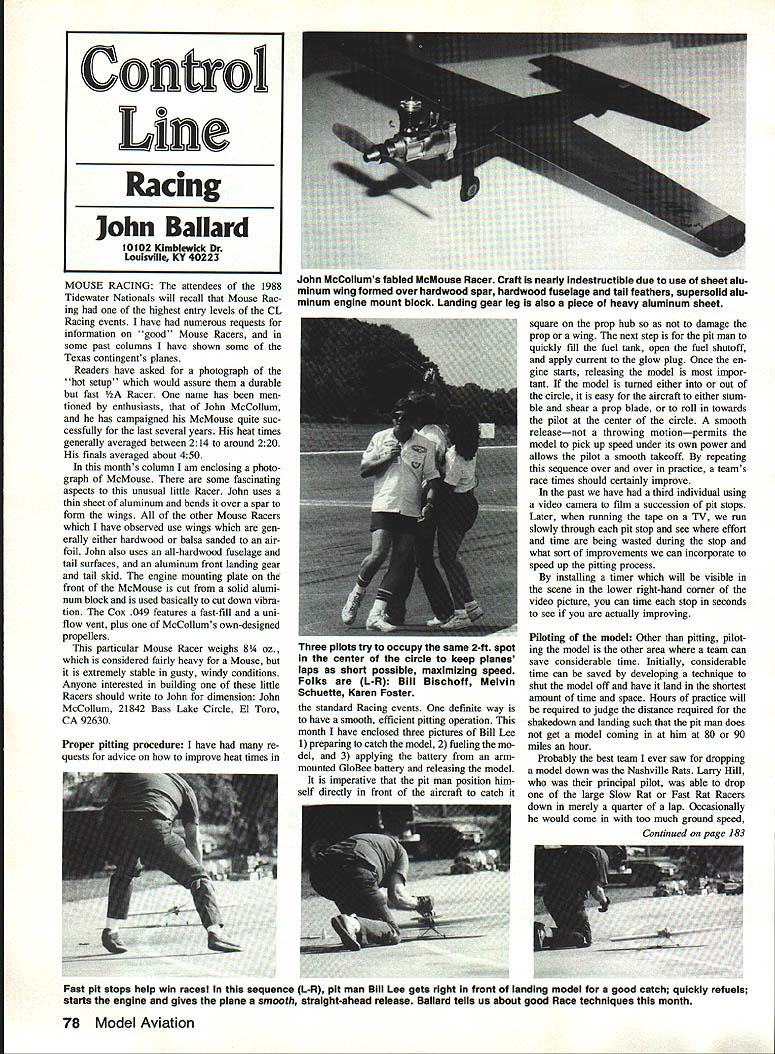
One name mentioned by enthusiasts is John McCollum, who has campaigned his McMouse quite successfully for the last several years. His heat times generally averaged between 2:14 and 2:20. His finals averaged about 4:50.
I am enclosing a photograph of McMouse. There are some fascinating aspects to this unusual little racer. John uses a thin sheet of aluminum bent over a spar to form the wings; most other Mouse Racers use wings of hardwood or balsa sanded to an airfoil. John also uses an all-hardwood fuselage and tail surfaces, and an aluminum front landing gear and tail skid. The engine mounting plate on the front of the McMouse is cut from a solid aluminum block and is used primarily to reduce vibration. The Cox .049 features a fast-fill and a uniflow vent, plus one of McCollum's own-designed propellers.
This particular Mouse Racer weighs 8 1/2 oz., which is considered fairly heavy for a Mouse, but it is extremely stable in gusty, windy conditions. Anyone interested in building one of these little racers should write to John for dimensions:
John McCollum 21842 Bass Lake Circle El Toro, CA 92630
Proper Pitting Procedure
I have had many requests for advice on how to improve heat times in standard Racing events. One definitive way is to have a smooth, efficient pitting operation. This month I have enclosed three pictures of Bill Lee showing the pit sequence:
- Preparing to catch the model.
- Fueling the model.
- Applying the battery from an arm-mounted GloBee battery and releasing the model.
Key points for a good pit man:
- Position directly in front of the aircraft to catch it square on the prop hub so as not to damage the prop or a wing.
- Quickly fill the fuel tank, open the fuel shutoff, and apply current to the glow plug.
- Once the engine starts, release the model smoothly — do not throw it. A smooth release allows the model to pick up speed under its own power and gives the pilot a smooth takeoff. If the model is turned either into or out of the circle during release, it may stumble, shear a prop blade, or roll toward the pilot at the center of the circle.
Practice this sequence repeatedly to improve a team's race times.
For analysis and improvement, have a third individual film a succession of pit stops. Later, run the tape slowly on a TV to see where effort and time are being wasted and what improvements can be made. By installing a timer visible in the scene (for example, in the lower right-hand corner of the picture), you can time each stop in seconds to determine if you are actually improving.
Piloting of the Model
Other than pitting, piloting the model is the area where a team can save considerable time. Initially, considerable time can be saved by developing a technique to shut the model off and have it land in the shortest amount of space possible. Hours of practice are required to judge the distance needed to make such a shakedown landing so that the pit man does not get the model coming in at 80 or 90 mph.
Probably the best team I ever saw for dropping a model down was the Nashville Rats. Larry Hill, their principal pilot, was able to drop one of the large Slow Rat or Fast Rat racers in merely a quarter of a lap; occasionally he would come in with too much ground speed. Of course, you've built a warp into the wing itself — but that's a story for another time. Did I say this stuff was simple? Naw, it's an art form.
Another useful technique: Paul Tuma would back up 1/8 or 1/4 of a circle to allow the model to slow down before he grabbed it. The use of a well-padded glove also helps reduce the impact as the model is caught during a routine stop.
I have enclosed a photograph showing three race pilots, all attempting to share the same 2-1/2-ft.-radius center circle: Karen Foster, Bill Bischoff (with his shirt out), and Melvin Schuette. They have pressed extremely close together to have the shortest possible distance from the center of the circle to the model.
If a pilot walks a very wide circle, the aircraft must fly much farther each lap and is slowed by perhaps 5–10 mph. The tighter the circle the pilot walks and the closer he holds the hand to his chest, the shorter the effective radius of the control lines. Shortening the effective line length has a definitive positive influence on the speed of the model.
Fancher-style Bellcranks
A limited number of Fancher-style 3-1/2-in.-dia. circular bellcranks are once again available. They are now being produced by master machinist John Schwickrath:
John Schwickrath 1660 Laurel St. San Carlos, CA 94070
The price for this beautifully machined aluminum, brass, and steel unit is $15 plus $1.50 shipping and handling. I am a big fan of the circular format, and most fliers who have tried one are convinced as well. Try it — I think you'll like it.
New Nelson .15 Engine
I understand there is a new Nelson .15 in the works. It is purported to have a 15 mm shaft and to be aimed at Scale Racing. Henry Nelson is importing some very expensive ball bearings from Switzerland and is busy producing cranks and cases for it; it is hoped that this will improve performance in Racing. Nelson competition engines will be testing with the new modification in late February 1989. I hope to be able to report the results in my next column.
Closing
As always, I solicit your comments, ideas, and photographs.
Transcribed from original scans by AI. Minor OCR errors may remain.

