

Control Line: Racing
John Ballard 10102 Kimbewick Dr. Louisville, KY 40223
New Model for Scale Racing
In the past few years, increased growth in racing events has, for the most part, been in Mouse and Scale Racing. In general, there is a very limited number of full-scale racers which can be accurately scaled down for use in our event. Usually the fuselage and/or wing location makes unsatisfactory mounting of the .15 engine, fuel shutoff, and fuel tank. Finding a full-scale aircraft with good flying characteristics that also satisfies the required caveats for control line use is difficult.
In the early history of scale racing, one of the first subjects which produced a model with excellent flying characteristics was the Falcon Special. We then found that the Midget Mustang lent itself nicely to the exhaust megaphone pipe. The mid-Seventies brought the Little Quickie, which could also be used with a megaphone or pipe. Occasionally a few different aircraft were seen, but their numbers were still overshadowed by the accepted winners.
Leo Wittenberg has scaled the Ohm Special .15, which meets all the prerequisites for control line scale racing. This particular aircraft has a wing with the highest aspect ratio (wingspan-to-chord ratio—Ed.) of any full-scale racer seen to date. The wing is long and slender, which makes for good stability during windy flying conditions. The fuselage is large enough to accommodate the engine, tank, and fuel shutoff, and the rear of the fuselage is stout enough to withstand hard landings. The scaled-up elevator is satisfactory, and with the allowable 15% increase in area is more than adequate for good control.
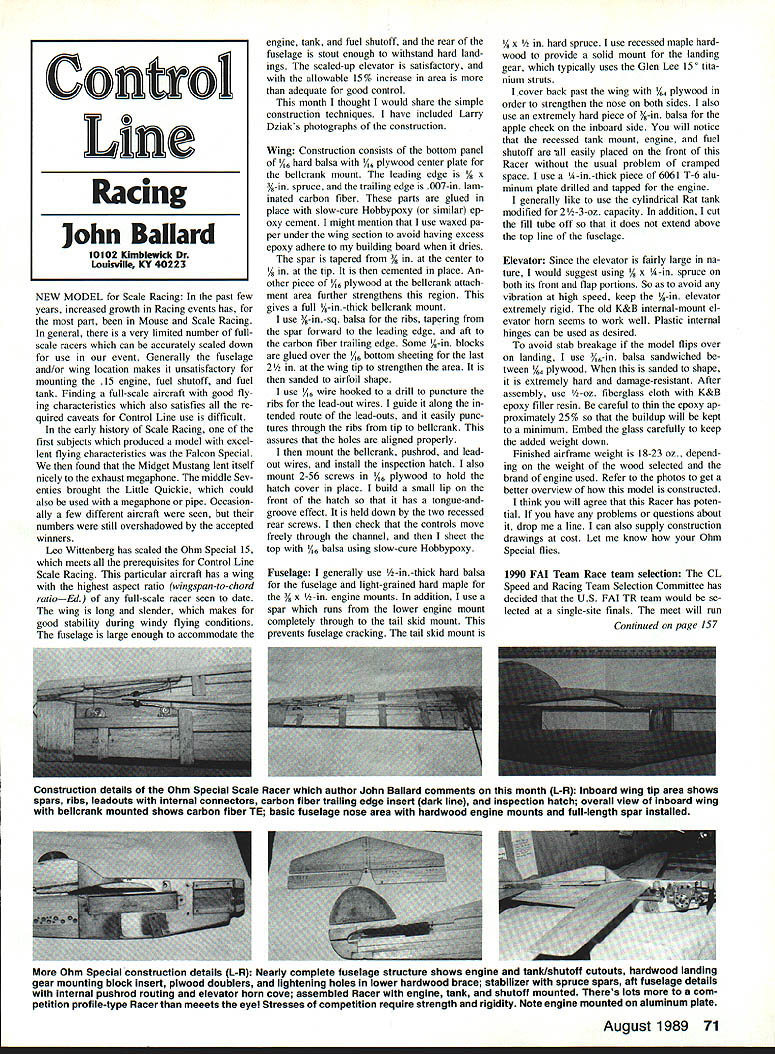
This month I thought I would share the simple construction techniques. I have included Larry Dziak's photographs of the construction.
Wing
Construction consists of a bottom panel of 1/16-in. hard balsa with a 1/16-in. plywood center plate for the bellcrank mount. The leading edge is 3/16 x 3/16-in. spruce, and the trailing edge is .007-in. laminated carbon fiber. These parts are glued in place with slow-cure Hobbypoxy (or similar) epoxy cement. I use waxed paper under the wing section to avoid having excess epoxy adhere to my building board when it dries.
The spar is tapered from 3/16 in. at the center to 1/8 in. at the tip and is then cemented in place. Another piece of 1/16-in. plywood at the bellcrank attachment area further strengthens this region. This gives a full 1/8-in.-thick bellcrank mount.
I use 1/8-in. square balsa for the ribs, tapering from the spar forward to the leading edge and aft to the carbon fiber trailing edge. Some 1/8-in. blocks are glued over the 1/16-in. bottom sheeting for the last 2 in. at the wing tip to strengthen the area. The tip area is then sanded to airfoil shape.
For the lead-outs I use 1/8-in. wire hooked to a drill to puncture the ribs. I guide it along the intended route and the lead-outs easily puncture through the ribs. A tip bellcrank assures the holes are aligned properly. I then mount the bellcrank, pushrod, and lead-out wires, and install the inspection hatch. I also mount two 2-56 screws in 1/16-in. plywood to hold the hatch cover in place. I build a small lip on the front of the hatch so that it has a tongue-and-groove effect; it is held down by the two recessed rear screws. I then check that the controls move freely through the channel, and then sheet the top with 1/16-in. balsa using slow-cure Hobbypoxy.
Fuselage
I generally use 1/2-in.-thick hard balsa for the fuselage and light-grained hard maple for the 3/16 x 3/16-in. engine mounts. In addition, I use a spar which runs from the lower engine mount completely through to the tail skid mount. This prevents fuselage cracking. The tail skid mount is 1/8 x 1/8-in. spruce. I use recessed maple hardwood to provide a solid mount for the landing gear, which typically uses Glen-Lee .015 titanium struts.
I cover back past the wing with 1/16-in. plywood in order to strengthen the nose on both sides. I also use an extremely hard piece of 3/16-in. balsa for the apple cheek on the inboard side. You will notice that the recessed tank mount, engine, and fuel shutoff are all easily placed on the front of this racer without the usual problem of cramped space. I use a 1/4-in.-thick piece of 6061-T6 aluminum plate drilled and tapped for the engine.
I generally like to use the cylindrical Rat tank modified for a 2–3-oz. capacity. In addition, I cut the fill tube off so that it does not extend above the top line of the fuselage.
Elevator
Since the elevator is fairly large, I suggest using 1/8 x 3/8-in. spruce for both its front and flap portions. To avoid vibration at high speed, keep the elevator extremely rigid. An old K&B internal-mount elevator horn seems to work well. Plastic internal hinges can be used if desired to avoid stab breakage.
For protection if the model flips over on landing, use 3/16-in. balsa sandwiched between 1/64-in. plywood and sanded to shape; it is extremely hard and damage-resistant. After assembly, use 3/4-oz. fiberglass cloth with K&B epoxy filler resin. Careful, thin epoxy — approximately 25% buildup — will keep added weight to a minimum. Embed glass carefully and keep added weight down.
Finished airframe weight is 18–23 oz., depending on the wood selected and the brand of engine used. Refer to the photos to get a better overview of how this model is constructed. I think you will agree that this racer has potential. If you have any problems or questions about it, drop me a line. I can also supply construction drawings at cost. Let me know how your Ohm Special flies.
CL Racing / Ballard
Over a two-day period, a total of six rounds will be flown, three per day.
- Participants' final scores will be the average of their three fastest heats.
- The U.S. team will be composed of the three teams with the best scores.
The event will be held at Dick Scobee Memorial Field, Houston, TX on October 7–8, 1989. Host club will be the Clear Lake Line Winders. Contest director will be Frank Williams. Discussion of the contest procedures and processing of models will occur on Friday evening, October 6.
You can contact Frank Williams at 1-713-488-1371 for motel or site directions.
As always, I solicit and welcome your comments and photos.
Transcribed from original scans by AI. Minor OCR errors may remain.

