
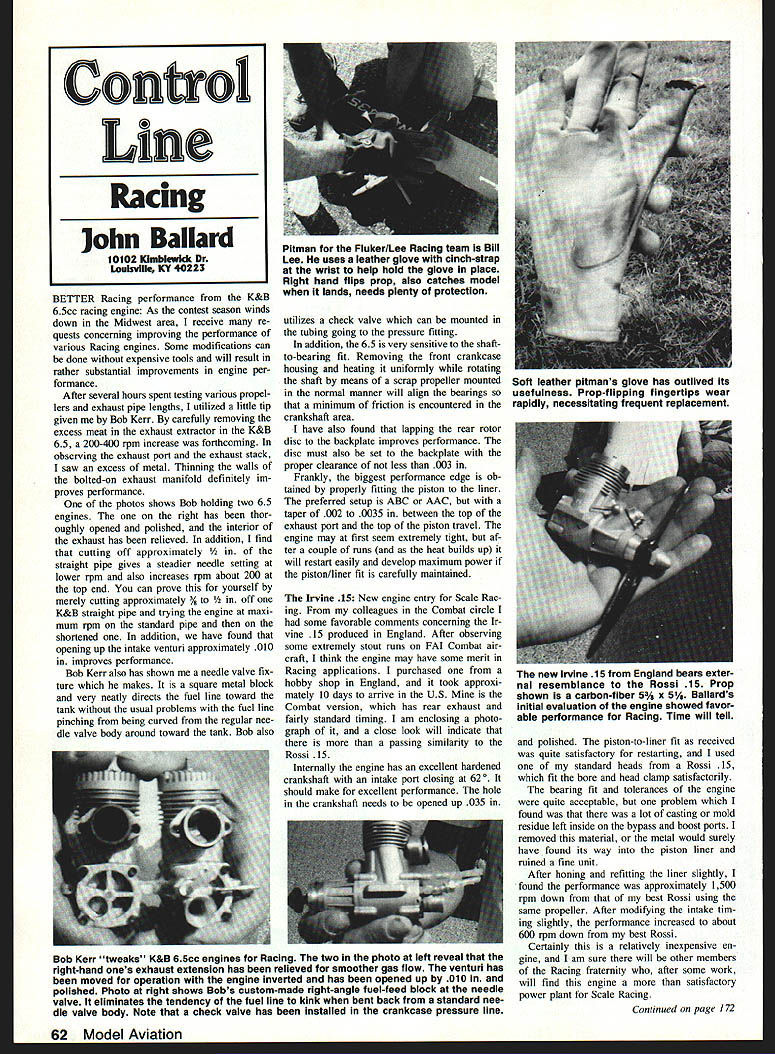
Control Line: Racing
John Ballard 10102 Kimblewick Dr. Louisville, KY 40223
Better racing performance from the K&B 6.5cc racing engine
As the contest season winds down in the Midwest area, I receive many requests concerning improving the performance of various racing engines. Some modifications can be done without expensive tools and will result in substantial improvements in engine performance.
After several hours spent testing various propellers and exhaust pipe lengths, I used a little tip given me by Bob Kerr. By carefully removing the excess metal in the exhaust extractor of the K&B 6.5, a 200–400 rpm increase was forthcoming. In observing the exhaust port and the exhaust stack, I saw an excess of metal. Thinning the walls of the bolted-on exhaust manifold definitely improves performance.
One photo shows Bob holding two 6.5 engines. The one on the right has been thoroughly opened and polished, and the interior of the exhaust has been relieved. In addition, cutting off approximately 1/8 in. of the straight pipe gives a steadier needle setting at lower rpm and also increases rpm about 200 at the top end. You can prove this for yourself by cutting approximately 1/2 in. off one K&B straight pipe and trying the engine at maximum rpm on the standard pipe and then on the shortened one. In addition, we have found that opening up the intake venturi approximately .010 in. improves performance.
Bob Kerr also showed me a needle-valve fixture that he makes. It is a square metal block and neatly directs the fuel line toward the tank without the usual problems of the fuel line pinching from being curved around the regular needle valve body. Bob also uses a check valve which can be mounted in the tubing going to the pressure fitting.
The 6.5 is very sensitive to the shaft-to-bearing fit. Removing the front crankcase housing and heating it uniformly while rotating the shaft by means of a scrap propeller mounted in the normal manner will align the bearings so that a minimum of friction is encountered in the crankshaft area.
I have also found that lapping the rear rotor disc to the backplate improves performance. The disc must be set to the backplate with the proper clearance of not less than .003 in.
Frankly, the biggest performance edge is obtained by properly fitting the piston to the liner. The preferred setup is ABC or AAC, with a taper of .002 to .0035 in. between the top of the exhaust port and the top of the piston travel. The engine may at first seem extremely tight, but after a couple of runs (and as the heat builds up) it will restart easily and develop maximum power if the piston/liner fit is carefully maintained.
Recommended K&B 6.5 modifications (summary)
- Remove excess metal in the exhaust extractor and relieve the interior of the exhaust stack.
- Thin walls of the bolted-on exhaust manifold.
- Cut about 1/8 in. off the straight pipe for steadier needle settings; experiment by cutting up to 1/2 in. to compare.
- Open the intake venturi by approximately .010 in.
- Use a needle-valve fixture to prevent fuel-line pinching; consider adding an inline check valve to the pressure line.
- Ensure proper shaft-to-bearing fit: heat the front crankcase housing and rotate the shaft to align bearings.
- Lap the rear rotor disc to the backplate; maintain at least .003 in. clearance.
- Fit piston to liner carefully (ABC or AAC) with a taper of .002–.0035 in.
The Irvine .15
The Irvine .15 is a new engine entry for scale racing. From my colleagues in the combat circle I received favorable comments concerning the Irvine .15 produced in England. After observing some stout runs on FAI Combat aircraft, I think the engine may have merit in racing applications. I purchased one from a hobby shop in England; it took approximately 10 days to arrive in the U.S. Mine is the combat version, which has rear exhaust and fairly standard timing. I enclose a photograph; a close look shows more than a passing similarity to the Rossi .15.
Internally the engine has an excellent hardened crankshaft with an intake-port closing at 62°. It should make for good performance. The hole in the crankshaft needs to be opened up .035 in.
After honing and refitting the liner slightly, I found the performance was approximately 1,500 rpm down from that of my best Rossi using the same propeller. After modifying the intake timing slightly, the deficit was reduced to about 600 rpm down from my best Rossi.
Certainly this is a relatively inexpensive engine and I am sure other members of the racing fraternity, after some work, will find the engine more than satisfactory as a power plant for scale racing.
Pitman's finger protection
I have been asked on several occasions to recommend the best type of glove for a pitman to use. Over the years I have found that the all-leather glove is absolutely the best. Gloves that use a fabric body with leather trim are too stiff for good, flexible finger movement.
Remember, the pitman's right hand is generally used to adjust the needle valve, open fuel shutoffs (which require smooth finger movement), and flip the prop—which mandates protection from kickback of the racing engine. Most people prefer a glove that can be cinched at the wrist.
One photo shows a well-used leather glove discarded after many racing campaigns. The flip-finger has finally become cut and mangled and no longer offers protection to the pitman's digit. By cinching the glove near the wrist, the glove is held stationary on the hand and reduces slippage when grabbing an aircraft on landing. The glove also acts as a damping unit when the pitman catches the airplane on either the prop nut or the wing. Leather gloves are much more slip-resistant when grabbing a racer covered with oil during a fast pit stop.
Pitmen prefer gloves that have no lining, are flexible, and have dense leather throughout the fingers and palm.
Half-A Mouse Racing
I spent part of my spring and summer working on my Cox .049 engines. After receiving several tips from fellow Mouse Racing enthusiasts, I found a great deal of my problem involved varnish buildup on the piston and in the bore of the liner.
In 1988 I was 50 seconds shy of qualifying for the final race, whereas in 1989 I finished the finals in Open Mouse only four seconds off the winner's time. I used exactly the same airplanes and engines, except that this year I started using a wooden dowel to remove varnish from the cylinder every 25–30 runs.
In the past I would experience acceptable performance for several minutes, only to find the engine performance deteriorate—running more slowly and with poor starting characteristics. It became almost impossible to find a proper needle-valve setting. I found that cleaning the varnish from the cylinder restored the original performance, and movement of the needle valve was not nearly as critical. I was then able to work on propeller combinations to improve airspeed.
I cannot emphasize enough that the varnish-beveled cylinder must be cleaned regularly if consistent performance is to be obtained from one of these little engines.
As always, I solicit your photos and comments.
Transcribed from original scans by AI. Minor OCR errors may remain.

