
Control Line: Racing
John Ballard 10102 Kimblewick Dr. Louisville, KY 40223
Foxberg Racing in southern California will soon be off to a big start. Contest organizers Kenn Smith (CD) and Bill Noyes (Assistant CD) are promulgating the 1990 Southern California Foxberg Championship Series, an annual series of six contests spaced approximately two months apart.
Kenn sent me the rules and regulations booklet (12 pages long), and I am reprinting the General Rules section (2 pages) which concern the concept for the event and the specifications for the airplane, and specific rules for the Racing portion of the event (about one page).
The contests are unique in that there are three tasks flown at each contest—Racing, Stunt, and Balloon Bust—and the same plane must be used for all three.
Certainly the concept could be utilized in any area of the country, and a big plus of using such a thing would be to improve participation by local modelers. Mandating a specific type of airplane (in this case a totally unmodified Fox .35 Stunt) makes for some very, very exciting, and slow Racing. Any other club which may be interested in using these very complete rules (which include scoresheets) can ask for a booklet from Kenn Smith, 521 Jansen Ave., San Dimas, CA 91773; tel. 1-714/592-2100.
Now here are the promised sections of the rule book:
General
- All current AMA regulations apply to this contest series except as amended below.
- The purpose of this contest series is to promote fun, simple and friendly competition using established rules for each event and basic aircraft and equipment. It is the intent of this contest series to promote family participation through special activities on contest days such as picnics, novelty contests, potlucks, and other events.
Note: It is not the intent of this contest series to become a complaining corner, a ventilation for your outside frustrations, or a sounding board for anyone inclined to complain about every little rules infraction, whether it affects the outcome of the event or not.
Unless it is obvious that a particular competitor has a decided advantage over other competitors, no infractions of the rules will be initiated by contest officials.
Rules infractions are to be brought to the attention of the contest officials by the contest participants. After discussion of the infraction with the accused competitor, the Contest Director will make a determination which will stand with no additional discussion.
Concept
- The Southern California Foxberg Championship Series is an annual series of six contests spaced approximately two months apart. At each contest three events will be available for competition: Racing, Stunt, and Dive Bombing. The Racing rules are derived from the Dallas Model Aircraft Association Goldberg Racing rules. The Stunt rules are derived from the Old-Time Stunt event rules generally in use across the United States. The Dive Bombing rules are taken directly from the current AMA Competition Regulations book.
- At completion of each contest awards will be given to the first-place Junior of each event and to the first, second, and third-place Senior/Open (combined) winners in each event. Additional awards will be presented to specialty, novelty, and theme event winners when held.
- At the end of the series, a banquet will be held where the series Grand Champion Junior and Senior/Open (combined) trophies will be awarded. In addition, several other specialty awards will be presented at the banquet.
The airplane
- The same airplane must be used in each of the three events at a particular contest. A substitution will be allowed only in the event that the original airplane is wrecked.
- The airplane must be a Carl Goldberg Shoestring, Cosmic Wind, or Buster profile Stunter or a direct copy. Substitution of kit wood is permitted, but the part must be a duplicate of the original.
- Engine mounts and plywood doublers may be lengthened for strength but may not be increased or decreased in thickness.
- Elevator horn doubler may be enlarged and/or placed on both sides for strength.
- All remaining items must be per the kit, including rudder offset (1/2 in.) and line sweep. Engine offset is optional.
- No additional wing sheeting will be allowed. Wing airfoil and fuselage thickness must remain unchanged.
- Landing gear must be of the two-wheel, side-by-side type with a minimum of five inches between wheels. Wheels must be at least two inches in diameter. Tail wheels are allowed.
- The fin must be colorful and representative of a real scale airplane, with the canopy either a contrasting color or outlined in a contrasting color. Racing numbers shall be placed on each side of the fuselage and on the upper side of the left wing. Decals furnished with the kit are recommended.
- The engine must be a stock Fox .35 Stunt engine, #13500, with absolutely no modification. The piston and cylinder may be deburred to prevent excessive wear. The needle valve assembly shall be stock Fox .35 Stunt with no modifications. Skids to protect the needle valve are permitted. Needle valve stems may be shortened to prevent damage. All engines are subject to disassembly to verify legality.
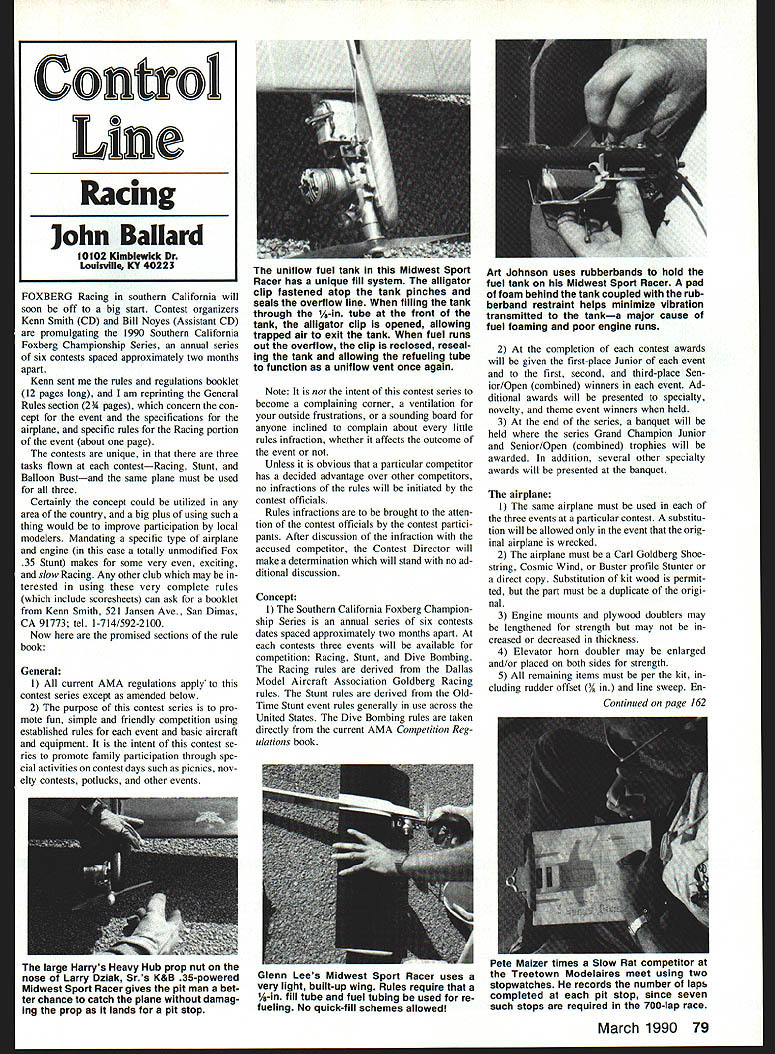
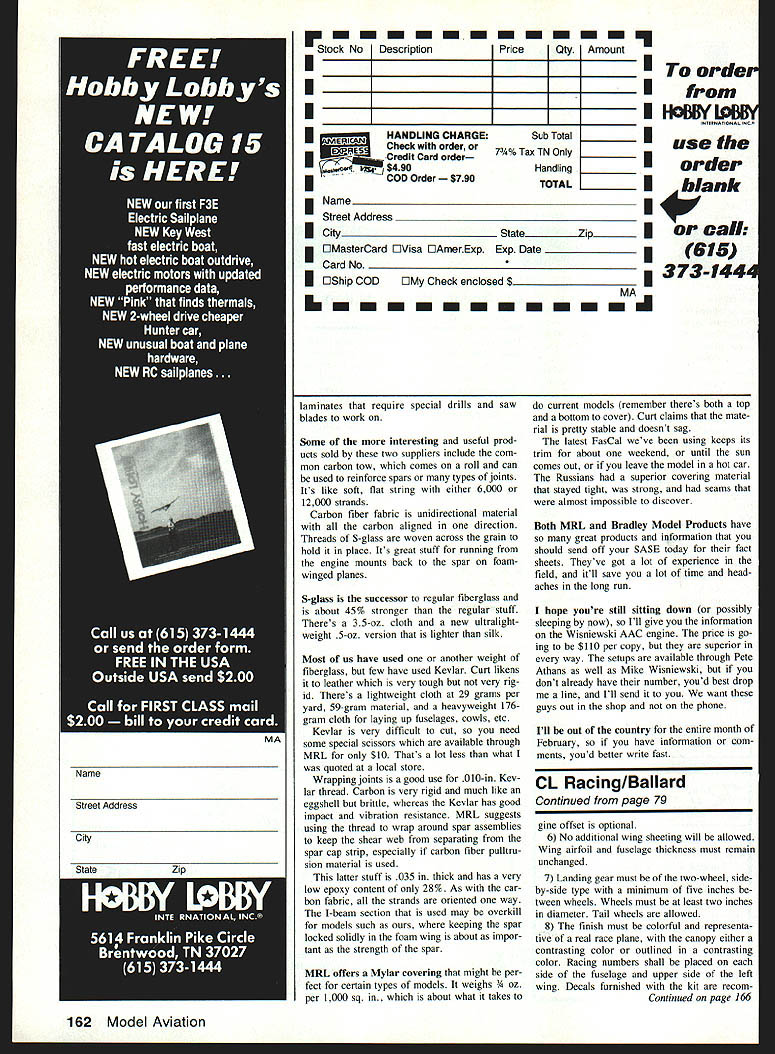
- The fuel tank shall be a stock manufactured 1-1/2-oz. stunt tank with a single fuel feed tube and a top and bottom vent tube. No uniflow, no pressure systems, no quick-fill systems, no fuel shutoffs or other special fuel supply systems are allowed.
- Fuel: 10% nitromethane and 25% castor or oil will be provided for the Racing event only. The contestant will provide fuel of his or her choice for other events.
- No commercial glow plug is permitted. No hot gloves, electric, or mechanical starting devices are allowed. Just clip it on and flip it.
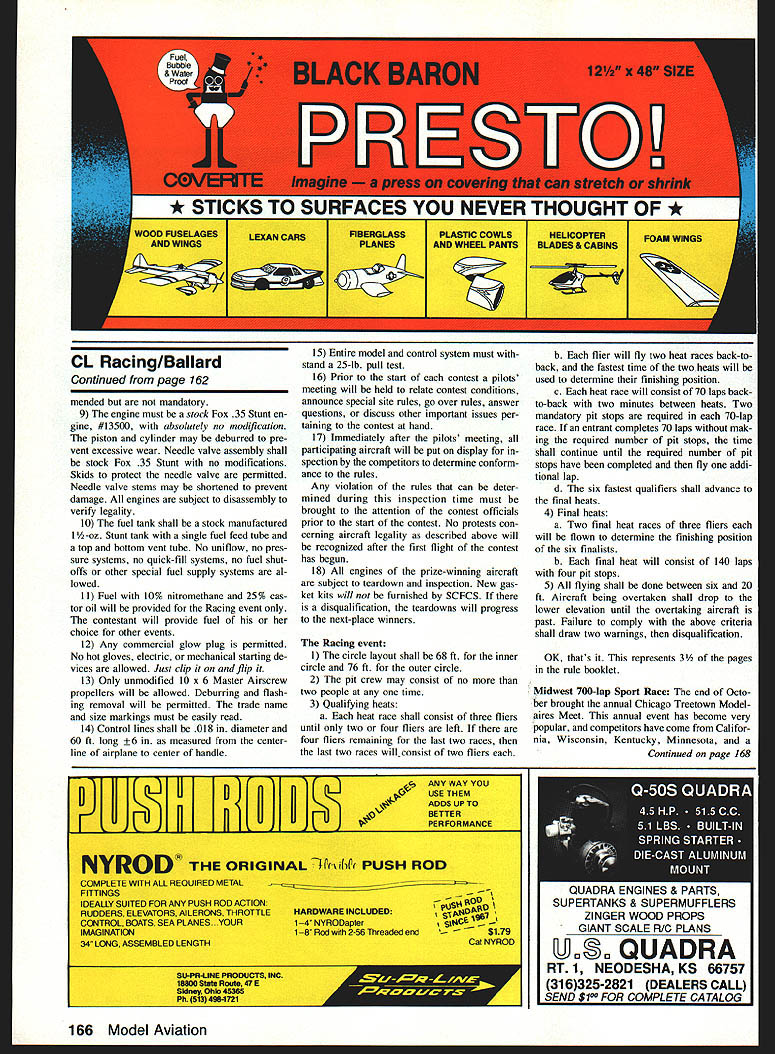
- Only unmodified 10 x 6 Master Airscrew propellers will be allowed. Deburring and flashing removal will be permitted. The trade name and size markings must be easily read.
- Control lines shall be .018 in. diameter and 60 ft. long ± 6 in. as measured from the centerline of airplane to center of handle.
- Entire model and control system must withstand a 25-lb. pull test.
- Prior to the start of each contest a pilots' meeting will be held to relate contest conditions, announce special rules, go over rules, answer questions, or discuss other important issues pertaining to the contest at hand.
- Immediately after the pilots' meeting, all participating aircraft will be put on display for inspection by the competitors to determine conformance to the rules.
Any violation of the rules that can be determined during the inspection time must be brought to the attention of the contest officials prior to the start of the contest. No protests concerning aircraft legality as described above will be recognized after the first flight of the contest has begun.
- All engines of the prize-winning aircraft are subject to teardown and inspection. New gasket kits will not be furnished by SCFCS. If there is a disqualification, the teardowns will progress to the next-place winners.
The Racing event
- The circle layout shall be 68 ft. for the inner circle and 76 ft. for the outer circle.
- The pit crew may consist of no more than two people at any one time.
- Qualifying heats:
- a) Each heat race shall consist of three fliers until only two or four fliers are left. If there are four fliers remaining for the last two races, the last two races will consist of two fliers each.
- b) Each flier will fly two heat races back-to-back, and the fastest time of the two heats will be used to determine their finishing position.
- c) Each heat race will consist of 70 laps back-to-back with two minutes between heats. Two mandatory pit stops are required in each 70-lap race. If an entrant completes 70 laps without making the required number of pit stops, the time sheet continues until the required number of pits have been completed and then one additional lap is flown.
- d) The six fastest qualifiers shall advance to the final heats.
- Final heats:
- a) Two final heat races of three fliers each will be flown to determine the finishing position of the six finalists.
- b) Each final heat will consist of 140 laps with four pit stops.
- c) All flying shall be done between six and twelve o'clock. Aircraft being overtaken shall drop to the lower elevation until the overtaking aircraft is past. Failure to comply with the above criteria shall draw two warnings, then disqualification.
OK, that's it. This represents three-quarters of the pages in the rule booklet.
Midwest 700-lap Sport Race
The end of October brought the annual Chicago Treetop Modelers Meet. This annual event has become very popular, and competitors have come from California, Wisconsin, Kentucky, Minnesota, and a very large contingent of local Chicago Racing enthusiasts. This year the event was held at the Rivahall School parking lot on the outskirts of Rockford, IL. The contest is traditionally held at the end of October, as most of the Midwest contests have long since become history.
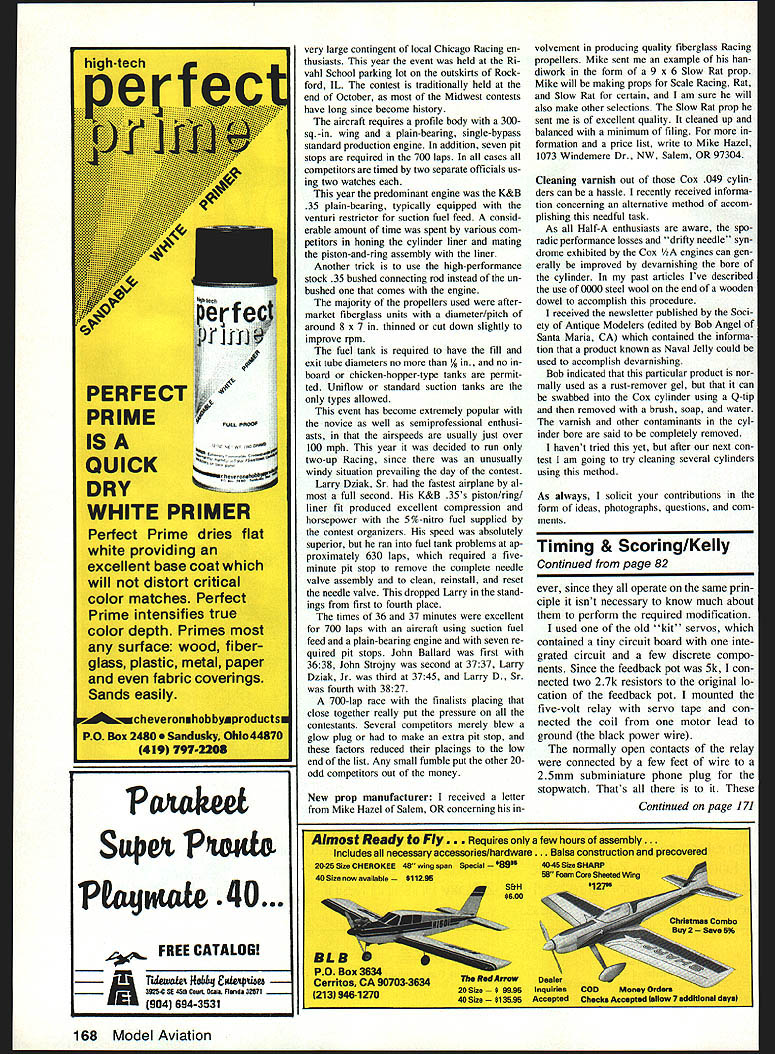
The aircraft requires a profile body with a 300-sq.-in. wing and a plain-bearing, single-bypass standard production engine. In addition, seven pit stops are required in the 700 laps. In all cases all competitors are timed by two separate officials using two watches each.
This year the predominant engine was the K&B .35 plain-bearing, typically equipped with the venturi restrictor for suction fuel feed. A considerable amount of time was spent by various competitors in honing the cylinder liner and mating the piston-and-ring assembly with the liner.
Another trick is to use the high-performance stock .35 bushed connecting rod instead of the unbushed one that comes with the engine.
The majority of the propellers used were aftermarket fiberglass units with a diameter/pitch of around 8 x 7 in., thinned or cut down slightly to improve rpm.
The fuel tank is required to have the fill and exit tube diameters no more than 1/4 in., and no in-board or chicken-hopper-type tanks are permitted. Uniflow or standard suction tanks are the only types allowed.
This event has become extremely popular with novices as well as semi-professional enthusiasts, in that the airspeeds are usually just over 100 mph. This year it was decided to run only two-up Racing, since there was an unusually windy situation prevailing the day of the contest.
Larry Dziak, Sr. had the fastest airplane by almost a full second. His K&B .35's piston/ring/liner fit produced excellent compression and horsepower with the 5%-nitro fuel supplied by the contest organizers. His speed was absolutely superior, but he ran into fuel tank problems at approximately 630 laps, which required a five-minute pit stop to remove the complete needle-valve assembly and to clean, reinstall, and reset the needle valve. This dropped Larry in the standings from first to fourth place.
The times of 36 and 37 minutes were excellent for 700 laps with an aircraft using suction fuel feed and a plain-bearing engine and with seven required pit stops. John Ballard was first with 36:38, John Strojny was second at 37:37, Larry Dziak, Jr. was third at 37:45, and Larry D., Sr. was fourth with 38:27.
A 700-lap race with the finalists placing that close together really put the pressure on all the contestants. Several competitors nearly blew a glow plug or had to make an extra pit stop, and these factors reduced their placings to the lower end of the list. Any small fumble put the other 20-odd competitors out of the money.
New prop manufacturer
I received a letter from Mike Hazel of Salem, OR concerning his involvement in producing quality fiberglass Racing propellers. Mike sent me an example of his handiwork in the form of a 9 x 6 Slow Rat prop. Mike will be making props for Scale Racing, Rat, and Slow Rat for certain, and I am sure he will also make other selections. The Slow Rat prop he sent me is of excellent quality. It cleaned up and balanced with a minimum of filling. For more information and a price list, write to Mike Hazel, 1073 Windemere Dr., N.W., Salem, OR 97304.
Cleaning varnish from Cox .049 cylinders
Cleaning varnish out of those Cox .049 cylinders can be a hassle. I recently received information concerning an alternative method of accomplishing this needful task.
As all Half-A enthusiasts are aware, the sporadic performance losses and "drifty needle" syndrome exhibited by the Cox .049 engines can generally be improved by devarnishing the bore of the cylinder. In my past articles I've described the use of 0000 steel wool on the end of a wooden dowel to accomplish this procedure.
I received the newsletter published by the Society of Antique Modelers (edited by Bob Angel of Santa Maria, CA) which contained the information that a product known as Naval Jelly could be used to accomplish devarnishing.
Bob indicated that this particular product is normally used as a rust remover gel, but that it can be swabbed into the Cox cylinder using a Q-tip and then removed with a brush, soap, and water. The varnish and other contaminants in the cylinder bore are said to be completely removed, but I haven't tried this yet; after our next contest I am going to try cleaning several cylinders using this method.
As always, I solicit your contributions in the form of ideas, photographs, questions, and comments.
Transcribed from original scans by AI. Minor OCR errors may remain.

