
Control Line: Racing
John Ballard 10102 Kimblewick Dr. Louisville, KY 40223
Good news on glow plugs
I just received samples of new products offered by Twinn-K, Inc. (Glo Bee). One is a reintroduction, while the other is a totally new product for racing and speed enthusiasts.
Mr. Jim J. Massa sent some of the reintroduced GB-5R glow plugs, which are specifically designed for high-nitro fuels in 1/2A racing engines. A few years back these plugs were discontinued, and both speed and racing enthusiasts scrambled to corner remaining stocks.
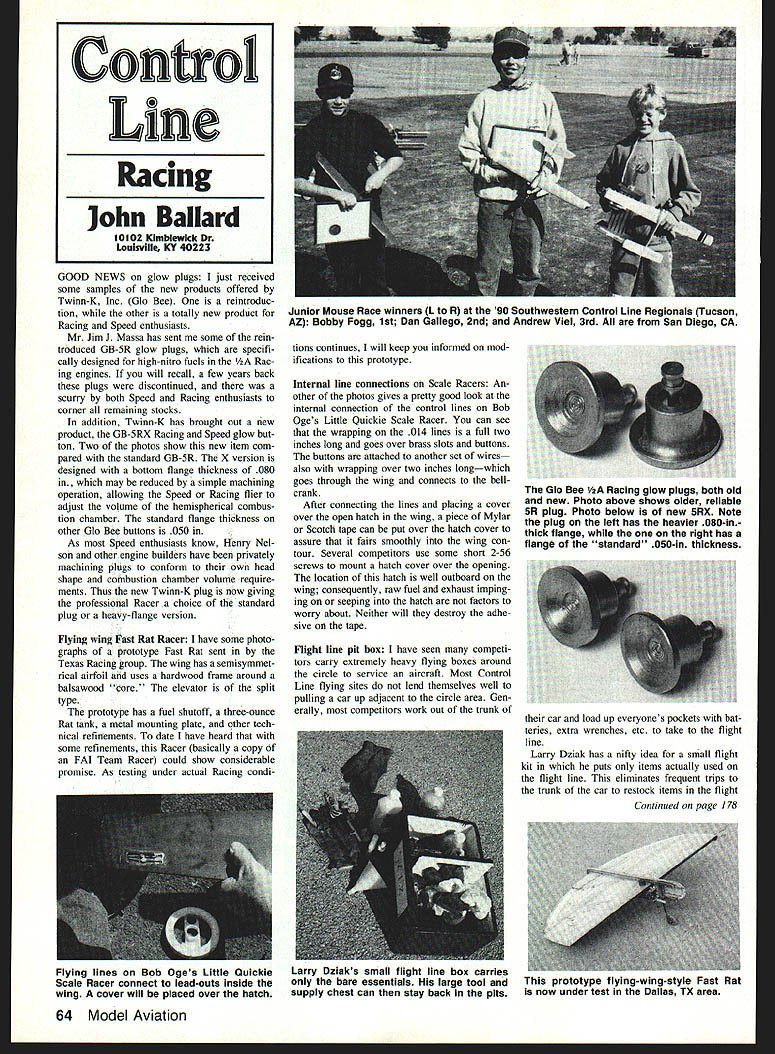
Twinn-K has also introduced a new product, the GB-5RX racing and speed glow button. Two photos compare the new item with the standard GB-5R. The X version is designed with a bottom flange thickness of .080 in., which may be reduced by simple machining, allowing the speed or racing flier to adjust the volume of the hemispherical combustion chamber. The standard flange thickness on other Glo Bee buttons is .050 in.
As many speed enthusiasts know, Henry Nelson and other engine builders have been privately machining plugs to conform to their own head shapes and combustion chamber volume requirements. The new Twinn-K plug now gives the professional racer a choice of the standard plug or a heavy-flange version.
Flying-wing Fast Rat Racer
I have photographs of a prototype Fast Rat sent in by the Texas racing group. The wing has a semisymmetrical airfoil and uses a hardwood frame around a balsa core. The elevator is of the split type.
The prototype has a fuel shutoff, a three-ounce Rat tank, a metal mounting plate, and other technical refinements. With some further refinements, this racer (basically a copy of an FAI Team Racer) could show considerable promise. As testing under actual racing conditions continues, I will report on modifications to this prototype.
Internal line connections on scale racers
One photo gives a good look at the internal connection of the control lines on Bob Oge's Little Quickie scale racer. The wrapping on the .014 lines is a full two inches long and goes over brass slots and buttons. The buttons are attached to another set of wires—also with wrapping over two inches long—which pass through the wing and connect to the bellcrank.
After connecting the lines and placing a cover over the open hatch in the wing, a piece of Mylar or Scotch tape over the hatch cover will help it fair smoothly into the wing contour. Several competitors use short 2-56 screws to mount a hatch cover over the opening. The hatch location is well outboard on the wing; consequently, raw fuel and exhaust impinging or seeping into the hatch are not significant concerns and will not usually destroy the adhesive on the tape.
Flight line pit box
Many competitors carry extremely heavy flying boxes around the circle to service aircraft. Most control line flying sites do not lend themselves well to pulling a car up adjacent to the circle area. Generally, competitors work out of the trunk of the car and load up everyone's pockets with batteries, extra wrenches, etc., to take to the flight line.
Larry Dziak has a nifty idea for a small flight kit that contains only items actually used at the flight line. This eliminates frequent trips to the trunk or to get a wrench or screwdriver which may be needed for a minor adjustment. Larry's large tool and supply chest can then stay back in the pits.
Larry's flight box generally contains:
- Two extra batteries
- An extra set of flying wires
- Alcohol to clean the lines
- A filter-equipped funnel for refilling the flight fuel bottle
- Hot Stuff and activator
- A prop wrench
- At least two starting gloves
- Assorted wrenches
- Battery connecting leads
- His flying handle, various props, and spare glow plugs
This very small, lightweight box can be carried easily to the outer perimeter of the circle. It contains enough items to allow either test flying or full-bore competition. I have seen large tackle boxes actually struck by aircraft, or kicked by pitmen dashing around the circle to service a downed aircraft.
Contest activity
Chris Peter sent photos from the Southwestern Control Line Regionals (SWCLR) at Tucson, AZ on January 20–21, 1990. The Junior Mouse Racers will, of course, be the pilots of the future. Results:
- Bobby Fogg (San Diego, CA) — 1st, 5:29
- Dan Gallego (San Diego, CA) — 2nd, 5:46
- Andrew Viel (San Diego, CA) — 3rd, 5:53
We will see these juniors at the 1990 Nats.
As always, I solicit your comments, ideas, and photos. I want to pass them on to the many other racing enthusiasts who read this column.
Transcribed from original scans by AI. Minor OCR errors may remain.

