
Control Line: Racing
John Ballard 10102 Kimblewick Dr. Louisville, KY 40223
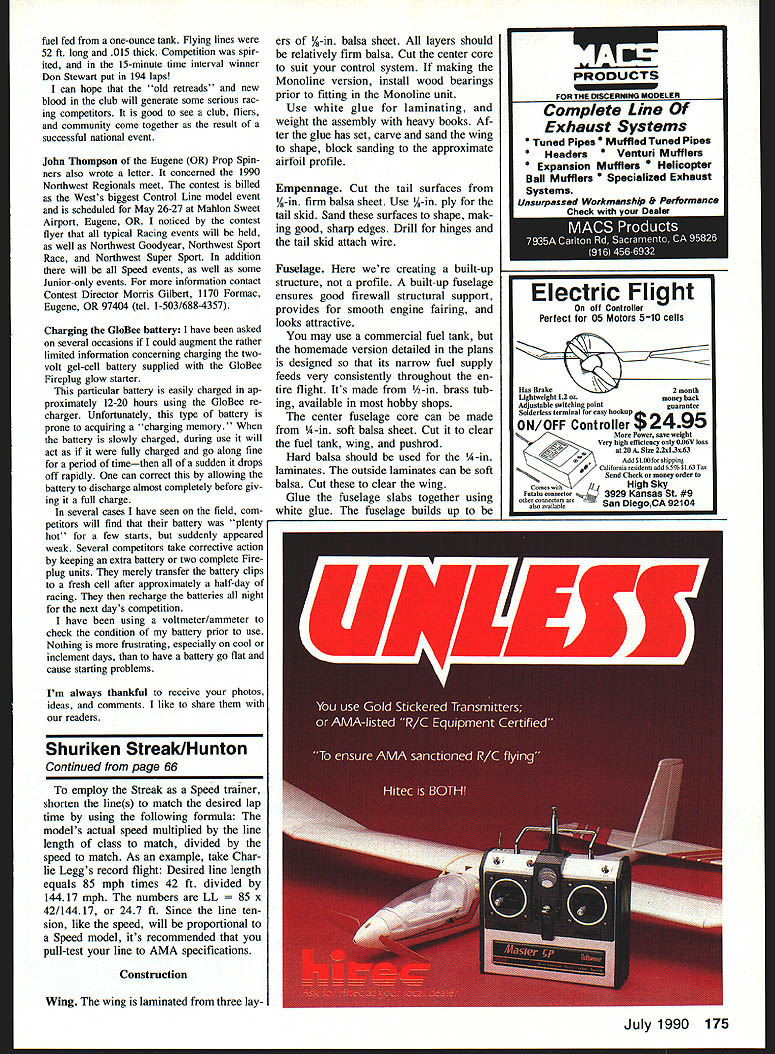
FAI Team Racer plan (Van Uden brothers)
Here is the plan for the FAI Team Racer used by the Van Uden brothers from the Netherlands. I printed it once before in my March 1988 column. If you can still read the print on the drawing (it had to be reduced in size a bunch to fit in the magazine), you will have to translate the written information for yourself. I'm reprinting it because I've received several letters from our overseas competitors requesting the copies I promised back in '88. In the full-size version, you can easily see a wealth of detail.
DB diesel Team Race engine (Delrue-Benoit)
I received a letter from Oliver Benoit of Belgium concerning his production of the DB diesel Team Race engine. The DB stands for Delrue-Benoit; the two team members decided to produce their own engines after competing in the CL World Championships in Kiev. I've included a photo of a finished unit as well as pictures of their crankcase casting procedure. The pictures show a handmade master, a wax pattern, and a rough casting. Another photo shows the wax pattern in the mold. At the present time the engine uses Cipolla internal parts. We'll all be watching its performance at the next CL World Championships.
Balsa Bashers meet
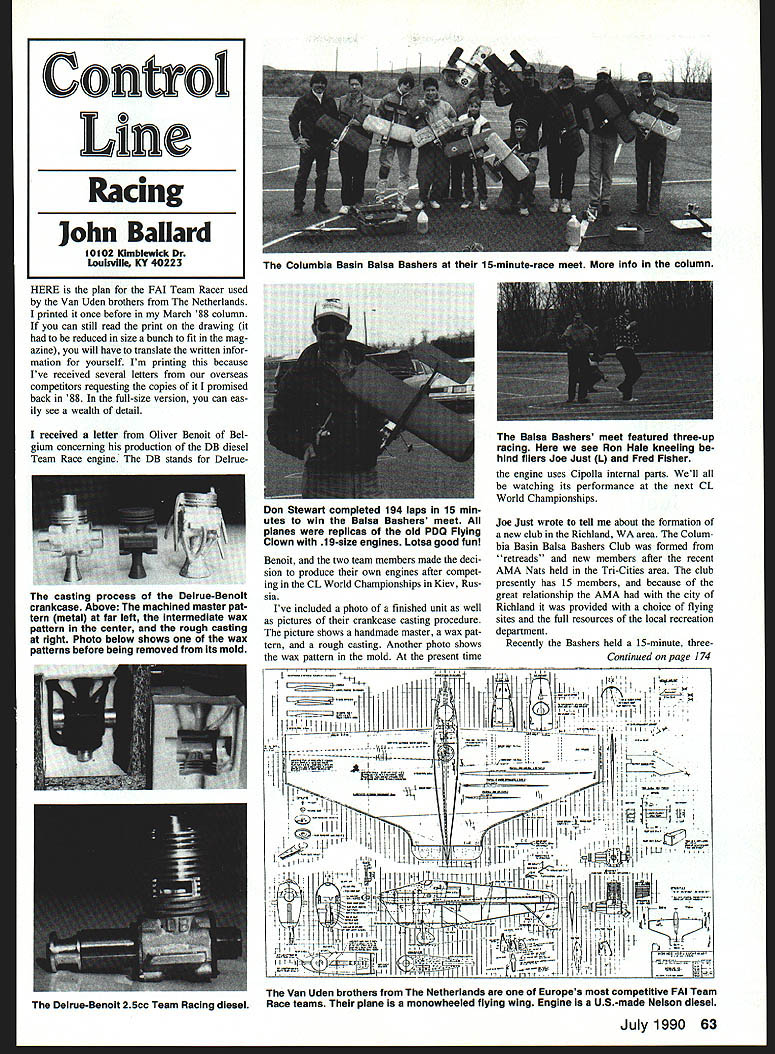
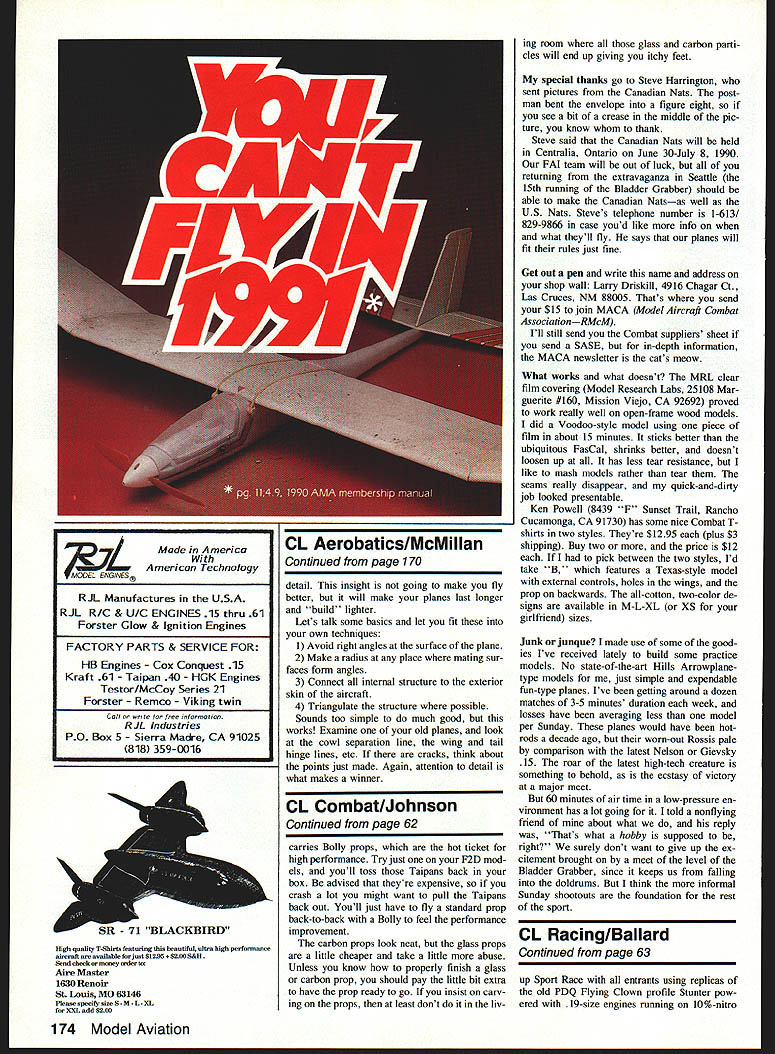
Don Stewart completed 194 laps in 15 minutes to win the Balsa Bashers' meet. All planes were replicas of the old PDQ Flying Clown, with .19-size engines. Lotsa good fun!
Columbia Basin Balsa Bashers Club
Joe Just wrote to tell me about the formation of a new club in the Richland, WA area. The Columbia Basin Balsa Bashers Club was formed from "retreads" and new members after the recent AMA Nats held in the Tri-Cities area. The club presently has 15 members, and because of the great relationship the AMA had with the city of Richland it was provided with a choice of flying sites and the full resources of the local recreation department.
Recently the Bashers held a 15-minute, three-up Sport Race with all entrants using replicas of the old PDQ Flying Clown profile Stunter, powered with .19-size engines running on 10% nitro. I can hope that the "old retreads" and new blood in the club will generate some serious racing competitors. It is good to see a club, fliers, and community come together as the result of a successful national event.
Northwest Regionals (1990)
John Thompson of the Eugene (OR) Prop Spinners wrote about the 1990 Northwest Regionals meet. The contest is billed as the West's biggest Control Line model event and is scheduled for May 26–27 at Mahlon Sweet Airport, Eugene, OR. All typical Racing events will be held, as well as Northwest Goodyear, Northwest Sport Race, and Northwest Super Sport. In addition there will be all Speed events, as well as some Junior-only events.
For more information contact:
- Morris Gilbert, Contest Director
- 1170 Formac, Eugene, OR 97404
- Tel: 1-503-688-4357
Charging the Globe battery
I have been asked several times to augment the limited information concerning charging the two-volt gel-cell battery supplied with the Globe Fireplug glow starter.
This particular battery is easily charged in approximately 12–20 hours using the Globe recharger. Unfortunately, this type of battery is prone to acquiring a "charging memory." When the battery is slowly charged, during use it will act as if it were fully charged and go along fine for a period of time — then suddenly it drops off rapidly. One can correct this problem by discharging the battery almost completely before giving it a full charge.
On the field, competitors will sometimes find that their battery was "plenty hot" for a few starts, but suddenly appears weak. Several competitors take corrective action by keeping an extra battery or two as complete Fireplug units. They merely transfer the battery clips to a fresh cell after approximately a half-day of racing, then recharge the batteries all night for the next day's competition.
I have been using a voltmeter/ammeter to check the condition of my battery prior to use. Nothing is more frustrating, especially on cool or inclement days, than to have a battery go flat and cause starting problems.
Closing
I'm always thankful to receive your photos, ideas, and comments. I like to share them with our readers.
Transcribed from original scans by AI. Minor OCR errors may remain.

