
Control Line: Racing
Bill Lee
A FEW MONTHS BACK, I told you of the availability of 3-views for a large number of Formula 1 aircraft from R. S. Hirsch, 8439 Dale St., Buena Park, CA 90620. A recent count reveals 88 different sets of 3-view drawings are available from Hirsch. Another source of 3-views recently came my way. I received a mailer from Pylon Publications, P. O. Box 2726, Rochester, NY 14626 which outlined a new publication, "The Modern Air Racers in Three-Views 1949-1975." This 8-1/2" by 11" soft-back book contains 3-views and brief histories of 25 different Formula 1 racing aircraft of the 49-75 period. This is in addition to 3-views and histories of many of the unlimited and biplane racing aircraft of the period. For the price, $4.95, this is one of the best sources of information on racing planes in general and Formula 1's in particular that I've seen in a long time. Many of the planes included are the long time favorites of scale racing fans such as the Shoestring or the many variations of the Cassutt. But there are also several not too commonly seen planes that would be quite good for Goodyears, such as the Owl OR-65-2 Pogo or the Foss Jinny, later modified and re-named Little Mike by Keith Sorenson. If you're interested in any of the many forms of modern air racing, I recommend you get this book.
Notes on Various Goodyears: I purchased the entire set of Hirsch 3-views of the Formula 1 class some time back. Recently, I've been scanning these plans in order to decide a new model to build to replace the Buster which I lost in the finals at the Nats. And when you start looking at all the various planes that have flown in Formula 1, you suddenly realize you have to define what is a "good" plane to model.
Many considerations go into this definition, and each person will have a different set of criteria which will define his "good" plane. But several factors will have to be considered by all. First, do you intend to run a pipe? Obviously, if you do, then you have to be looking at planes that are low- or high-wing designs to allow room behind the engine for the pipe without interfering with the wing. I do not run a pipe on my Goodyears, in spite of what Phill Bussell said in his Nats write up (Phill took a lot of good-natured ribbing about that oversight). And because I don't run a pipe, I prefer a mid-wing design, such as the Buster which I flew at the Nats, or the old stand-by, the Falcon Special.
Second, what is your preference for wing span? Do you want a long, skinny wing or a short, fat one? There is such a range available that you really have a choice to make. My preference is for a wing that is intermediate in span. For years, I have flown the Buster which is a 16.0" wing span on the full-size aircraft. This scales out to 24" at 1 1/2" to the foot, and the 5% scale factor allows you to build the model at 22.8" if you want to go that small. I feel, for my own application, that this is about the right size.
Third, where do you want the landing gear placed? Remember that the rules state that the gear must emerge from the model at the scale location but may be swept forward or backward if desired. But the gear must exit from the scale location! My own preference is for the gear to be towards the leading edge of the wing, near the CG of the model after it's ready to go. This is one area where I have not been happy with the Buster since its gear is quite far forward, well in front of the leading edge. I know that a lot of fliers say that the wheels should be far forward for ground handling. I don't agree with that and ask you how many FAI team racers you have seen with the gear more than an inch or inch-and-a-half ahead of the CG? And they have far and away better ground handling characteristics than most Goodyears you see.
Fourth, what kind of moments do you want? Remember that a short nose/long tail set up will be virtually impossible to build balanced. Again, this has been a problem I've had with the Buster every time I've built one; always very close to being tail heavy. Also, a short nose complicates getting a fuel tank of sufficient size along with a fuel shutoff in behind the engine if you choose a mid-wing model. One reason I've built the Buster is that it does have a reasonably long nose which eases the fuel tank/shutoff problem. Of course, with a low-wing model, tank problems are eased.
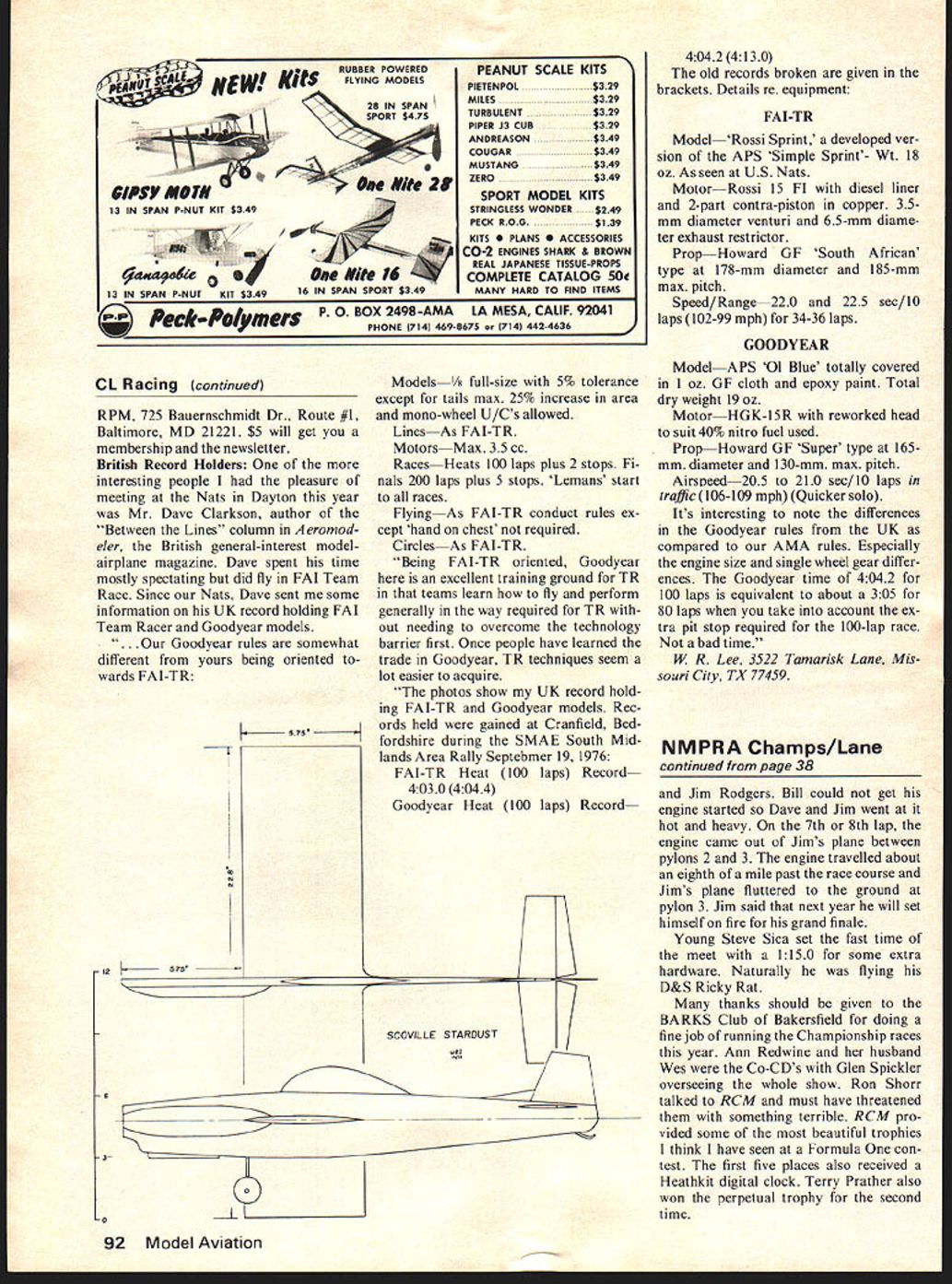
Well, with all this rambling on, what did I finally choose to replace the Buster? Included with this article is a drawing of a Formula 1 by John R. Scoville called the Stardust. This looks like a good design for my definition of a "good" scale racer in that it closely matches the Buster that I've used for years with two changes that should more closely follow my criteria: an inch-and-a-half shorter tail and gear which is at the leading edge of the wing. The drawing I've supplied is scaled to 1 1/2" to the foot with the 5% tolerance applied to the wing span and chord. (Full-size aircraft is 16' by 4'.) The tail surfaces are also at 5% scale and may be a little too small, but the rules of scale racing allow the elevator-stabilizer to be enlarged up to 25% of the wing area so long as the scale shape is retained. This drawing was made from a set of 3-views from Hirsch.
A chart also accompanies this column where I've tried to summarize a few of the important characteristics of many Formula I aircraft that might be suitable for our purposes.
New CL Racing Assoc.: A new organization is currently in the process of forming to be called the Control Line Racing Pilots and Mechanics, CL-RPM. The organization effort grew out of some discussions held at the Nats in Dayton and is being headed by two Maryland fliers, Russ Sandusky and Dave Tisdale.
Let me quote from a letter Russ sent to me on the subject: "The organization would bring together and represent the modelers who compete in the AMA events of Rat, Slow Rat, Scale Race and 1/2A Scale/Mouse Race. It was suggested that a newsletter be issued by this organization to further stimulate the interests of the racing competitors.
"The organization will be known as the CL-RPM, Control Line Racing Pilots and Mechanics. The newsletter will be titled RPM and should be ready for mailing by February of 1977. The CL-RPM's intended purposes are as follows:
- Be a forum for its members to voice their ideas and opinions.
- Members will have the opportunity to vote on rules, proposals and cross proposals. The results will be published and forwarded to the chairman of the CLCB and other interested AMA policy making bodies.
- Establish a national ranking system for each racing event. It is hoped to have an award for each event as an annual competition.
- Publish contest events and report results.
- Establish a consistent guide for contest direction of the racing events. Also, to provide selection of officials for future National Championship contests.
- The exchange of competitive and informative ideas.
"We realize these goals are ambitious, but they are possible with the help of a responsible membership."
If you have an interest in Control Line racing events and want to be involved, then join the CL-RPM. Address is: CL- RPM, 725 Bauernschmidt Dr., Route #1, Baltimore, MD 21221. $5 will get you a membership and the newsletter.
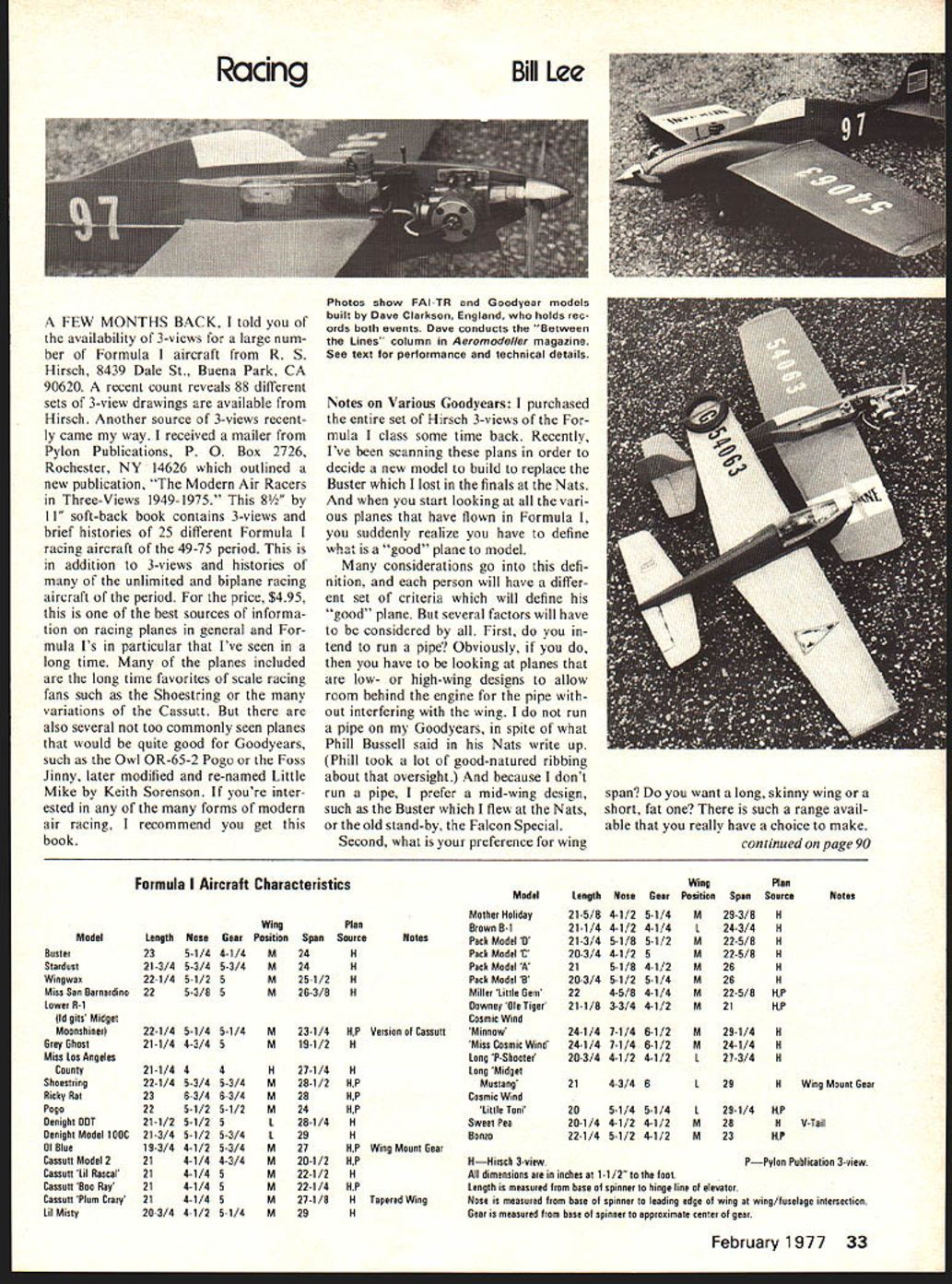
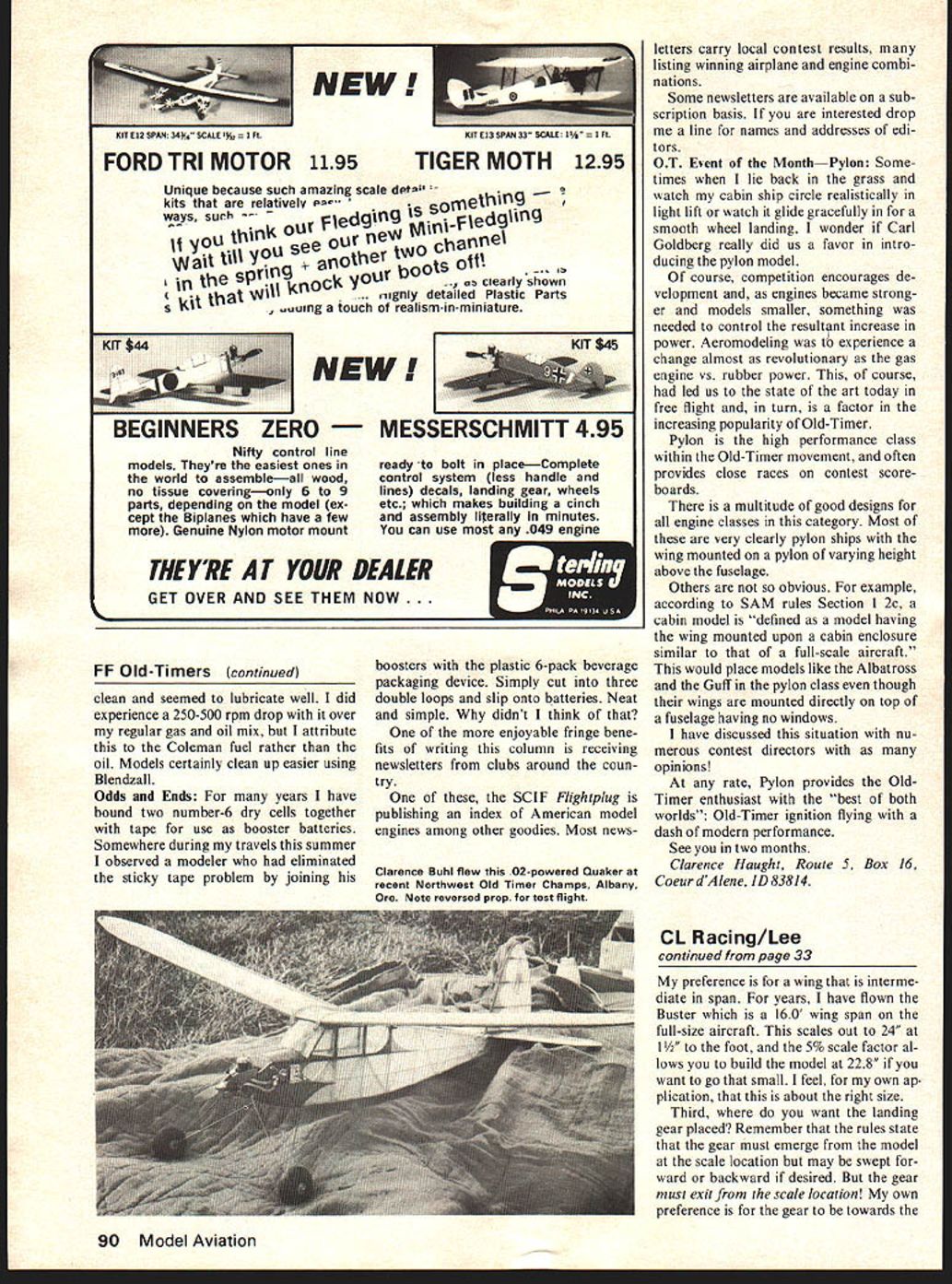
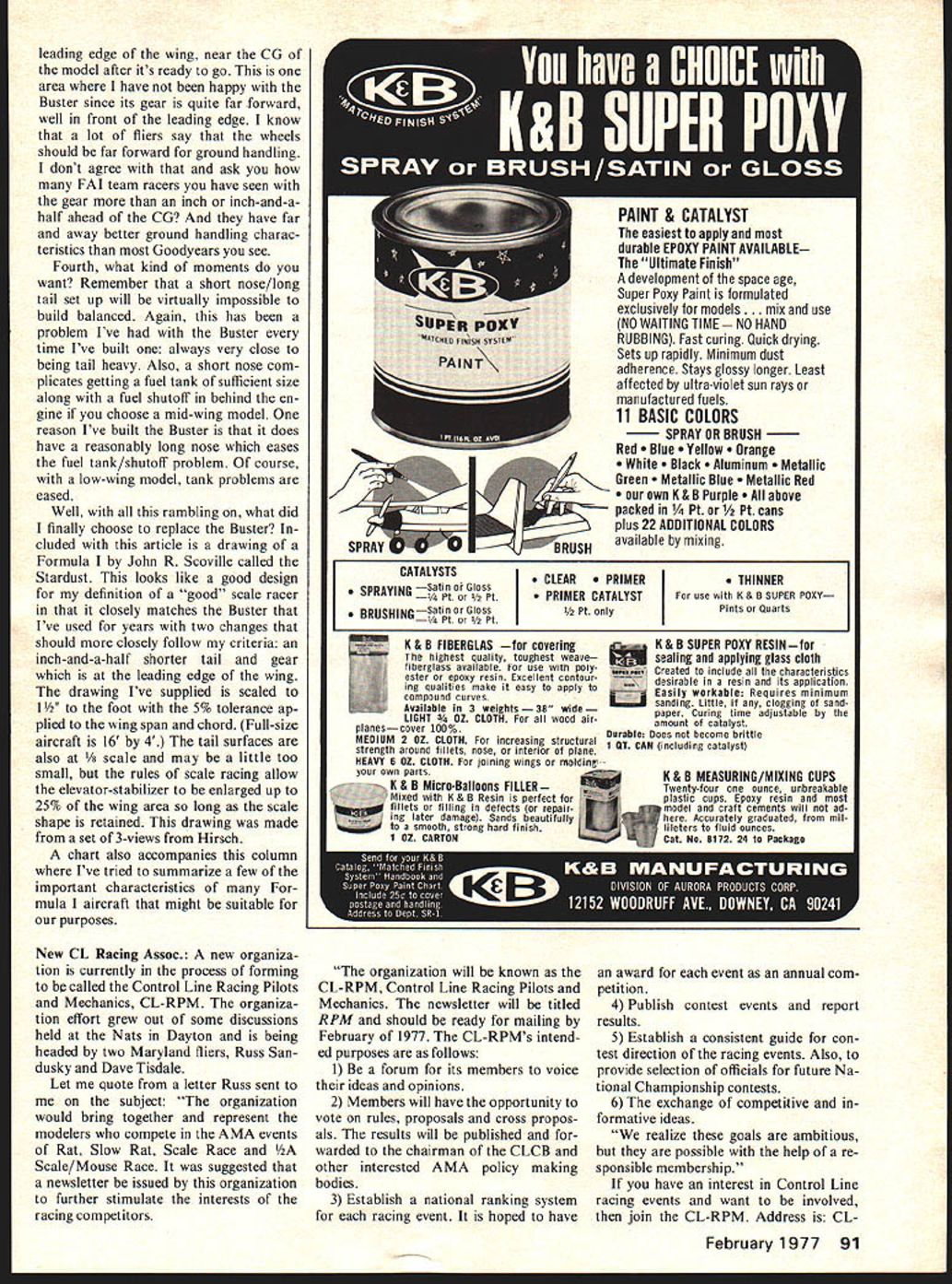
British Record Holders: One of the more interesting people I had the pleasure of meeting at the Nats in Dayton this year was Mr. Dave Clarkson, author of the "Between the Lines" column in Aeromodeller, the British general-interest model-airplane magazine. Dave spent his time mostly spectating but did fly in FAI Team Race. Since our Nats, Dave sent me some information on his UK record holding FAI Team Racer and Goodyear models.
....Our Goodyear rules are somewhat different from yours being oriented towards FAI-TR:
Models—1/8 full-size with 5% tolerance except for tails max. 25% increase in area and mono-wheel U/C's allowed.
Lines—As FAI-TR.
Motors—Max. 3.5 cc.
Races—Heats 100 laps plus 2 stops. Finals 200 laps plus 5 stops. "Lemans" start to all races.
Flying—As FAI-TR conduct rules except "hand on chest" not required.
Circles—As FAI-TR.
"Being FAI-TR oriented, Goodyear here is an excellent training ground for TR in that teams learn how to fly and perform generally in the way required for TR without needing to overcome the technology barrier first. Once people have learned the trade in Goodyear, TR techniques seem a lot easier to acquire.
"The photos show my UK record holding FAI-TR and Goodyear models. Records held were gained at Cranfield, Bedfordshire during the SMAE South Midlands Area Rally September 19, 1976:
FAI-TR Heat (100 laps) Record—4:03.0 (4:04.4)
Goodyear Heat (100 laps) Record—4:04.2 (4:13.0)
The old records broken are given in the brackets. Details re. equipment:
FAI-TR
Model—"Rossi Sprint," a developed version of the APS "Simple Sprint." Wt. 18 oz. As seen at U.S. Nats.
Motor—Rossi 15 F1 with diesel liner and 2-part contra-piston in copper. 3.5-mm diameter venturi and 6.5-mm diameter exhaust restrictor.
Prop—Howard GF "South African" type at 178-mm diameter and 185-mm max. pitch.
Speed/Range—22.0 and 22.5 sec/10 laps (102-99 mph) for 34-36 laps.
GOODYEAR
Model—APS "Ol Blue" totally covered in 1 oz. GF cloth and epoxy paint. Total dry weight 19 oz.
Motor—HGK-15R with reworked head to suit 40% nitro fuel used.
Prop—Howard GF "Super" type at 165-mm diameter and 130-mm max. pitch.
Airspeed—20.5 to 21.0 sec/10 laps in traffic (106-109 mph) (Quicker solo).
It's interesting to note the differences in the Goodyear rules from the UK as compared to our AMA rules. Especially the engine size and single wheel gear differences. The Goodyear time of 4:04.2 for 100 laps is equivalent to about a 3:05 for 80 laps when you take into account the extra pit stop required for the 100-lap race. Not a bad time.
W. R. Lee, 3522 Tamarisk Lane, Missouri City, TX 77459.
Transcribed from original scans by AI. Minor OCR errors may remain.

