
Control Line: Racing
John Ballard 10102 Kimblewick Dr. Louisville, KY 40223
Modified FAI Team Race engines
Modified FAI Team Race engines will be my first subject this month. Although there isn't a lot of interest in Team Racing here in the U.S., maybe we can generate a greater degree of excitement in this very challenging event.
I've had many comments about my recent article (July '90 issue) concerning Team Racing engine modifications. One of the U.S. 1990 FAI Team Race teams (Willoughby/Oge) is using two heavily modified engines for the upcoming CL World Championships.
Newcomers to FAI Team Racing should know that the engines must be 2.5 cc (.1525 cu. in.) displacement or less. The models are limited to a very small fuel capacity (7 cc, or about 0.24 fl. oz.), so diesel engines are the universal choice of fliers because they give the best fuel economy. The modified engines described here are therefore diesels.
The first engine is made from a crankcase Stewart Willoughby acquired from a Russian at the 1988 championships. Stewart machined the backplate from phenolic plastic and uses a K&B rotary valve running in a bronze bushing to keep the backplate assembly as light as possible. The engine is a front-exhaust AAC (aluminum/aluminum/chrome — an aluminum piston running in a chrome-plated aluminum cylinder liner) with a bore/stroke of 15/14 mm. Front-exhaust engines have become quite popular in Europe and are used almost universally by the Russian teams.
Diesels run extremely hot, so placing the hot exhaust side of the engine toward the front, where it gets the greatest exposure to cooling air, keeps it cooler and reduces cylinder thermal distortion. The exhaust gases aren't blown back into the engine to any significant extent, since propwash velocity in this region is very low compared to the velocity of the expelled exhaust gas.
The second engine is a heavily modified Nelson .15, basically the standard rear-exhaust Nelson with the crankcase reversed. The crankshaft housing has been cut off, and the stock backplate machined and press-fitted where the housing was originally located. An all-steel front housing using the standard Nelson bearings and crankshaft is mounted where the backplate was formerly bolted onto the engine.
You will notice that the Russian engine has one mounting lug on the crankcase itself and the other mounting lug well forward on the bolt-on front end. The modified Nelson uses the standard two-bolt lugs attached to the crankcase. Stewart calls his front-stack Nelson a "Noslen" (Nelson spelled backwards). I have included photos of both of these engines.
CL Racing/Ballard
Southwestern Regionals (Cholla Choppers' Invitational)
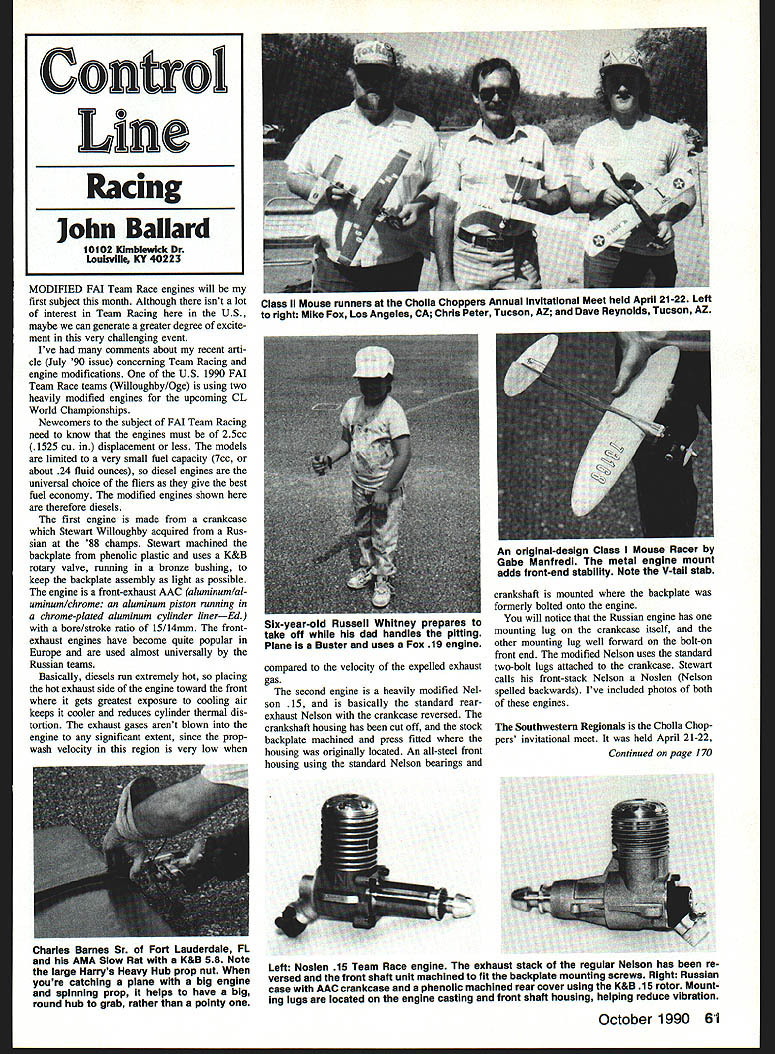
The Southwestern Regionals is the Cholla Choppers' invitational meet. It was held April 21–22, 1990, at Tucson, AZ. Events of interest to racers were Class II Mouse Race, Limited Sport Racing, and Texas Quickie Rat. I am including photos of some of the winners of their respective events.
Annual Rebel Rally (Jacksonville, FL)
I recently attended the 30th Annual Rebel Rally control line contest held in Jacksonville, FL. The contest is held over a weekend and included most CL events: Florida Slow Rat, Mouse Race I, Texas Quickie, Lil' Wizard, and Slow Rat for the kids. The contest had numerous entries, with some participants as young as six years old. One of these fine junior pilots was Russell Whitney; I am enclosing a photo of him flying his Florida Slow Rat.
Another photo shows the Lickety Split Slow Rat flown by Charles Barnes Sr. (Fort Lauderdale, FL). It uses a K&B 5.8 cc engine. Look closely at the photo and you'll see the engine is mounted on a large aluminum plate. This minimizes engine vibration and steadies the fuel flow. The engine uses a swing-weight carburetor which chokes the engine on the ground, then opens up full bore in the air.
Dick Lambert and I were practicing with our Scale Racers and found that the hot, humid air was quite similar to what we expect at the forthcoming AMA Nats in Illinois. We found that the Scale Race engines must turn higher — about 27,000 rpm on the ground. A propeller diameter of 6-1/2 to 6-3/8 in. seemed just right. A smaller diameter prop will allow your engine to reach this rpm, but it does not pull the airplane properly.
We also tried the new Nelson heavy-duty one-piece glow plug and found that distortion and/or frosting of the element were virtually nonexistent. We ran one of the plugs for almost 300 laps with only .005 in. of head clearance without any trouble. The element appears to hold up much better than the wire ones used in the first two production runs of this plug. We were testing because of an earlier report that the heavy-duty plug did not develop enough heat; this may be the case on an extremely cool day. However, if the temperature is in the high eighties with about 65% relative humidity, the plug works very satisfactorily.
Superfast!
One of the photos shows Gabe Manfredi's Class I Mouse Racer that posts times of five minutes flat (or less). This 1/2A Mouse I racer features some unique characteristics:
- The profile body is laminated from a piece of 1/8" plywood (dowelled with lightening holes) and is surfaced with two sheets of very light balsa.
- The finset is extremely sleek.
- The wing uses very light balsa with a lightweight basswood spar and 1/16" basswood veneer on the bottom of the wing for added strength.
- The rest of the tail is built-up balsa; the tailpost is a piece of hard 1/16".
Note that the engine mounts onto a thick metal plate. This reduces engine vibration and gives an extra margin of speed. The engine uses a left-handed crankshaft that rotates opposite to the usual direction to minimize adverse effects of engine torque trying to roll the model during the pull. The plane gets off quickly and has excellent flying characteristics even in windy conditions.
As always, I solicit your ideas, comments, and photos. I use them whenever possible and really appreciate the effort you make in sending them.
Transcribed from original scans by AI. Minor OCR errors may remain.

