
Control Line: Racing
John Ballard 10102 Kimblewick Dr. Louisville, KY 40223
1/2A Engine modification
Those of you who attended the 1990 Nats in Lawrenceville, IL will remember that the highest-entry racing event was Open Mouse. A variety of designs were flown, and several competitors were plagued by myriad engine problems. The ensuing discussions on engine rework turned up some good information that could save you time and headaches.
Shown in one of the photos is Bob Fogg pitting his son's Mouse Racer. It's an all-wood version with a V-tail, which minimizes damage on rough substrates. Instead of a hot glove, which he finds cumbersome, Bob uses a 1/2A starting clip. This works quite satisfactorily and eliminates having to mount contact points to the plane and glow plug tip.
The Tornado Black .5 x 4 propeller, cut down to 4-3/4 in., seems to be about the best combination for a decent number of laps and good airspeed.
Most of the Nats contestants have done hop-up work quite similar to what Joe Klaus of Kustom Kraftsmanship recommends. To hop up your Cox .049, you'll need drill bit sizes ranging approximately .060 to .095. I also recommend buying a bunch of junk engines at garage sales and/or model flea markets, then assembling a cadre of spare parts. The older, bargain-priced parts, especially backplates and tanks, are actually preferable, since they seem both durable and fit better.
Key crank and case work:
- Use one of the breakproof race car cranks, an aftermarket steel crank, or an earlier-model heavy-web crank—don't use anything else.
- Sliding the shaft into the crankcase, adding the thrust washer and tightening the prop should give the crankshaft little play and allow it to spin very freely.
- The crank channels of aluminum cases swell and bind up after a few hot runs. A shaft reamer is useful; you may have to ream out the crankcase several times before achieving the proper fit.
- The crankshaft should spin freely but without side-to-side flop. Extra play allows fuel to blow to the side of the crankcase, lowering fuel economy and requiring extra pit stops.
Backplate, venturi and tank notes:
- Try to use older backplates with a .062-inch diameter hole. I generally drill the backplate hole to approximately .085 in., and the venturi tube in the tank must be opened to the same size.
- Be careful to prevent drill penetration of the venturi tube wall inside the tank.
- Many Nats competitors had enlarged their backplate hole to .093 or .095. That can cost an extra pit stop in a 100-lap final, which requires a minimum of 36 laps between stops.
- I find that a venturi size of about .070 to .085 in. gives the best tradeoff between performance potential and lap requirements. I've ruined many a tank and lost many a race trying larger sizes.
Tank and needle valve tips:
- Your fuel tank should have the new Teflon reed; the older-style brass reed tends to corrode or fail.
- Install a new small venturi black gasket.
- After removing the needle valve spring, put a small length of medium tubing over the valve seal and the air screw valve back; this helps prevent air leaks around the needle valve threads.
- Use a new tank gasket.
- Be cautious when tightening the 2-56 tank hold-down screws—it's easy to tighten them unevenly or too much, tearing the metal where the screws seat and causing an air leak. I generally put fiber or small rubber washers under the screws to help prevent air leaks and minimize overtightening.
Cylinder, piston and rod:
- The TD cylinder/piston head is the best choice for all-out performance. The extra milling slots in TD liners can be smoothed with a little Dremel work.
- The piston/rod fit must prevent play between the rod ball and the inside of the piston. There is a rod-setting tool on the market that can be used to reseat the rod securely over its mounting ball.
After the cylinder is installed, add a minimum of four head gaskets and then test-run the engine. Though many racers have run 50%–70% nitro with excellent results, I have found that 40%–50% nitro eliminates a lot of problems. Try it and see if the rpm on your Cox comes up to snuff—around 21,000 rpm is a killer.
FAST Goodyear racer
The FAST Goodyear racer uses an inventive tank and fuel shutoff system. The engine is mounted with an aluminum saddle, the fuel shutoff has a press-down mechanism, and two tubes are pinched at the bottom. Rather than the conventional Quick-Fill, the fuel tank has a flush valve that uses a filler with a rubber gasket, while spring pressure inside the tank seals the lip.
The very lightweight titanium wheels and landing gear minimize weight and add a degree of streamlining. The tank has at least two mounting screws on the rear, which assures security and helps prevent vibration and foaming.
Fast Rat tank and fuel shutoff mounting
I've been asked several times to show a decent mounting procedure for a Fast Rat tank. Seen in two of the photos is Larry Dziak's inside-down Fast Rat showing the full pan and tank mounting. I use Permagasket blue silicone sealant, placing several beads inside the pan, and then press the tank in, making sure there's a bead of silicone around all contact areas. I also grind out the ridge in the bottom of the pan so it doesn't vibrate against the tank later and cause an internal leak.
Larry resolders the lines at the front of the tank, then uses a typical brass plate fitted with a spring made from 1/16" wire to seal the two lines. Wrapping the two loops of 1/16" wire around a 1/8" stationary wire makes enough of a spring to mash the fuel tubing.
Note that the bellcrank has speed buttons to hold the flying wires. Made of T-6061 aluminum, it's installed as flush as possible to avoid interference with the tank.
Cooling and mounting details:
- A solid fit around the engine pan and top can promote overheating in the lower portion, causing bearing failures and loosened props. Larry avoids this by angling three holes from the bottom of the pan forward of the mounting lugs, allowing air to enter over the bottom of the case for cooling without weakening the structure.
- The majority of racers now use 6-32 hold-down bolts to reliably secure the pan and airframe.
Team Racing
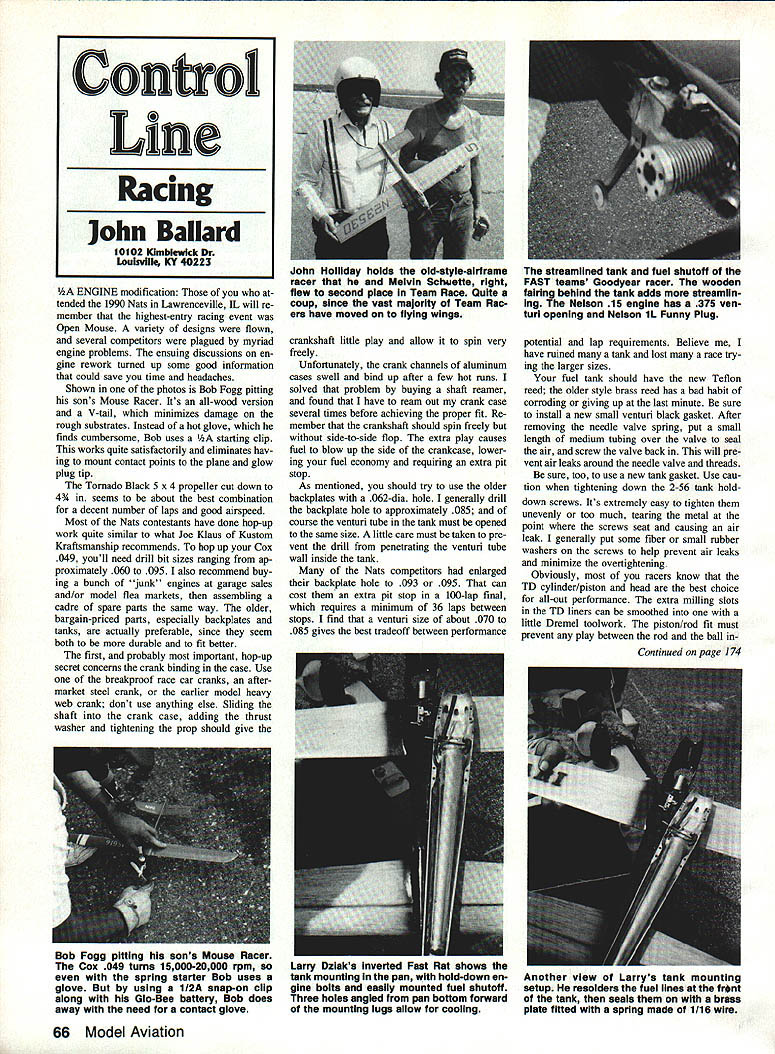
John Holliday and Melvin Schuette have been flying Team Race for at least two years. One of the photos shows them at the Nats, where they were fortunate enough to take second place. Their traditionally styled racers weigh about 450–500 grams and use the standard Nelson .15 diesel for power. Though they've also flown the high-speed, present-day racers, John and Melvin have found their more conservative model to be consistent as well as highly stable on takeoff over extremely rough surfaces.
I might add that the two assisted the Russian team at the Nationals by supplying them with fuel ingredients and containers for mixing and storing the fuel.
As always, your comments and photos are solicited.
Transcribed from original scans by AI. Minor OCR errors may remain.

