
Control Line: Racing
John Ballard 10102 Kimblewick Dr. Louisville, KY 40223
Fast Rat wing construction
I have had several requests concerning the construction of a Fast Rat wing that will be durable in flight and will support aggressive grabs during pit stops under racing conditions. In the early eighties most wings were fabricated from a piece of ultra-light 3/8" basswood. The inner section of the basswood was cut out and slotted for the wires, and the airfoil was shaped to requirements. Most of the wings I saw in those early days were Clark-Y with a flat bottom surface.
Present-day Rat racers generally utilize a 60%–40% airfoil in their construction, and most aircraft are of laminated hard balsa with Kevlar reinforcement and hardwood leading and trailing edges in the spar areas.
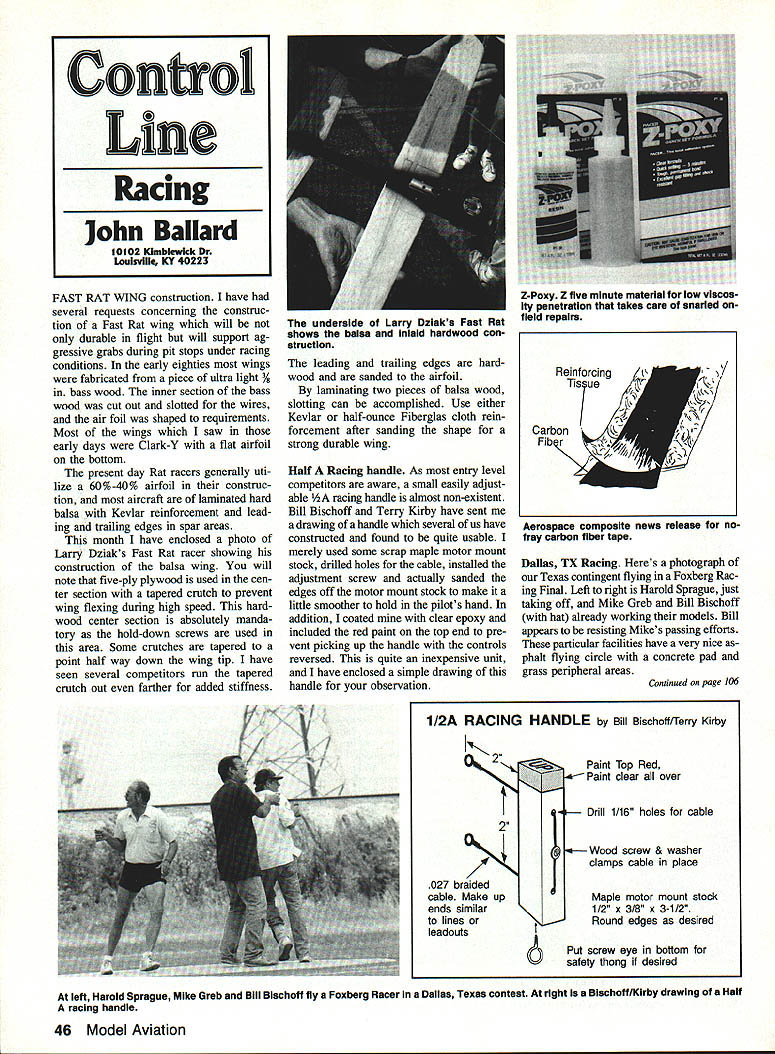
I have enclosed a photo of Larry Dziak's Fast Rat racer showing his construction of the balsa wing. You will note that five-ply plywood is used in the center section with a tapered crutch to prevent wing flexing during high-speed flight. This hardwood center section is absolutely mandatory as the hold-down screws are used in this area. Some crutches are tapered to a point halfway toward the wing tip; I have seen several competitors run the tapered crutch even farther for added stiffness.
The leading and trailing edges are hardwood and are sanded to the airfoil. By laminating two pieces of balsa wood, slotting for the wires can be accomplished. Use either Kevlar or half-ounce fiberglass cloth reinforcement after sanding the shape for a strong, durable wing.
Half-A racing handle
As most entry-level competitors are aware, a small, easily adjustable 1/2A racing handle is almost non-existent. Bill Bischoff and Terry Kirby have sent me a drawing of a handle that several of us have constructed and found quite usable. I used some scrap maple motor-mount stock, drilled holes for the cable, installed the adjustment screw, and sanded the edges off the motor-mount stock to make it a little smoother in the pilot's hand. In addition, I coated mine with clear epoxy and added red paint on the top end to prevent picking up the handle with the controls reversed. This is an inexpensive unit, and I have enclosed a simple drawing of this handle for your observation.
Dallas, TX racing
Here's a photograph of our Texas contingent flying in a Foxberg Racing final. Left to right: Harold Sprague, just taking off; Mike Greb; and Bill Bischoff (with hat) already working their models. Bill appears to be resisting Mike's passing efforts. These facilities have a very nice asphalt flying circle with a concrete pad and grass peripheral areas.
Carbon fiber tape
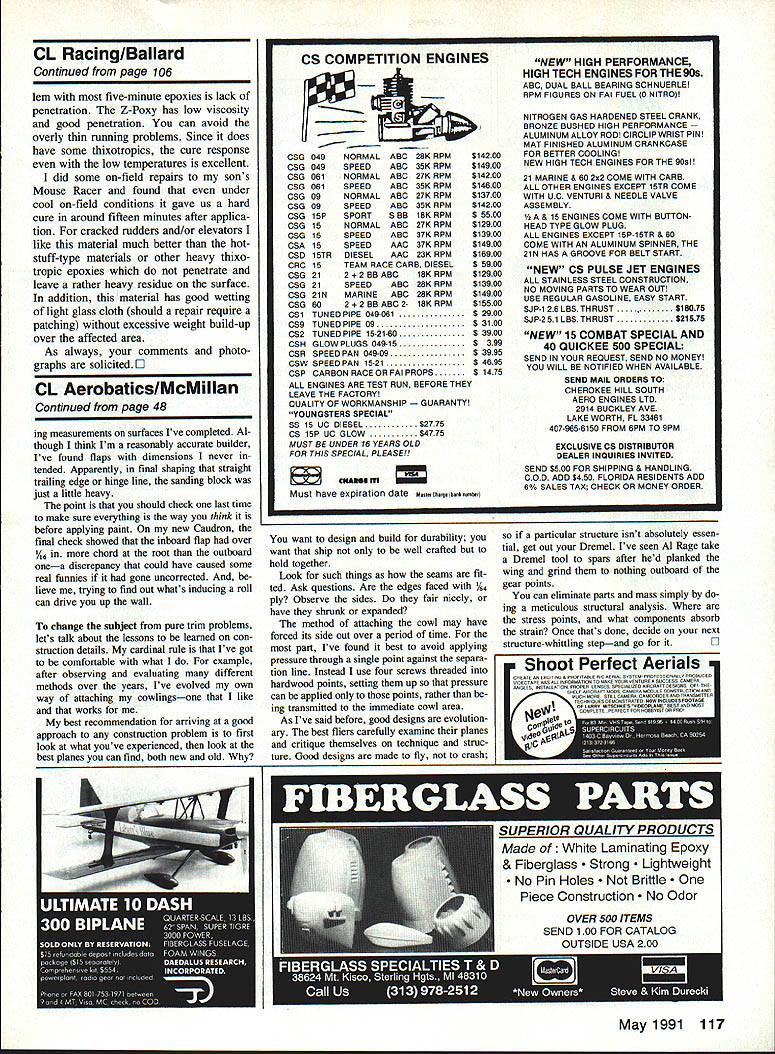
During my winter construction projects I found an excellent carbon fiber tape that does not separate or fray at the ends and which, when used with extremely thin epoxy, gives an excellent reinforcing laminate for wings or stump areas. In addition to aerospace composite products, the company also makes a no-fray carbon fiber tape which can be used for strengthening. The no-fray feature is what makes this product excellent.
For information and samples, write to: Aerospace Composites Products P.O. Box 1621 Irvine, CA 92714 (714) 250-1107
Z-Poxy
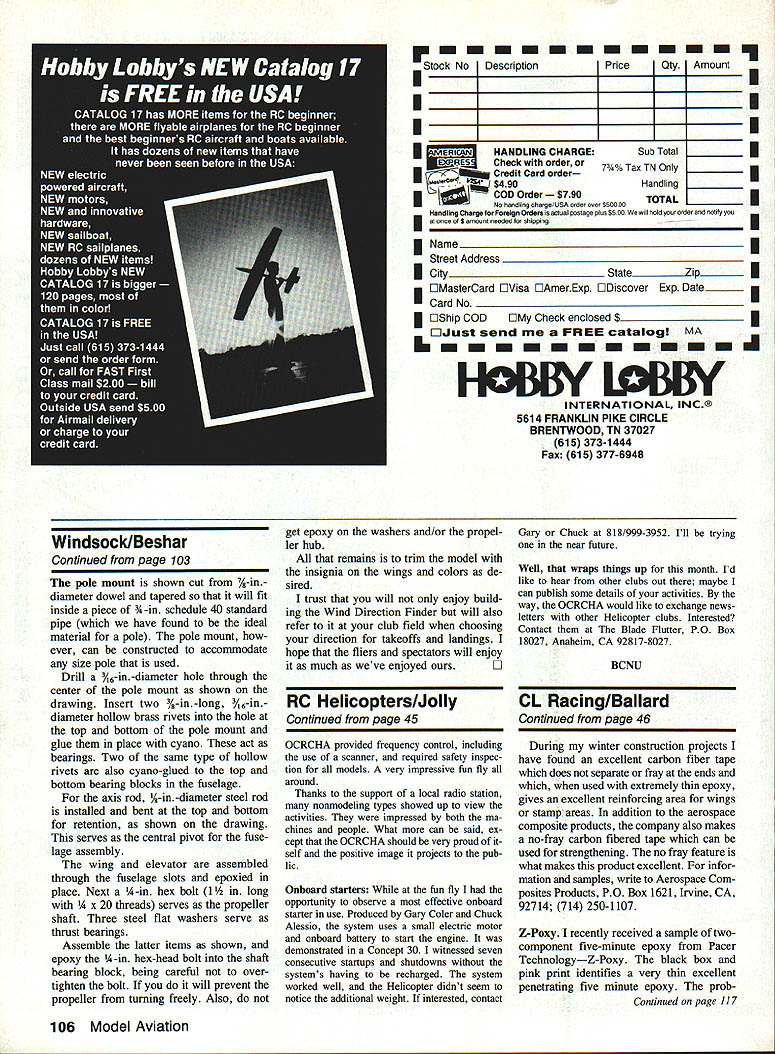
I recently received a sample of a two-component five-minute epoxy from Pacer Technology—Z-Poxy. The black box with pink print identifies a very thin, excellent penetrating five-minute epoxy. The problem with most five-minute epoxies is lack of penetration; Z-Poxy has low viscosity and good penetration. You can avoid overly thin running problems because it contains some thixotropic additives, so the cure response even at low temperatures is excellent.
I did some on-field repairs to my son's Mouse Racer and found that even under cool conditions it gave us a hard cure in around fifteen minutes after application. For cracked rudders or elevators I prefer this material to hot-stuff-type adhesives or other heavy thixotropic epoxies, which do not penetrate well and leave a heavy residue on the surface. In addition, Z-Poxy wets light glass cloth well (should a repair require a patch) without excessive weight buildup over the affected area.
As always, your comments and photographs are solicited.
Transcribed from original scans by AI. Minor OCR errors may remain.

