
Control Line: Racing
John Ballard 10102 Kimblewick Dr. Louisville, KY 40223
Glo-Bee 1-L Plugs
Mr. Bill Massa of Twinn-K sent me some samples of a new prototype Glo-Bee 1-L plug for field testing in early February. I tried these on my Slo and Rat race engines, but in the cool February air the comparison between a standard 1-L and the prototype showed virtually no difference. Spring of this year in Kentucky has been warm, with high temperatures and high humidity.
I have tried two Sundays running with these plugs and find that after an extended five-minute blast at just over 21,000 rpm, the new prototype plug shows absolutely no glass softening, nor does the glass appear to drain, distort, or discolor inside the plug cavity. They are certainly an improvement over the standard 1-Ls. All my runs were with the standard flying prop on the test stand with 10% nitro and 100% synthetic oil fuel.
Texas Quickie Rat — Tank Location and Filling
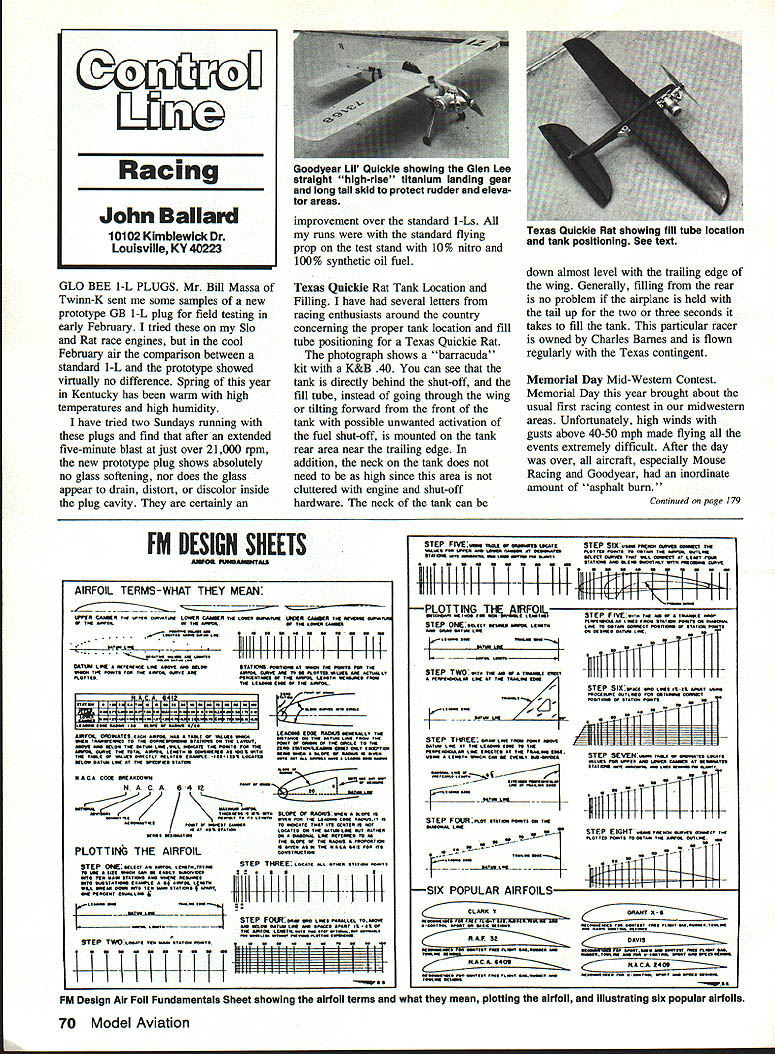
I have had several letters from racing enthusiasts around the country concerning the proper tank location and fill-tube positioning for a Texas Quickie Rat. The photograph shows a "barracuda" kit with a K&B .40. You can see that the tank is directly behind the shut-off, and the fill tube, instead of going through the wing, is tilting forward from the front of the tank. Tilting forward from the front of the tank could cause possible unwanted activation of the fuel shut-off.
If the shut-off is mounted on the tank rear area near the trailing edge, the neck on the tank does not need to be as high since this area is not cluttered with engine and shut-off hardware. The neck of the tank can be down almost level with the trailing edge of the wing. Generally, filling from the rear is no problem if the airplane is held with the tail up for the two or three seconds it takes to fill the tank. This particular racer is owned by Charles Barnes and is flown regularly with the Texas contingent.
Memorial Day Midwestern Contest
Memorial Day this year brought about the usual first racing contest in our Midwestern areas. Unfortunately, high winds with gusts above 40–50 mph made flying all the events extremely difficult. After the day was over, all aircraft, especially Mouse Racing and Goodyear, had an inordinate amount of "asphalt burn."
CL Racing/Ballard
The Lil' Quickie
The Lil' Quickie (see photo) is flown by Gabe Manfredi of Port Saint Lucie, Florida. Florida weather is always breezy with unusually gusty winds. By using the Glen Lee "Long Titanium Landing Gear" and a sturdy 3/32" music-wire tail skid, these features minimize nipped and chipped wings, elevators, and lower body parts. Note the extra-long landing gear with the elevator and rudder at least three inches off the pavement. Even with the best pilot, it is almost impossible to land these lightweight aircraft without substantial bouncing and damage to the airframe unless precautions are taken to minimize ground contact.
Airfoil Fundamentals
I have had several requests concerning the type of airfoils used for Goodyear and Rat racers. For many years most of my colleagues used a Clark Y-type airfoil. We now use a 60–40 ratio, which is represented by NACA 2409. I have had this spec sheet on airfoil fundamentals for some years and refer to it frequently. You might include this in your reference library.
Nelson Super Slo Rat .36 RR
I just finished evaluating the new Nelson "big block" slow Rat .36 rear-rotor engine. If you will recall, the hot set-up Slo Rat engine of today is basically the Super Tiger X .40 modified to .36 displacement. These engines run very slowly and have been proven durable. The new Nelson .36 Slo Rat engine is 800 to 1,000 rpm better than the Super Tiger X .36. We will be trying one of these in the upcoming Springfield NATS this year.
As always, your comments and photographs are solicited.
Transcribed from original scans by AI. Minor OCR errors may remain.

