
Control Line: Racing
John Ballard 10102 Kimblewick Dr. Louisville, KY 40223
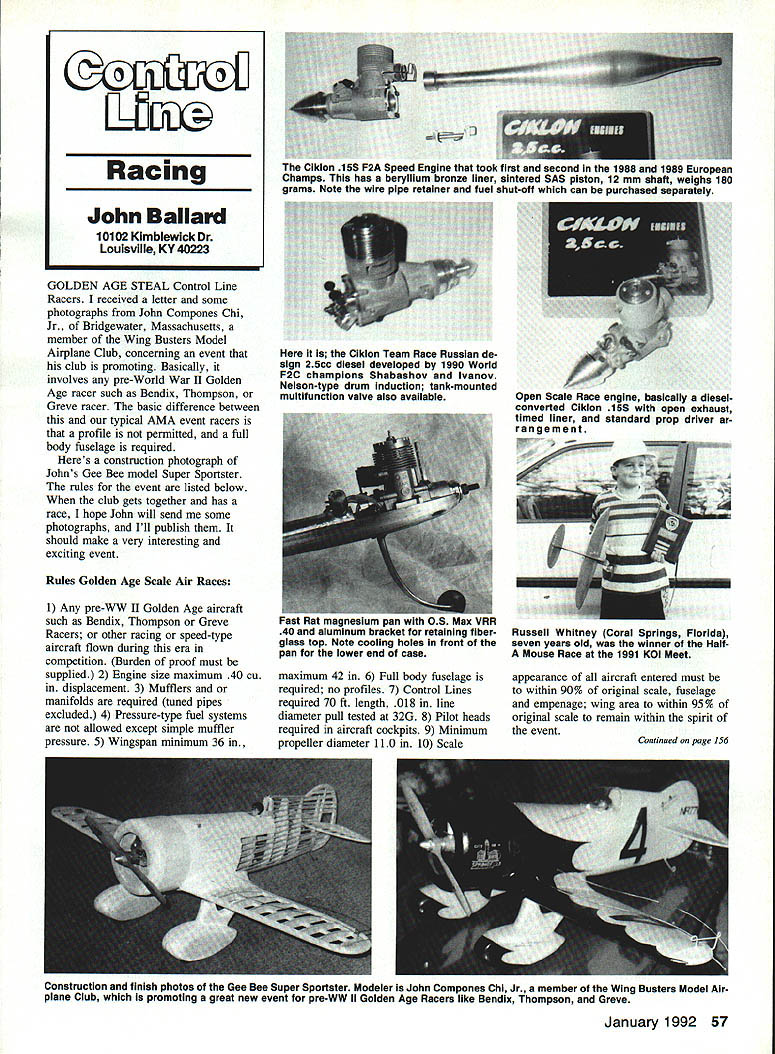
GOLDEN AGE STEAL. Control Line Racers. I received a letter and some photographs from John Componeschi, Jr., of Bridgewater, Massachusetts, a member of the Wing Busters Model Airplane Club, concerning an event that his club is promoting. Basically, it involves any pre-World War II Golden Age racer such as Bendix, Thompson, or Greve racers. The basic difference between this and our typical AMA event racers is that a profile is not permitted, and a full-body fuselage is required.
Here's a construction photograph of John's Gee Bee model Super Sportster. The rules for the event are listed below. When the club gets together and has a race, I hope John will send me some photographs, and I'll publish them. It should make a very interesting and exciting event.
Rules — Golden Age Scale Air Races:
- Any pre-WWII Golden Age aircraft such as Bendix, Thompson, or Greve racers; or other racing or speed-type aircraft flown during this era in competition. (Burden of proof must be supplied.)
- Engine size maximum .40 cu. in. displacement.
- Mufflers and/or manifolds are required (tuned pipes excluded).
- Pressure-type fuel systems are not allowed except simple muffler pressure.
- Wingspan minimum 36 in., maximum 42 in.
- Full-body fuselage is required; no profiles.
- Control lines required: 70 ft. length, .018 in. line diameter, pull tested at 32G.
- Pilot heads required in aircraft cockpits.
- Minimum propeller diameter 11.0 in.
- Scale appearance of all aircraft entered must be within 90% of original scale fuselage and empennage; wing area within 95% of original scale to remain within the spirit of the event.
CL Racing / Ballard
Continued from page 57
I received a letter from my colleague in England, Dave Clarkson. Dave has been to the U.S. on many occasions to fly in our Team Race contests. He is presently importing engines from Russia. His engine is called a Ciklon, and there are three versions: the Team Race diesel, the Scale Race version, and a Speed version with pipe. These engines were designed by Alexander Gievsky and Alexander Kalmykov. The Russians claim that the Ciklon .15 TR is very similar to the engine used by Shabashov/Ivanov to win Team Race at the 1991 World Championships. The engine is in a production run of their design. In addition, the Gievsky/Kalmykov team is producing a compatible carbon-fiber prop and a compatible tank multi-function fill valve assembly — all designed around the specifications of the current Russian Team Race world champion.
You must further understand that for the piston-liner material they will be using AK4-1 sintered 17% silicon aluminum for the sleeve and SAS sintered 28% silicon aluminum for the piston. I understand that sleeve and piston are presently available and can be ordered from:
Engines from Russia 12 Heathland Terrace Shaw Heath, Stockport, Cheshire SK3 8DU Telephone or fax: 061-477-7395
I will be evaluating the Scale Race engine as well as the Team Race engine and will keep you informed as to my progress.
I received a picture of Russell Whitney from Coral Springs, Florida, who is showing off his trophy and airplane for Open Mouse Racing. Russell placed second, and he also flew in Goldberg Little Wizard (an event for Juniors only) and the Texas Quickie Rat. All of these events were flown at the FMA contests during this year's King Orange International Meet in May. I am hopeful that we will have a new pilot coming up in the ranks.
Fiberglass hold-down mountings for Fast Rat
I have had several requests concerning a satisfactory method for holding down the front of the fiberglass top on the Fast Rat racers. Most racers use two 6-32 hold-down screws to hold the wing and top in place around the bellcrank area, tapped, of course, through the Harter pan. Then a 6-32 bolt is usually used at the rear as an additional hold-down screw.
However, the up-front area beneath a big-block engine such as a Nelson .40 or O.S. Max .40 takes up so much of the front of the pan, and the front-end ball-bearing races are so large that there is very little space left to keep the frontal area of the fiberglass top mounted securely. Take a look at the photograph of Dick Lambert's Fast Rat, which shows a metal T mounted on a lightweight aluminum bracket which, in turn, mounts to the top-mounting screws of the crankshaft housing. After the top is installed on the small metal plate (approximately 3/8 in. wide), a set screw threads into the bar, holding the top securely around the engine and flush to the metal pan.
In addition, you will note some holes through the bar which will allow cooling air to flow over the engine even though the bar is only 1/8 in. thick. Careful use of a countersunk screw will keep the front of the fairing on the fiberglass top smooth. This aluminum T is quite easy to mount to the screws on the O.S., since these screws are a full 7/8 in. long. With this secure mounting, front vibration and loss of airspeed are kept to a minimum.
As always, your comments and photographs are solicited.
Transcribed from original scans by AI. Minor OCR errors may remain.

