
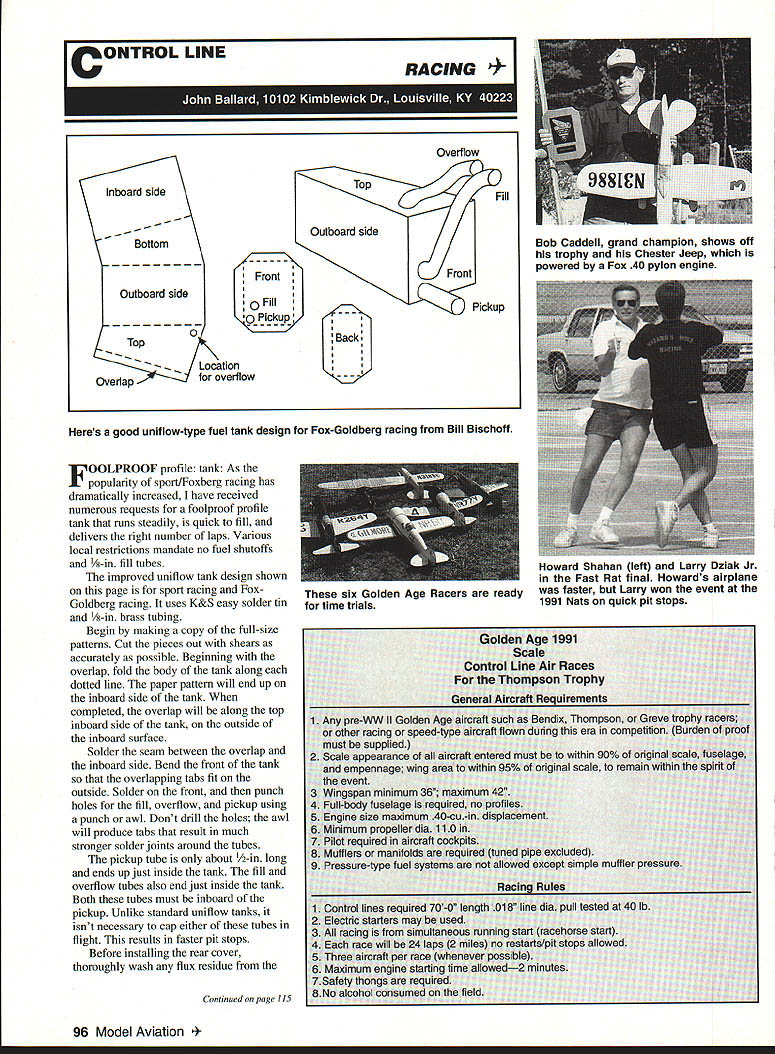
Control Line: Racing
John Ballard, 10102 Kimblewick Dr., Louisville, KY 40223
Foolproof profile tank
As the popularity of sport/Fox‑Goldberg racing has increased, I’ve had many requests for a foolproof profile tank that runs steadily, is quick to fill, and delivers the right number of laps. The improved uniflow tank design below is for sport racing and Fox‑Goldberg racing. It uses K&S easy‑solder tin and 1/8‑in. brass tubing.
- Make a copy of the full‑size patterns. Cut the pieces out with shears as accurately as possible.
- Beginning with the overlap, fold the body of the tank along each dotted line. The paper pattern will end up on the inboard side of the tank. When completed, the overlap will be along the top inboard side of the tank, on the outside of the inboard surface.
- Solder the seam between the overlap and the inboard side.
- Bend the front of the tank so that the overlapping tabs fit on the outside. Solder on the front.
- Punch holes for the fill, overflow, and pickup using a punch or awl. Do not drill the holes; the awl will produce tabs that result in much stronger solder joints around the tubes.
- Install the tubes:
- The pickup tube is about 1/2‑in. long and ends just inside the tank.
- The fill and overflow tubes also end just inside the tank.
- Both the fill and overflow tubes must be inboard of the pickup.
- Unlike standard uniflow tanks, it is not necessary to cap the fill or overflow tubes during flight, which results in faster pit stops.
- Before installing the rear cover, thoroughly wash any flux residue from the interior surfaces.
The tank shown should give about 30–32 laps with a 9 x 7 APC prop. Aircraft can effectively block the starter prop. Bill Bischoff originated this design; it has satisfied many racers in the Texas area.
Golden Age air racing
I’ve had a flood of letters requesting more information on Golden Age racers. Enclosed this month are the general aircraft requirements and rules. George McGinnis has sent some spectacular photos of aircraft and participants from a recent contest. More information is available from:
George McGinnis c/o Hanson Hobby Inc. 830 Main Street, P.O. Box 150 Hanson, MA 02341 Phone: (617) 293‑2804
Rat Race piloting
- Walking the smallest circle can reduce elapsed race time by 0.5 to 1.5 seconds. Since many races are decided by tenths of a second, this can be the difference between victory and also‑ran.
- Pilots leaning into the center circle make passing difficult, especially when airspeeds are close. Most cat races today are won or lost in the pits.
- A good pilot with an aircraft that is 4 seconds slower can effectively block a faster competitor by “backwalking” the circle, placing extra pressure on the opposing pit crew for a fast stop.
- Another area for time saving is “shut down” elapsed time. One to three seconds can be lost gliding an extra unpowered lap or on slow approaches to the pitman.
In contest race preparation, work on saving time and your team’s race performance will improve.
As always, your comments and photos are solicited. Write to me at the address shown above.
Transcribed from original scans by AI. Minor OCR errors may remain.

