
Control Line: Racing
John Ballard 10102 Kimblewick Drive, Louisville, KY 40223
TRAGEDY coupled with record-setting Control Line Racing performances hallmarked the 67th National Aeromodeling Championships.
The Mid-America Aircenter in Lawrenceville, Illinois, was included on the fringe of the severe-weather front that flooded much of the Midwest. The first of three days of competition was marked by intense humidity, searing heat, and occasional storm cells with heavy rain and lightning.
The scheduling of Racing events was unfortunate for the Racing competitors. Racing equipment requires on-site tuning, and the mandatory safety net was not erected until 3 p.m. on Friday—primarily the result of flooding and removal of parked aircraft near the site. Standing water negated the use of electric drills for post installation, requiring improvisation by event directors—they utilized forklifts, trucks, and campers to maintain the net.
The schedule was:
- Scale Racing on Saturday
- Mouse Racing on Sunday
- Slow Rat on Monday
- Fast Rat and Team Racing on Tuesday
The Event Director was Melvin Schuette, assisted by his longtime partner, John Holliday.
Scale Racing
Most competitors arrived on Thursday. Several used a high-school parking lot on the edge of Lawrenceville for testing. Thunderstorms on Thursday evening and Friday morning halted any further practice.
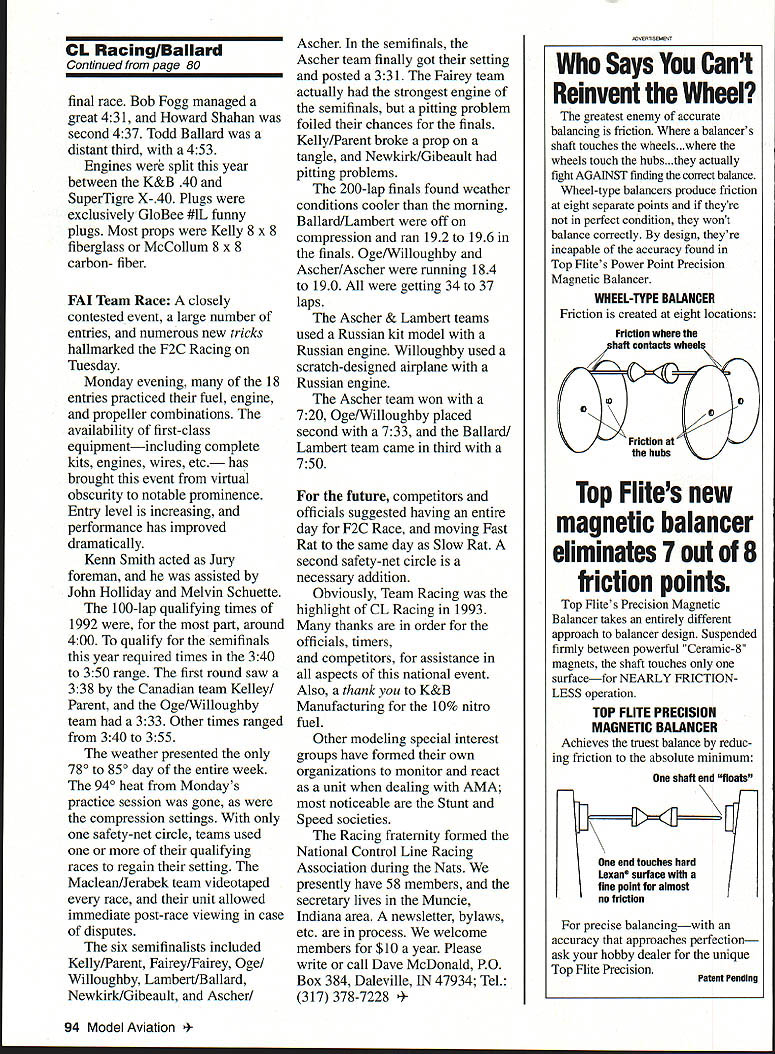
By Saturday at 6:30 a.m., practice times were in the 14.0- to 14.5-second speed range. Stewart Willoughby had his ultra-light Little Quickie running at a steady 14 flat.
Power plants this year were predominantly the GP-modified Rossi .15 Mark III with a few Nelson .15s.
Several new Australian Bolly carbon-fiber/epoxy propellers of different configurations produced overall improved speeds. The props come with pitch and length close, but the blades must be thinned to obtain 25,000 to 27,000 ground rpm, and airspeed in the mid-14s.
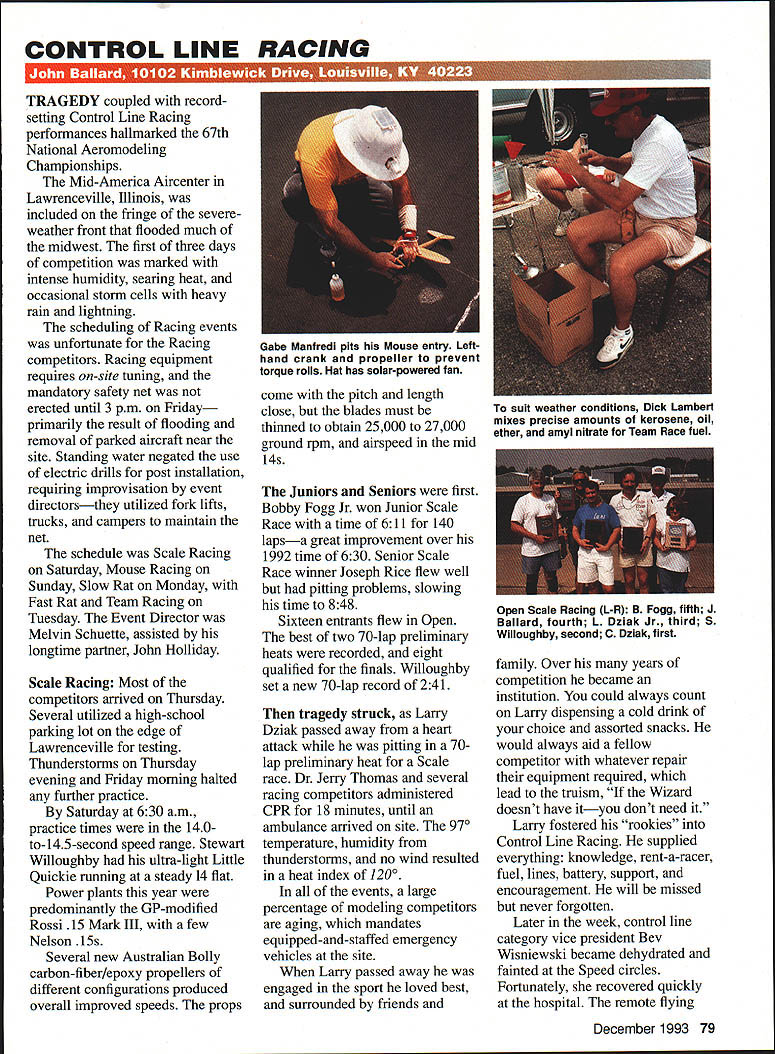
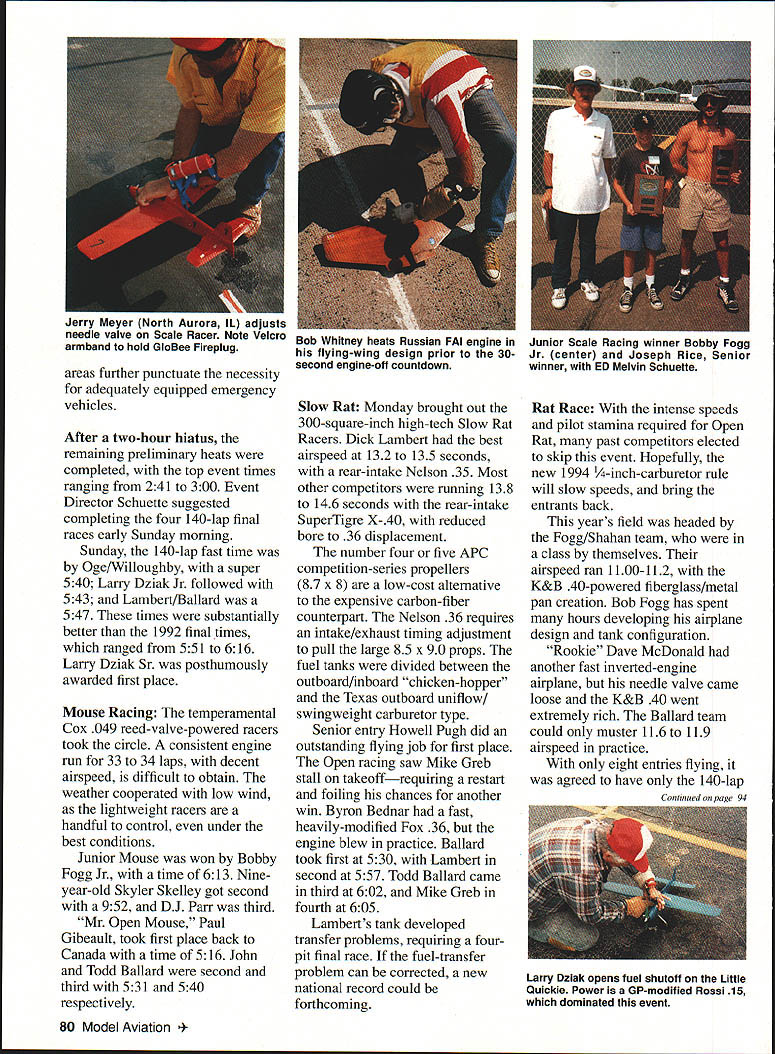
The Juniors and Seniors were first. Bobby Fogg Jr. won Junior Scale Race with a time of 6:11 for 140 laps—a great improvement over his 1992 time of 6:30. Senior Scale Race winner Joseph Rice flew well but had pitting problems, slowing his time to 8:48.
Sixteen entrants flew in Open. The best of two 70-lap preliminary heats were recorded, and eight qualified for the finals. Willoughby set a new 70-lap record of 2:41.
Then tragedy struck. Larry Dziak passed away from a heart attack while he was pitting in a 70-lap preliminary heat for a Scale race. Dr. Jerry Thomas and several racing competitors administered CPR for 18 minutes, until an ambulance arrived on site. The 97° temperature, humidity from thunderstorms, and no wind resulted in a heat index of about 120°.
In all of the events, a large percentage of modeling competitors are aging, which mandates equipped-and-staffed emergency vehicles at the site.
When Larry passed away he was engaged in the sport he loved best, and surrounded by friends and family. Over his many years of competition he became an institution. You could always count on Larry dispensing a cold drink of your choice and assorted snacks. He would always aid a fellow competitor with whatever repair their equipment required, which led to the truism, "If the Wizard doesn't have it—you don't need it." Larry fostered his "rookies" into Control Line Racing. He supplied everything: knowledge, rent-a-racer, fuel, lines, battery, support, and encouragement. He will be missed but never forgotten.
Later in the week, Control Line category vice president Bev Wisniewski became dehydrated and fainted at the speed circles. Fortunately, she recovered quickly at the hospital. The remote flying areas further punctuate the necessity for adequately equipped emergency vehicles.
After a two-hour hiatus, the remaining preliminary heats were completed, with top preliminary times ranging from 2:41 to 3:00. Event Director Schuette suggested completing the four 140-lap final races early Sunday morning.
On Sunday the 140-lap fast time was by Oge/Willoughby, with a superb 5:40; Larry Dziak Jr. followed with 5:43; and Lambert/Ballard was 5:47. These times were substantially better than the 1992 final times, which ranged from 5:51 to 6:16. Larry Dziak Sr. was posthumously awarded first place.
Mouse Racing
The temperamental Cox .049 reed-valve-powered racers took the circle. A consistent engine run for 33 to 34 laps, with decent airspeed, is difficult to obtain. The weather cooperated with low wind, as the lightweight racers are a handful to control even under the best conditions.
Junior Mouse was won by Bobby Fogg Jr., with a time of 6:13. Nine-year-old Skyler Skelley took second with 9:52, and D.J. Parr was third.
"Mr. Open Mouse," Paul Gibeault, took first place back to Canada with a time of 5:16. John and Todd Ballard were second and third with 5:31 and 5:40 respectively.
Slow Rat
Monday brought out the 300-square-inch high-tech Slow Rat Racers. Dick Lambert had the best airspeed at 13.2 to 13.5 seconds, with a rear-intake Nelson .35. Most other competitors were running 13.8 to 14.6 seconds with the rear-intake SuperTigre X-.40, with reduced bore to .36 displacement.
The number four or five APC competition-series propellers (8.7 x 8) are a low-cost alternative to the expensive carbon-fiber counterparts. The Nelson .36 requires an intake/exhaust timing adjustment to pull the large 8.5 x 9.0 props. Fuel tanks were divided between the outboard/inboard "chicken-hopper" type and the Texas outboard uniflow/swingweight carburetor type.
Senior entry Howell Pugh did an outstanding flying job for first place. In Open racing, Mike Greb stalled on takeoff—requiring a restart and foiling his chances for another win. Byron Bednar had a fast, heavily modified Fox .36, but the engine blew in practice. Ballard took first at 5:30, with Lambert in second at 5:57. Todd Ballard came in third at 6:02, and Mike Greb in fourth at 6:05.
Lambert's tank developed transfer problems, requiring a four-pit final race. If the fuel-transfer problem can be corrected, a new national record could be forthcoming.
Rat Race
With the intense speeds and pilot stamina required for Open Rat, many past competitors elected to skip this event. Hopefully, the new 1994 1/4-inch-carburetor rule will slow speeds and bring the entrants back.
This year's field was headed by the Fogg/Shahan team, who were in a class by themselves. Their airspeed ran 11.00–11.2 seconds, with the K&B .40-powered fiberglass/metal pan creation. Bob Fogg has spent many hours developing his airplane design and tank configuration.
"Rookie" Dave McDonald had another fast inverted-engine airplane, but his needle valve came loose and the K&B .40 went extremely rich. The Ballard team could only muster 11.6 to 11.9 airspeed in practice.
With only eight entries flying, it was agreed to have only the 140-lap final race. Bob Fogg managed a great 4:31, and Howard Shahan was second at 4:37. Todd Ballard was a distant third at 4:53.
Engines were split this year between the K&B .40 and SuperTigre X-40. Plugs were exclusively Glo-Bee #11L glow plugs. Most props were Kelly 8 x 8 fiberglass or McCollum 8 x 8 carbon-fiber.
FAI Team Race (F2C)
A closely contested event, a large number of entries, and numerous new tricks hallmarked the F2C Racing on Tuesday.
Many of the 18 entries practiced their fuel, engine, and propeller combinations Monday evening. The availability of first-class equipment—including complete kits, engines, wires, etc.—has brought this event from virtual obscurity to notable prominence. Entry level is increasing, and performance has improved dramatically.
Kenn Smith acted as jury foreman, assisted by John Holliday and Melvin Schuette.
The 100-lap qualifying times of 1992 were, for the most part, around 4:00. To qualify for the semifinals this year required times in the 3:40 to 3:50 range. The first round saw a 3:38 by the Canadian team Kelley/Parent, and the Oge/Willoughby team had a 3:33. Other times ranged from 3:40 to 3:55.
The weather presented the only 78° to 85° day of the entire week. The 94° heat from Monday's practice session was gone, as were the compression settings. With only one safety-net circle, teams used one or more of their qualifying races to regain their settings. The Maclean/Jerabek team videotaped every race; their unit allowed immediate post-race viewing in case of disputes.
The six semifinalists included Kelly/Parent, Fairey/Fairey, Oge/Willoughby, Lambert/Ballard, Newkirk/Gibeault, and Ascher. In the semifinals, the Ascher team finally got their setting and posted a 3:31. The Fairey team actually had the strongest engine of the semifinals, but a pitting problem foiled their chances for the finals. Kelly/Parent broke a prop on a tangle, and Newkirk/Gibeault had pitting problems.
The 200-lap finals found weather conditions cooler than the morning. Ballard/Lambert were off on compression and ran 19.2 to 19.6 in the finals. Oge/Willoughby and Ascher/Ascher were running 18.4 to 19.0. All were getting 34 to 37 laps.
The Ascher and Lambert teams used a Russian kit model with a Russian engine. Willoughby used a scratch-designed airplane with a Russian engine.
The Ascher team won with a 7:20, Oge/Willoughby placed second with a 7:33, and the Ballard/Lambert team came in third with a 7:50.
For the future, competitors and officials suggested:
- Having an entire day dedicated to F2C Racing
- Moving Fast Rat to the same day as Slow Rat
- Adding a second safety-net circle
Team Racing was the highlight of CL Racing in 1993. Many thanks are in order for the officials, timers, and competitors for assistance in all aspects of this national event. Also, thanks to K&B Manufacturing for the 10% nitro fuel.
Other modeling special interest groups have formed their own organizations to monitor and react as a unit when dealing with the AMA; most noticeable are the Stunt and Speed societies.
The racing fraternity formed the National Control Line Racing Association during the Nats. We presently have 58 members, and the secretary lives in the Muncie, Indiana area. A newsletter and bylaws are in process. We welcome members for $10 a year.
Contact:
- Dave McDonald, P.O. Box 384, Daleville, IN 47934
- Tel.: (317) 378-7228
Transcribed from original scans by AI. Minor OCR errors may remain.

