
Control Line: Racing
Bill Lee
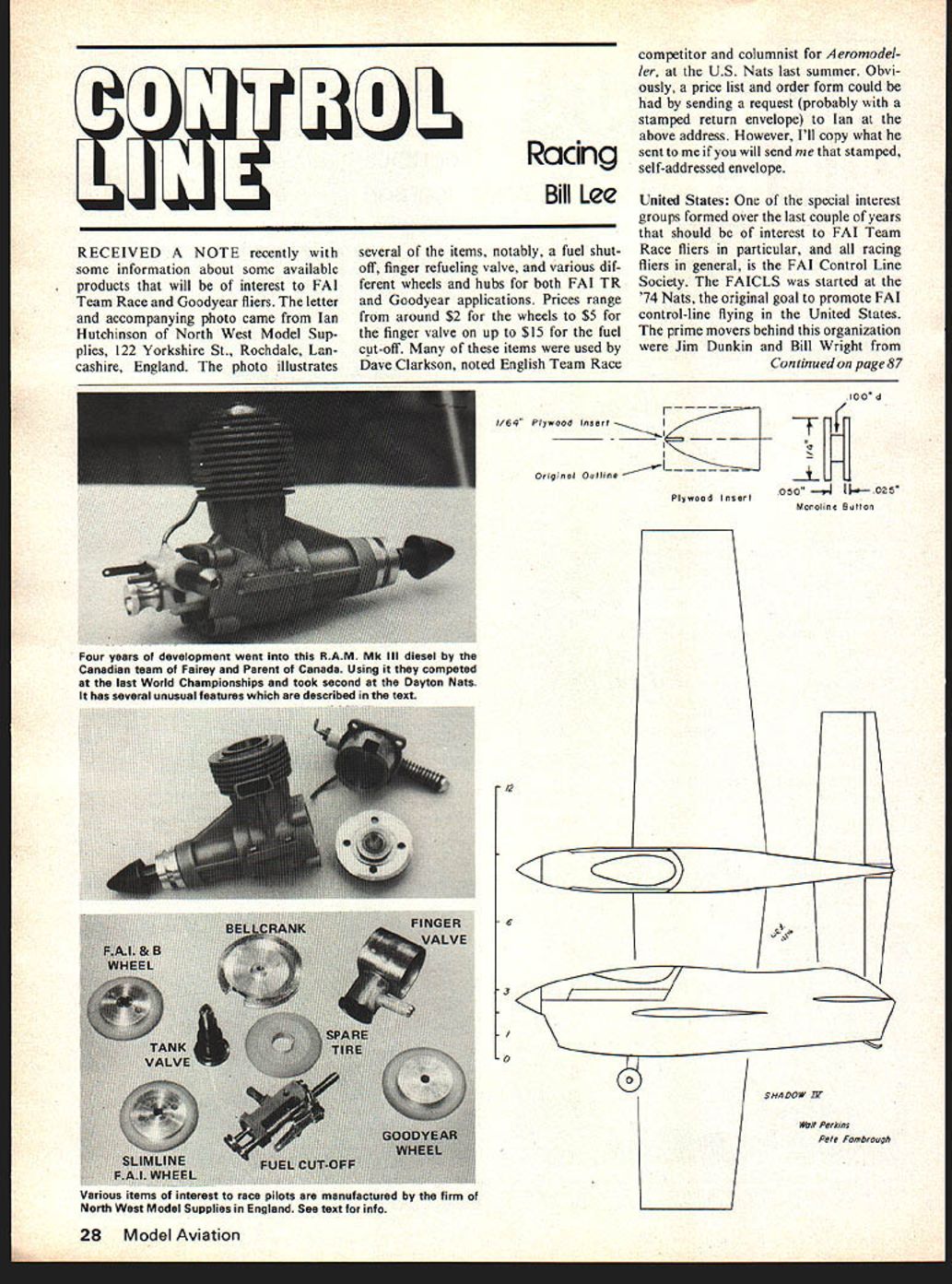
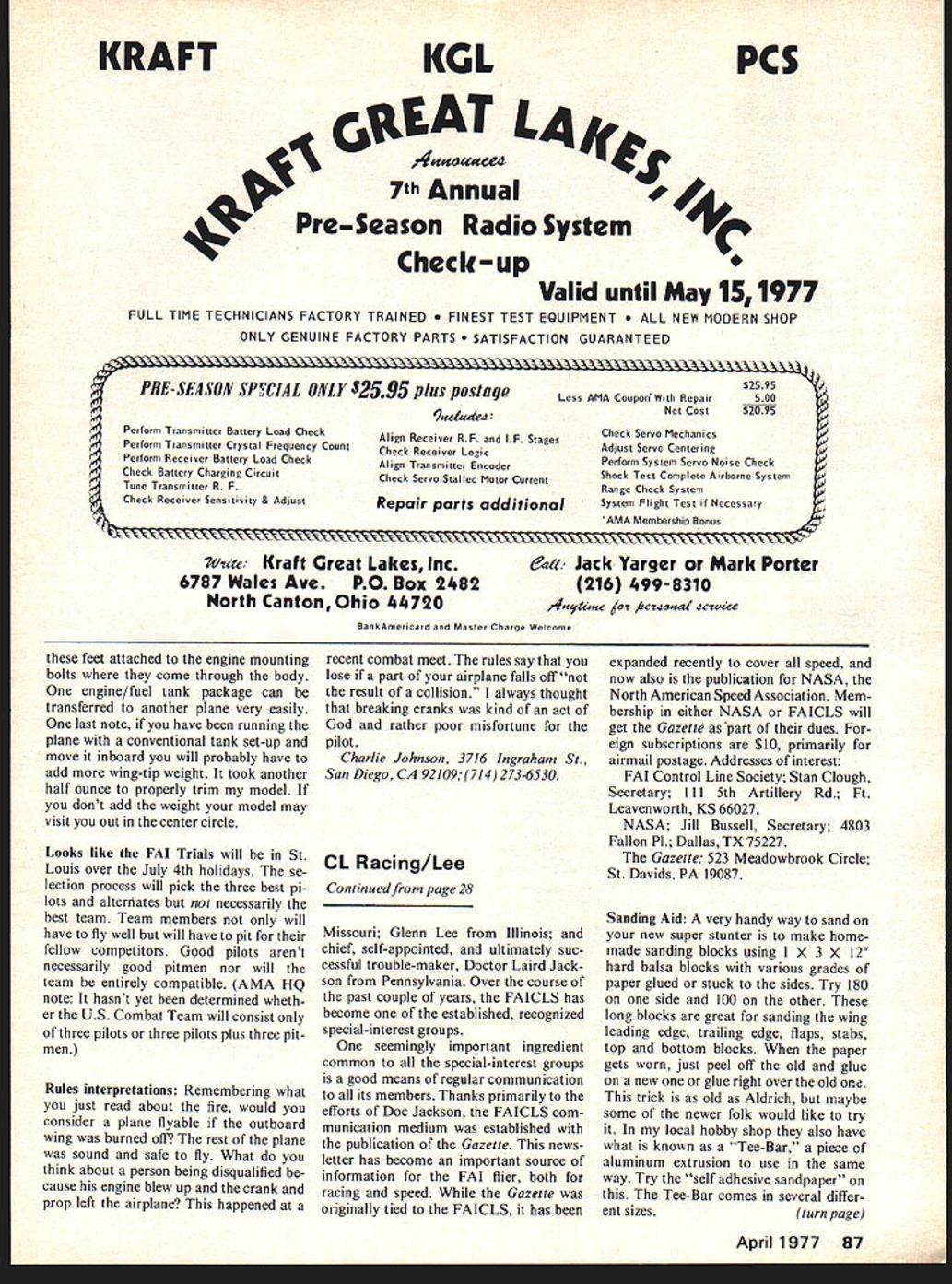
RECEIVED A NOTE recently with some information about some available products that will be of interest to FAI Team Race and Goodyear fliers. The letter and accompanying photo came from Ian Hutchinson of North West Model Supplies, 122 Yorkshire St., Rochdale, Lancashire, England. The photo illustrates several of the items, notably, a fuel shut-off, finger refueling valve, and various different wheels and hubs for both FAI TR and Goodyear applications. Prices range from around $2 for the wheels to $5 for the finger valve and up to $15 for the fuel cut-off. Many of these items were used by Dave Clarkson, noted English Team Race competitor and columnist for Aeromodeller, at the U.S. Nats last summer. Obviously, a price list and order form could be had by sending a request (probably with a stamped return envelope) to Ian at the above address. However, I'll copy what he sent to me if you will send me that stamped, self-addressed envelope.
United States: One of the special interest groups formed over the last couple of years that should be of interest to FAI Team Race fliers in particular, and all racing fliers in general, is the FAI Control Line Society. The FAICLS was started at the '74 Nats; the original goal was to promote FAI control-line flying in the United States. The prime movers behind this organization were Jim Dunkin and Bill Wright from Missouri, Glenn Lee, Illinois, chief self-appointed ultimately successful trouble-maker, and Doctor Laird Jackson, Pennsylvania. Over the course of the past couple years the FAICLS has become established and recognized. A special-interest group's seemingly important ingredient is a good means of regular communication with its members. Thanks primarily to the efforts of Doc Jackson, a FAICLS communication medium has been established — a publication (Gazette) newsletter has become an important source of information to the FAI flier, both racing and speed. The Gazette, originally tied to FAICLS, has expanded recently to cover speed and is now also the publication of NASA (North American Speed Association). Membership in either NASA or FAICLS will get the Gazette as part of the dues. Foreign subscriptions $10, primarily airmail postage. Addresses of interest: FAI Control Line Society
CL Racing/Lee
Missouri; Glenn Lee from Illinois; and chief, self-appointed, and ultimately successful trouble-maker, Doctor Laird Jackson from Pennsylvania. Over the course of the past couple of years, the FAICLS has become one of the established, recognized special-interest groups.
One seemingly important ingredient common to all the special-interest groups is a good means of regular communication to all its members. Thanks primarily to the efforts of Doc Jackson, the FAICLS communication medium was established with the publication of the Gazette. This newsletter has become an important source of information for the FAI flier, both for racing and speed. While the Gazette was originally tied to the FAICLS, it has been expanded recently to cover all speed, and now also is the publication for NASA, the North American Speed Association. Membership in either NASA or FAICLS will get the Gazette as part of their dues. Foreign subscriptions are $10, primarily for airmail postage. Addresses of interest:
FAI Control Line Society: Stan Clough, Secretary; 111 5th Artillery Rd.; Ft. Leavenworth, KS 66027.
NASA: Jill Bussell, Secretary; 4803 Fallon Pl.; Dallas, TX 75227.
The Gazette: 523 Meadowbrook Circle; St. Davids, PA 19087. Missing Persons: In order to clear up some mysteries for the nearly completed "History of stunt — 1940-1976," the writer seeks help in locating two stunt champions from the '40s. Robert "Bob" Daily won the open stunt division in the 1949 Nationals and was one of the first to utilize the "I-beam" wing construction. He originally was from Ferndale, Michigan. W. Howard Thombs won the Walker Cup in 1949 flying, according to George Aldrich, a profile biplane with about 12 degrees of engine offset. Thombs was originally from Warren, Ohio, but later was supposed to be working for an aircraft company in Texas. Any information on the whereabouts of these two stunters would be appreciated.
Canada: We had the good fortune at the Dayton Nats to have several foreign entrants in FAI Team Race. One team was Brian Fairey and Ken Parent of Canada, who attended after representing their country at the world champs in July. One notable aspect of their TR effort is their use of an engine of their own design and construction, the R.A.M. Mk III. The engine was first seen at the world championships and then at the Dayton Nats where they placed second behind the team of Jed Kusik and Larry Jolly of the U.S. This engine is the result of some four years of extensive development effort by the two Canadians. The engine is of conventional design with the exception of three features.
- The two-piece cylinder head consists of a high silicon content, aluminum contra-piston sliding directly in the aluminum cylinder head. The contra-piston is controlled by a differential compression screw that not only drives the contra-piston in when increasing the compression, but withdraws the contra-piston when decreasing the compression. The high heat transfer of the aluminum alloy, combined with the short heat path and well finned head, contributes to a non-critical compression setting.
- The underside of the piston crown is grooved, drilled and tapped for the wrist pin, which is held in place by two 2-56 button head cap screws. This allows bypass windows to be cut higher in the piston wall that would otherwise interfere with the wrist pin in a conventional piston.
- The filler valve body is cast in urethane resin with an integral brass-tube liner and pre-soldered brass pipes. The two-piece filler valve is of hard anodized aluminum alloy and is lapped to fit the brass liner in the valve body. The Cox-style venturi screws into the valve body and also retains the cut-out trip spring.
At the present time there are no plans for commercial production of this engine, although raw castings are available for those with the necessary machining facilities. If anyone is interested in more information, contact Equipe Canada, 242 Bellehaven Dr., Waterloo, Ont. Some of the dimensional particulars:
Type: Single cylinder air cooled Schnuerle loop scavenged two stroke diesel with rear rotary drum valve and twin ball bearings.
Bore: .574" Stroke: .579" Displacement: 2.485 cc. (.1511 cu. in.) Bore/stroke ratio: .9914 Weight: 165 gms.
Hints: It's strange how many little things you do in the course of building a new
Control Line: Racing
model that are not obvious to a newcomer, and which even the experienced modeler forgets about until he is into the construction cycle again. I've been working the past few weeks on the Scoville Stardust that I talked about in my last column and a few of the tricks I use probably would be of interest to others.
One I picked up from the RC boys (at least that was the first place I saw it) is inserting plywood into the edges of a balsa surface. See the drawing for an illustration of this technique. Now why, you ask, would anyone want to inset plywood into the edge of a balsa surface? Well, for a couple of reasons. First, the plywood provides a hard edge to sand to and, since this is a hard edge, you find that the surface is a lot more durable and less prone to damage. Second, a surprising amount of strength is gained from the plywood at a very small weight penalty. I've used this technique on balsa as thin as 3/32 in. that I've used for tail surfaces on my Goodyear, as well as in such places as leading and trailing edges of wings which are thicker. So how do you get all this good stuff put together?
First you must determine where in the edge of the balsa you want the plywood to be. This generally is in the center of the piece but could be offset if an airfoil shape is being carved. Next, you need to cut a slot in the edge of the balsa which has to be about 1/4 in. deep and accurately cut. And this is where the trick comes in. The easiest way to get this slot is to use a small circular saw in a drill press with the saw set at just the right height to cut the slot where you want it. Then you feed the balsa piece through the saw blade very slowly (to keep the cutting under control) and cut the slot. I've found the normal saw that comes with the Dremel Moto-Tool is too thin and tends to flex and wander all over the place when you're trying to cut the slot. However, I've found a similar saw blade that is thicker (.012") and has a larger mandrel which gives a very nice smooth cut that is just the right thickness to insert a piece of 1/64" plywood. It's made by Gyro company and should be available in your local hobby shop. They come in four sizes: 3/64" — $1.70, 1/8" — $1.85, 1/4" — $2.00, and 1/2" — $2.35.
There is also a mandrel required which runs 95c and is different from the Dremel mandrel. If you can't find this product locally, one of my local hobby shops here in Houston does a mail-order business and carries this line of saw blades. Write G and G Model Shop, 2522 Times Blvd., Houston, TX 77005. I use the 3/64" size which, with the 1/4" mandrel, gives the 1/4" deep slot.
Another problem you run into when building a Scale Racer or a Rat is how you make the Monoline buttons necessary for attaching your control lines internally to your model. After having tried every technique I could think of, with a notable lack of success, I stumbled across a method that really works and is quite easy. First, from a short strip of hardwood or hardwood ply cut small button blanks about 3/16" long. Drill or cut a hole for a short piece of music wire and epoxylite the wire into the blank. File the blank to a neat button shape, then cut a shallow slot in the inside surface of the wing or fuselage where the button will be located. Glue the button into the slot with slow-setting adhesive so the wire protrudes through a small hole to take the control line ferrule. This gives a very strong, low-profile anchor which is cheap and easy to make and has proven completely satisfactory in service. your hardware store buy a piece of 1/4"-diameter mild-steel rod. I've seen displays in several different local stores so this rod should be easily available almost anywhere; price should be less than $1.
Next, cut off a couple of inches or so and chuck it up in your 1/4-in. electric drill. Clamp the drill to the workbench so it is held quite steady. Then, in your Moto-Tool, put one of the thin cut-off discs. While the drill is turning the rod, very carefully smooth the end of the rod with the cut-off disc in the Moto-Tool. Now put a second cut-off disc on the mandrel along with the first. This will give you about a .050 in. thick cutter. While the drill is turning the rod make a slot about .025 in. from the end of the rod leaving a center that is about .100 in. in diameter. Now go back to a single cut-off disc and cut the rod off about .025 in. beyond the slot you just made. Bingo! A perfect button to use for those internally connected controls.
You might want to smooth the bottom of the slot with a single disc before you cut the button off the rod, but that is not absolutely necessary. If you have, or have access to, a Unimat-type lathe, simply use the drill chuck and let the lathe take the place of the drill. I have found the use of the cut-off discs and a Moto-Tool to be superior to trying to use a bit on the lathe.
Rules changes: By now you have undoubtedly read all the rules changes that have been proposed, especially those that pertain to the Control-Line Racing events. I'm sure that most of the rules change proposals will meet with universal acceptance, but there are a few that have already drawn some fire. Let me quote a letter from Tim Gillott, one of the best racing competitors we have in the sport.
"In the December '76 issue of MA, the Racing Advisory Committee (RAC) has made several rule change recommendations which they feel are for the betterment of control-line racing. While in agreement with most of them, I find two of them not to that end. The first is CL-78-17 (RAC), a ban on internal line hook-ups on all racing planes, with safety the reason. I disagree, feeling that internal systems are not only as safe as, but safer than external hook-up. I feel that either way is adequate as long as proper care is taken and, furthermore, that those who don't take care of internal hook-ups won't take any better care of external ones either. I feel the following reasons should be considered.
- No leadouts and/or line connectors which often tangle and cause trouble.
- No leadouts to be continually battered during transport and storage. (How many times have you straightened a bent leadout? Probably quite a few!)
- If the internal system is inspected each time you hook it up, but the external is generally buried permanently and can't be inspected.
"In 12 years of racing I have never seen a line break at the point of exit, but I have" seen solid leadouts bent during a rough landing, causing a crash on takeoff, often taking other planes with it. I have also seen line clips/leadouts become tangled with the same results. Neither of these things can happen to a properly installed and cared for internal system. In conclusion I feel there is no valid reason to handicap those of us who have, and do use, the internal system by banning them from racing. After all, FAI TR, which is more safety conscious, allows them.
"The second is CL-78-16(RAC), a ban on all exhaust extensions in racing. While I heartily agree that megaphones and full-length pipes should be outlawed, I feel that minipipes should be allowed as they are easily and cheaply obtained and used by anyone, since there is no 'secret' to them, except cut and try. It would also create havoc for rear exhaust engines in Rat Race, especially as to what constitutes a 'static performance gain'."
Tim's concern for the rules which we all have to live with is an example that all racing fliers should follow. I've said it until I'm blue in the face: If you don't contribute, then you don't have any reason to complain about the results! The current rules cycle is in the cross-proposal stage where any open AMA member may put in cross proposals to any of the original proposals that passed the CLCB's initial vote. Obviously, Tim's concern, at least for proposal 16, deserves a cross proposal. I only hope that he follows through the normal channels that are open to him and all other AMA members. And you do also have the CLCB person in your district to talk to. He is the one who represents you, it is for you to convince him to vote the way you think.
W.R. Lee, 3522 Tamarisk Lane, Missouri City, TX 77459.
Transcribed from original scans by AI. Minor OCR errors may remain.

