
CONTROL LINE RACING
Kenn Smith, 521 Jansen Avenue, San Dimas, CA 91773
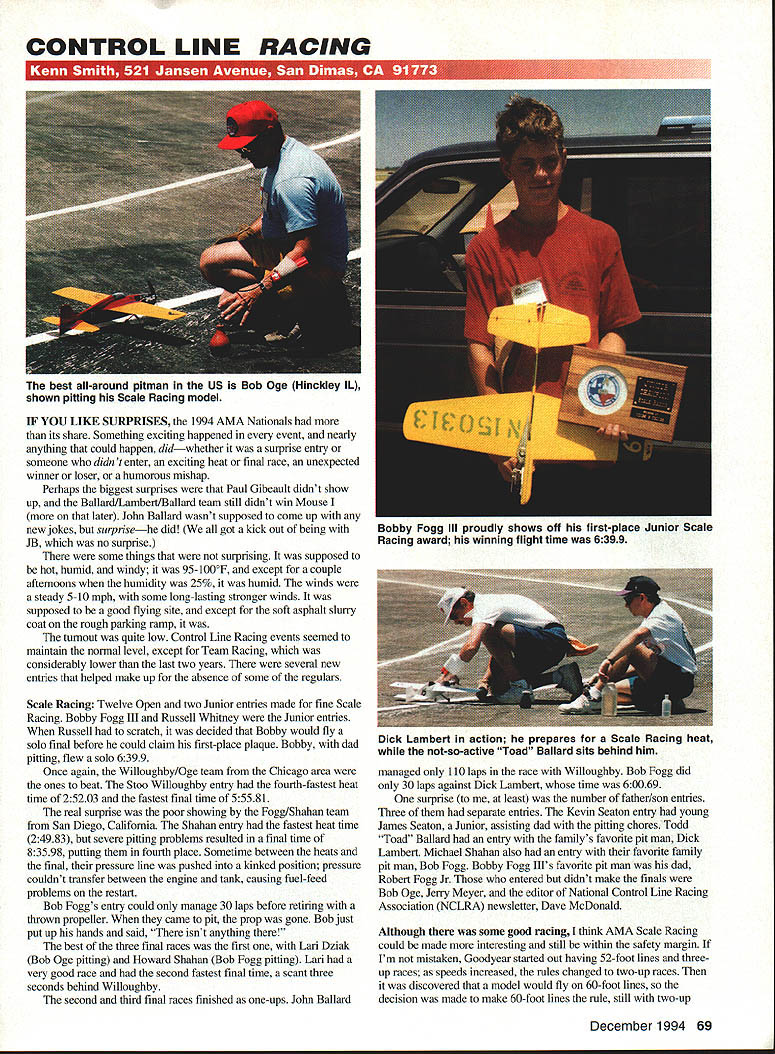
If you like surprises, the 1994 AMA Nationals had more than its share. Something exciting happened in every event, and nearly anything that could happen, did — whether it was a surprise entry or someone who didn't enter, an exciting heat or final race, an unexpected winner or loser, or a humorous mishap.
Perhaps the biggest surprises were that Paul Gibeault didn't show up, and the Ballard/Lambert/Ballard team still didn't win. (More on that later.) John Ballard wasn't supposed to come up with any new jokes, but surprise — he did! We all got a kick out of being with JB, which was no surprise.
Some things were not surprising. It was supposed to be hot, humid, and windy; it was 95–100°F, and except for a couple afternoons when the humidity was 25%, it was humid. The winds were a steady 5–10 mph, with some long-lasting stronger gusts. It was supposed to be a good flying site, and except for the soft asphalt slurry coat on the rough parking ramp, it was.
Turnout was quite low. Control Line Racing events maintained a normal level except for Team Racing, which was considerably lower than the last two years. Several new entries helped make up for the absence of some regulars.
Scale Racing
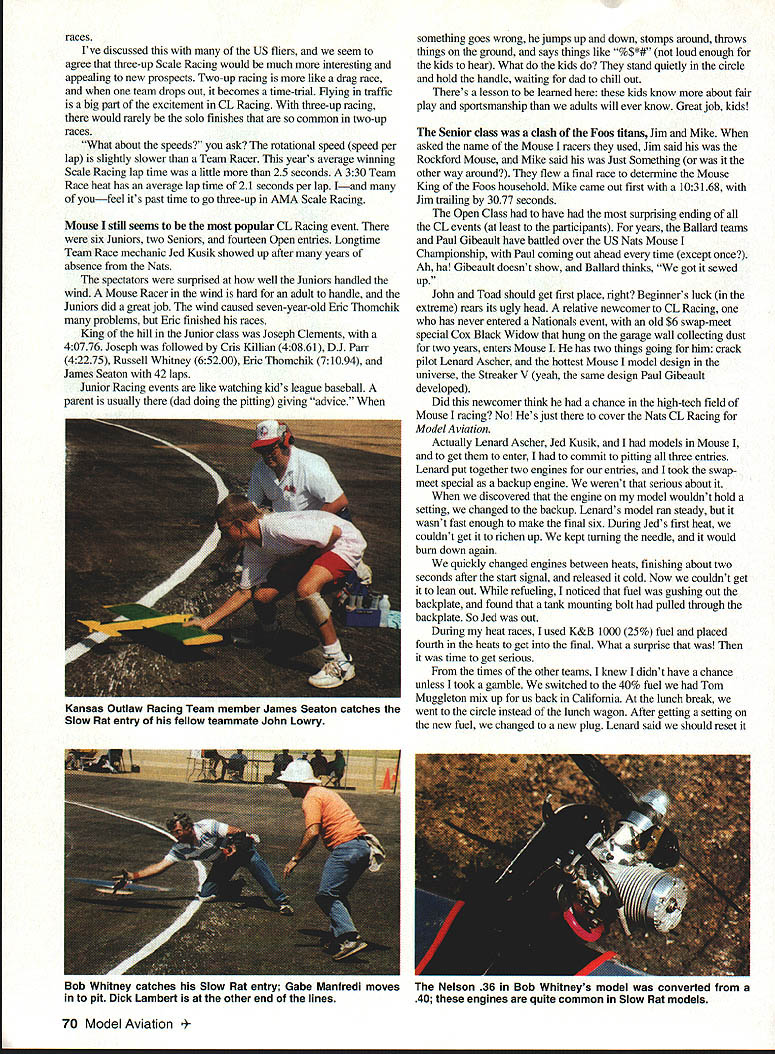
Twelve Open and two Junior entries made for fine Scale Racing. Bobby Fogg III and Russell Whitney were the Junior entries. When Russell had to scratch, it was decided that Bobby would fly a solo final before he could claim his first-place plaque. Bobby, with his dad pitting, flew a solo 6:39.9.
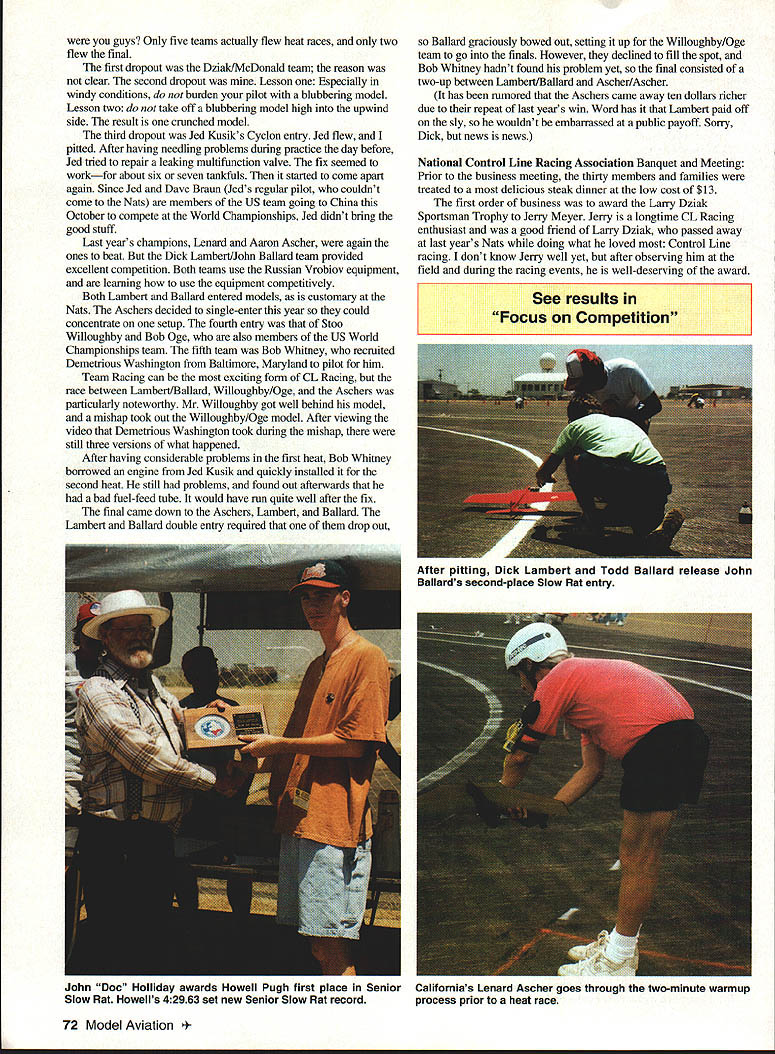
Once again, the Willoughby/Oge team from the Chicago area were the ones to beat. Stoo Willoughby's entry had the fourth-fastest heat time of 2:52.03 and the fastest final time of 5:55.81.
The real surprise was the poor showing by the Fogg/Shahan team from San Diego. The Shahan entry had the fastest heat time (2:49.83), but severe pitting problems resulted in a final time of 8:35.98, putting them in fourth place. Between the heats and the final their pressure line was pushed into a kinked position; pressure couldn't transfer between the engine and tank, causing fuel-feed problems on the restart.
Bob Fogg's entry could only manage 30 laps before retiring with a thrown propeller. When they came to pit there was no prop. Bob just put up his hands and said, "There isn't anything there."
The best of the three final races was the first one, with Lari Dziak (Bob Oge pitting) and Howard Shahan (Bob Fogg pitting). Lari had a very good race and had the second-fastest final time, a scant three seconds behind Willoughby.
The second and third final races finished as one-ups. John Ballard managed only 110 laps in the race with Willoughby. Bob Fogg did only 30 laps against Dick Lambert, whose time was 6:00.69.
One surprise was the number of father/son entries. Three of them had separate entries:
- Kevin Seaton entered with young James Seaton Jr. assisting dad with the pitting chores.
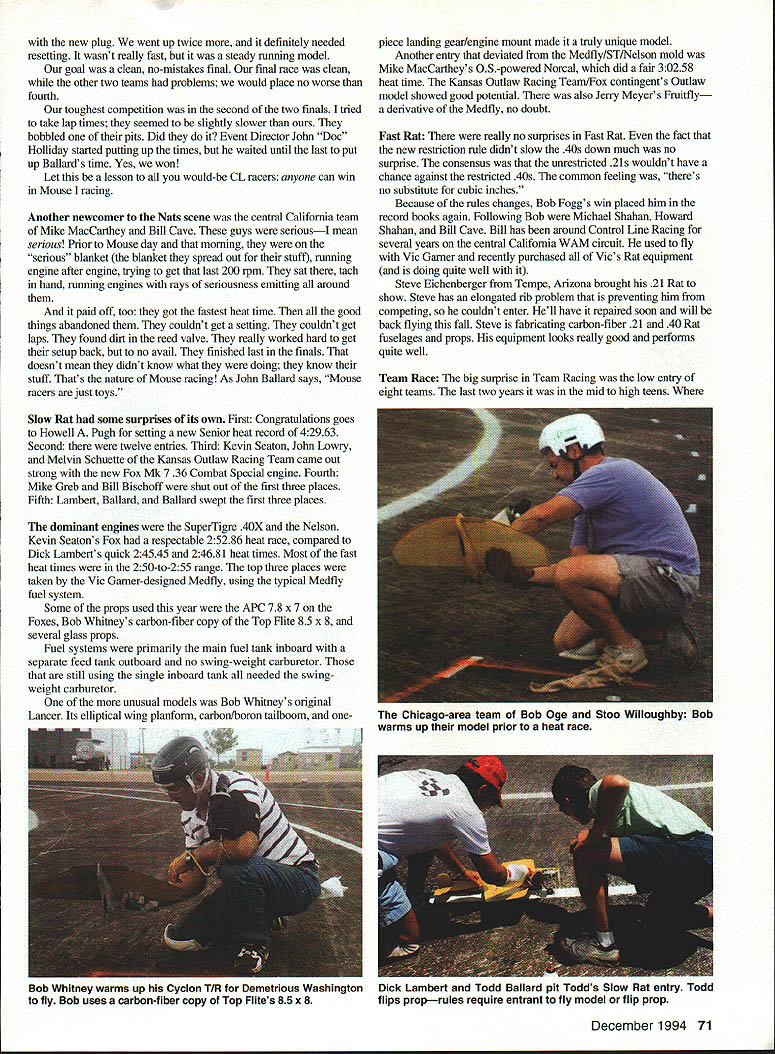
- "Toad" Ballard had an entry with the family's favorite pit man, Dick Lambert.
- Michael Shahan had an entry with their favorite family pit man, Bob Fogg.
- Bobby Fogg III's favorite pit man was his dad, Robert Fogg Jr.
Those who entered but didn't make the finals included Bob Oge, Jerry Meyer, and Dave McDonald of the National Control Line Racing Association (NCLRA) newsletter.
Although there was some good racing, I think AMA Scale Racing could be made more interesting and still be within safety margins. Goodyear started out having 52-foot lines and three-up races. As speeds increased, rules changed to two-up races. Then it was discovered that a model would fly on 60-foot lines, so 60-foot lines became the rule, still with two-up races.
I've discussed this with many US fliers, and we seem to agree that three-up Scale Racing would be much more interesting and appealing to new prospects. Two-up racing is more like a drag race, and when one team drops out, it becomes a time trial. Flying in traffic is a big part of the excitement in CL Racing. With three-up racing, there would rarely be the solo finishes that are so common in two-up races.
What about the speeds? The rotational speed (speed per lap) is slightly slower than a Team Racer. This year's average winning Scale Racing lap time was a little more than 2.5 seconds. A 3:30 Team Race heat has an average lap time of 2.1 seconds per lap. Many of you feel it's past time to go three-up in AMA Scale Racing.
Mouse I
Mouse I still seems to be the most popular CL Racing event. There were six Juniors, two Seniors, and four Open entries. Longtime Team Race mechanic Jed Kusik showed up after many years of absence from the Nats.
Spectators were surprised at how well the Juniors handled the wind. A Mouse Racer in the wind is hard for an adult to handle, and the Juniors did a great job. The wind caused seven-year-old Eric Thomhick many problems, but Eric finished his races.
King of the hill in the Junior class was Joseph Clements, with a 4:07.76. Joseph was followed by Cris Killian (4:08.61), D.J. Parr (4:22.75), Russell Whitney (6:52.00), Eric Thomhick (7:10.94), and James Seaton with 42 laps.
Junior Racing events are like kid's league baseball. A parent is usually there (dad doing the pitting) giving "advice." If something goes wrong, he jumps up and down, stomps around, throws things on the ground, and says things like "%$#!" (not loud enough for the kids to hear). The kids stand quietly in the circle and hold the handle, waiting for dad to fill out the call.
There's a lesson here: these kids know more about fair play and sportsmanship than we adults will ever know. Great job, kids.
The Senior class was a clash of the Foos titans, Jim and Mike. When asked the names of the Mouse I racers they used, Jim said his was the Rockford Mouse, and Mike said his was Just Something (or was it the other way around?). They flew a final race to determine the Mouse King of the Foos household. Mike came out first with a 3:01.68, with Jim trailing by 30.77 seconds.
The Open Class had the most surprising ending of all the CL events (at least to the participants). For years, the Ballard teams and Paul Gibeault have battled over the US Nats Mouse I Championship, with Paul coming out ahead every time. Gibeault doesn't show, and Ballard thought, "We got it sewed up."
John and Toad should get first place, right? Beginner's luck (in the extreme) reared its ugly head. A relative newcomer to CL Racing, one who had never entered a Nationals event, with an old .049 sweep-meet special Cox Black Widow that hung on the garage wall collecting dust for two years, entered Mouse I. He had two things going for him: crack pilot Lenard Ascher, and the hottest Mouse I model design in the universe, the Streaker V (the same design Paul Gibeault developed).
Did this newcomer think he had a chance in the high-tech field of Mouse I Model Aviation? No! He was just there to cover the Nats CL Racing for Model Aviation.
Actually Lenard Ascher, Jed Kusik, and I had models in Mouse I, and to get us to enter, I had to commit to pitting all three entries. Lenard put together two engines for our entries, and I took the swap-meet special as a backup engine. We weren't that serious about it.
When we discovered that the engine on my model wouldn't hold a setting, we changed to the backup. Lenard's model ran steady, but it wasn't fast enough to make the final six. During Jed's first heat we couldn't get his engine to richen up. We kept turning the needle, and it would burn down again.
We quickly changed engines between heats, finishing about two seconds after the start signal, and released it cold. Now we couldn't get it to lean out. While refueling, I noticed that fuel was gushing out the backplate and found that a tank mounting bolt had pulled through the backplate. So Jed was out.
During my heat races, I used K&B 1000 (25%) fuel and placed fourth in the heats to get into the final. What a surprise that was! Then it was time to get serious.
From the times of the other teams, I knew I didn't have a chance unless I took a gamble. We switched to the 40% fuel Tom Muggleton had mixed for us back in California. At the lunch break we went to the circle instead of the lunch wagon. After getting a setting on the new fuel, we changed to a new plug. Lenard said we should reset it and the new plug went up twice; it definitely needed resetting. It wasn't really fast, but a steady-running model was the goal — clean, no-mistakes final. In the final race we were clean; the other two teams' problems would place us no worse than fourth. The toughest competition in the second two finals tried to take lap times, seemed slightly slower, and bobbled pits. Event Director John "Doc" Holliday waited until last and put up Ballard's time. Yes, we won! Let this be a lesson to would-be CL racers: anyone can win Mouse racing.
Another newcomer to the Nats scene was a central California team, Mike MacCarthey and Bill Cave — guys serious, I mean serious. Prior to Mouse day morning they were all business: blankets spread out, running engine after engine trying to get that last 200 rpm; sat with a tach in hand running engines — rays of seriousness emitting around. It paid off too — they got the fastest heat time. But they couldn't get a setting for the final, couldn't get laps, found dirt in the reed valve, worked hard to get the setup back to no avail, and finished last in the finals. That doesn't mean they didn't know what they were doing. They know their stuff. That's Nats.
Slow Rat
Slow Rat had some surprises of its own.
- Congratulations to Howell A. Pugh for setting a new Senior heat record of 4:29.63.
- There were twelve entries.
- Kevin Seaton, John Lowry, and Melvin Schuette of the Kansas Outlaw Racing Team came out strong with the new Fox Mk.7 .36 Combat Special engine.
- Mike Greb and Bill Bischoff were shut out of the first three places.
- Lambert, Ballard, and Ballard swept the first three places.
The dominant engines were the SuperTigre .40X and the Nelson. Kevin Seaton's Fox had a respectable 2:52.86 heat race, compared to Dick Lambert's quick 2:45.45 and 2:46.81 heat times. Most fast heat times were in the 2:50–2:55 range. The top three places were taken by the Vic Garner–designed Medfly, using the typical Medfly fuel system.
Some of the props used this year were the APC 7.8 x 7 on the Foxes, Bob Whitney's carbon-fiber copy of the Top Flite 8.5 x 8, and several glass props.
Fuel systems were primarily the main fuel tank inboard with a separate feed tank outboard and no swing-weight carburetor. Those still using the single inboard tank all needed the swing-weight carburetor.
One unusual model was Bob Whitney's original Lancer. Its elliptical wing planform, carbon/boron tailboom, and one-piece landing gear/engine mount made it truly unique.
Another entry that deviated from the Medfly/ST/Nelson mold was Mike MacCarthey's O.S.-powered Norcal, which did a fair 3:02.58 heat time. The Kansas Outlaw Racing Team/Fox contingent's Outlaw model showed good potential. There was also Jerry Meyer's Fruitfly — a derivative of the Medfly, no doubt.
Fast Rat
There were really no surprises in Fast Rat. Even the fact that the new restriction rule didn't slow the .40s down much was no surprise. The consensus was that the unrestricted .21s wouldn't have a chance against the restricted .40s. The common feeling was, "there's no substitute for cubic inches."
Because of the rules changes, Bob Fogg's win placed him in the record books again. Following Bob were Michael Shahan, Howard Shahan, and Bill Cave. Bill has been around Control Line Racing for several years on the central California WAM circuit. He used to fly with Vic Garner and recently purchased all of Vic's Rat equipment (and is doing quite well with it).
Steve Eichenberger from Tempe, Arizona brought his .21 Rat to show. Steve has an elongated rib problem that is preventing him from competing, so he couldn't enter. He'll have it repaired soon and will be back flying this fall. Steve is fabricating carbon-fiber .21 and .40 Rat fuselages and props. His equipment looks really good and performs quite well.
Team Race
The big surprise in Team Racing was the low entry of eight teams. The last two years it was in the mid to high teens. Where were you guys? Only five teams actually flew heat races, and only two flew the final.
The first dropout was the Dziak/McDonald team; the reason was not clear. The second dropout was mine. Lesson one: especially in windy conditions, do not burden your pilot with a blubbering model. Lesson two: do not take off a blubbering model high into the upwind side. The result is one crunched model.
The third dropout was Jed Kusik's Cyclon entry. Jed flew and I pitted. After having needling problems during practice the day before, Jed tried to repair a leaking multifunction valve. The fix seemed to work — for about six or seven tankfuls. Then it started to come apart again. Since Jed and Dave Braun (Jed's regular pilot, who couldn't come to the Nats) are members of the US team going to China this October to compete at the World Championships, Jed didn't bring the good stuff.
Last year's champions, Lenard and Aaron Ascher, were again the ones to beat. But the Dick Lambert/John Ballard team provided excellent competition. Both teams use the Russian Vobrov equipment and are learning how to use it competitively.
Both Lambert and Ballard entered models, as is customary at the Nats. The Aschers decided to single-enter this year so they could concentrate on one setup. The fourth entry was Stoo Willoughby and Bob Oge, who are also members of the US World Championships team. The fifth team was Bob Whitney, who recruited Demetrios Washington from Baltimore to pilot for him.
Team Racing can be the most exciting form of CL Racing, and the race between Lambert/Ballard, Willoughby/Oge, and the Aschers was particularly noteworthy. Mr. Willoughby got well behind his model, and a mishap took out the Willoughby/Oge model. After viewing the video that Demetrios Washington took during the mishap, there were still three versions of what happened.
After considerable problems in the first heat, Bob Whitney borrowed an engine from Jed Kusik and quickly installed it for the second heat. He still had problems and found out afterward that he had a bad fuel-feed tube. It would have run quite well after the fix.
The final came down to the Aschers, Lambert, and Ballard. The Lambert/Ballard double entry required that one of them drop out, so Ballard graciously bowed out, setting it up for the Willoughby/Oge team to go into the finals. However, they declined to fill the spot, and Bob Whitney hadn't found his problem yet, so the final consisted of a two-up between Lambert/Ballard and Ascher/Ascher.
It has been rumored that the Aschers came away dollars richer due to their repeat of last year's win. Word has it that Lambert paid off on the sly, so he wouldn't be embarrassed at a public payoff.
National Control Line Racing Association Banquet and Meeting
Prior to the business meeting, the thirty members and families were treated to a most delicious steak dinner at the low cost of $13.
The first order of business was to award the Larry Dziak Sportsman Trophy to Jerry Meyer. Jerry is a longtime CL Racing enthusiast and was a good friend of Larry Dziak, who passed away at last year's Nats while doing what he loved most: Control Line racing. After observing Jerry at the field and during the racing events, he is well-deserving of the award.
Voting results:
- The proposal for current officers continuing for another year passed.
- The proposal for two-year officer terms passed.
- The proposal to limit officers to two terms did not pass.
- The proposal for the NCLRA to host Mouse II at next year's Nats passed.
Rules proposals that would make Mouse I a Jr./Sr. event only and make Mouse II a full AMA event for Jr./Sr./Open were discussed. Also discussed was a practical way of helping the AMA provide practice circles at the Nats.
The importance of national unification of rules for supplementary events (i.e., Texas Quickie Rat, Foberg, Classic Goodyear, etc.) that would be included in a national points-standing compilation was discussed. The purpose of unifying regional event rules is to bring US CL Racing enthusiasts together.
The National Control Line Racing Association needs your support
We are sixty-plus strong after only a year in business — a great start. Our officers are truly interested in seeing the CL Racing community grow and prosper; they are interested in your comments and ideas and welcome positive suggestions. Be critical if you must, but give positive suggestions.
Join the NCLRA by sending $10 to Dave McDonald, P.O. Box 384, Daleville IN 47334. The newsletter is bimonthly.
Epilogue
There were some new faces this year, such as Mike MacCarthey, Bill Cave, myself, and the long-absent old face of Jed Kusik. There were also many missing faces. What a great time it would be if we could get everyone together just once each year. Lenard and I are looking forward to defending our Mouse I title next year — won't you try to take it away from us?
A special thanks goes to John "Doc" Holliday and his crew for the excellent job they did in directing the Control Line events.
Transcribed from original scans by AI. Minor OCR errors may remain.

