
CONTROL LINE RACING
Kenn Smith, 521 Jansen Avenue, San Dimas, CA 91773
World Championships
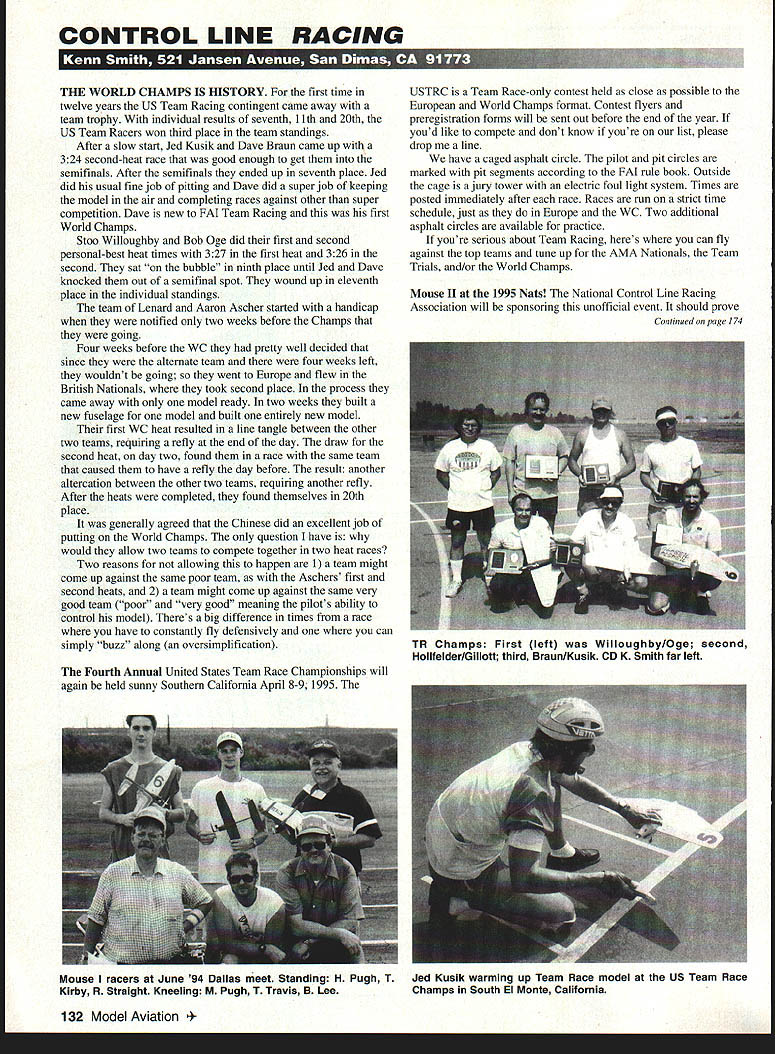
The World Champs is history. For the first time in twelve years the U.S. Team Racing contingent came away with a team trophy. With individual results of seventh, 11th and 20th, the U.S. team won third place in the team standings.
After a slow start, Jed Kusik and Dave Braun posted a 3:24 second-heat race that was good enough to get them into the semifinals. After the semifinals they finished in seventh place. Jed did his usual fine job of pitting and Dave did a superb job of keeping the model in the air and completing races against top competition. This was Dave’s first World Champs and his first time on the FAI Team Racing squad.
Stoo Willoughby and Bob Oge recorded personal-best heat times of 3:27 in the first heat and 3:26 in the second. They sat “on the bubble” in ninth place until Jed and Dave’s performance knocked them out of a semifinal spot. They wound up 11th in the individual standings.
Lenard and Aaron Ascher started with a handicap: they were notified only two weeks before the Champs that they were going. Four weeks earlier they had decided, as the alternate team, that they wouldn’t go; they had gone to Europe and flown in the British Nationals, where they took second place. As a result they brought only one model ready. In two weeks they built a new fuselage for one model and built one entirely new model.
Their first WC heat resulted in a line tangle between the other two teams, requiring a refly at the end of the day. The draw for the second heat, on day two, put them in a race with the same team that caused the refly the day before, producing another altercation and another refly. After the heats were completed they found themselves in 20th place.
It was generally agreed that the Chinese did an excellent job of hosting the World Champs. One question remains: why allow the same two teams to compete together in two heat races? Two reasons not to allow this are:
- A team might repeatedly meet the same poor team (as with the Aschers’ first and second heats).
- A team might repeatedly meet the same very good team. There's a big difference between races that require constant defensive flying and those where you can “buzz” along—this affects times significantly.
Fourth Annual United States Team Race Championships (USTRC)
The Fourth Annual United States Team Race Championships will be held in Southern California, April 8–9, 1995. The USTRC is a Team Race–only contest run as close as possible to the European and World Champs format. Contest flyers and preregistration forms will be sent out before the end of the year. If you'd like to compete and don't know if you're on our list, please drop me a line.
Facilities and format:
- Caged asphalt circle.
- Pilot and pit circles marked with pit segments according to the FAI rule book.
- Jury tower outside the cage with an electric foul light system.
- Times posted immediately after each race.
- Races run on a strict time schedule, as at the European World Champs.
- Two additional asphalt circles available for practice.
If you're serious about Team Racing, this is where you can fly against top teams and tune up for the AMA Nationals, the Team Trials, and/or the World Champs.
The NCLRA will be sponsoring an unofficial Mouse II event at the 1995 Nats. It should prove to be a hotly contested series of races.
Engines and competitive equipment
Several engines could be competitive. A few teams can still make a Cox Tee Dee go fast enough to beat the older Shurikens. Newer engines to watch include:
- Combat Stels (hot little units)
- VA Russian engines (very fast)
- Chinese CS engine (should be competitive)
- Fox Mk 7 (worth evaluating)
This range of engines should have a positive effect on turnout for events.
Five-Day Racing Calendar at the Nats?
One item discussed at the NCLRA annual meeting was the possibility of having one event each day at the Nats—requiring five days to complete racing events. This idea arose because Fast Rat and Team Racing were scheduled on the same day.
At first glance it seems appealing: more time to prepare and practice. But this is a national event; competitors should be ready before arriving. The biggest complaint from control line racers is that the Nationals are not run professionally: schedules start late, events move slowly, and heat races are delayed for individual problems. When you attend the country's top competition you should be prepared. If the countdown starts and you blow a plug, tough—you change it and go off late. Competitors should know their equipment and anticipate problems.
An alternative proposal: compress the five events into three competition days, plus two days for practice. Suggested schedule:
- Day -2 and Day -1: practice for all events.
- Day 1: first heats for all events.
- Day 2: second heats for all events.
- Day 3: semifinals and finals for all events, followed by the annual meeting and an awards banquet.
Benefits:
- Plenty of practice time before heats.
- Each night provides time to repair or adjust for the next day’s races.
- Better chance to make the finals after recovering from crashes or mechanical problems.
- Aligns with how the World Champs and European events are run (they attract more competitors per event).
- Frees competitors to enter events in other control line categories.
To do this requires starting each day earlier, having set race times, and abandoning the current lackadaisical approach. I think it’s worth it.
Call for contributions
Where's the support you promised? In the last year I've received only three tidbits of information from the control line community. I wouldn’t feel so bad if you were sending material to Dave McDonald and the NCLRA—but he isn't getting much either.
Am I doing that bad a job that you don't feel it's worth sending material? Come on, guys. Each of you has things to contribute. Don’t take any idea or technique for granted. Please send:
- Contest results
- New methods and ideas
- Photos of new models and action shots
- Field-box ideas and lists of tools you take to the pit area
- Reports on new props, wheels, engines, tanks, fuel shutoffs, landing gear struts, air-intake systems, etc.
- Evaluations of new engines on the market (e.g., Fox Mk 7) and how they performed
I’m not going to beg every two months. If you want a good, informative column you have to provide the material. I can only compile what is presented and put it into a useful format.
Transcribed from original scans by AI. Minor OCR errors may remain.

