
CONTROL LINE RACING
Kenn Smith, 521 Jansen Avenue, San Dimas CA 91773
PROPELLER BALANCING IS ONE of the most beneficial preparatory tasks you can perform. And it's very simple: you just stick the prop on the metal shaft, set it on the razor blades, and wait for the heavy end to go to the bottom. Right? Wrong!
To do a correct job of preparing your props for action, you need two pieces of special equipment (a prop pitch gauge and a good prop balancer) and a few small hand tools (prop reamer, files, sandpaper, and a small piece of plate glass).
In the next two columns we are going to discuss what it takes to properly prepare racing propellers for competition.
Prop Pitch Gauges
There are two pitch gauges that are excellent for preparing racing props. The first is the Prather Prop Pitch Gauge, available through your local hobby shop. The second is designed specifically for racing props, and is made by Walt Perkins of Shadow Racing, Inc., 4416 Southwest 4 Place, Ocala FL 32671.
Prop Balancers
There are also two balancers worth mentioning:
- Du-Bro's Tru-Spin Prop Balancer is a very good wheel-type balancer. It has adjustable sides that make it suitable for balancing spinners as well as props.
- The most accurate balancer on the market today is Top Flite's new Power Point Precision Magnetic Balancer. It is considerably more costly, but worth every penny.
Balance of a rotating object comes in two forms: static and dynamic.
Static balancing is what we are doing when we mount the prop on a shaft and suspend the shaft between our fingers, on parallel razor blades, or between two pairs of large wheels (let the heavy blade fall to the bottom, then start taking material off the heavy blade until the prop will stay where you put it).
Dynamic balancing is what is done to your car tires. The wheel/tire combination is spun, and the exact out-of-balance spot is determined electronically. Unless someone has developed a special tool for their own use, we do not dynamically balance props or spinners.
Static balancing, for our purposes, is a practical way to balance props. However, dynamic balancing would discover out-of-balance situations that we are unable to see when we static-balance. Most of these "situations" can be minimized by carefully measuring and adjusting differences between prop blades, such as thickness, shape, and pitch at various stages along the blade.
The first step is to clean up the prop. Depending upon the condition of the supplied product, cleaning will be an easy five-minute job or may take 30–60 minutes. Some props are supplied nearly ready to use, with only a small mold part-line to clean up; others have 1/4 inch of carbon fiber or fiberglass flashing to remove before you can even get to the final shape of the blades and hub.
Next time we'll get into cleaning and shaping props — the first steps to proper balancing.
Don't Change a Good Thing!
Got a call from John McCollum after the Nats issue came out. He had some good comments to make concerning the possibility of changing Mouse I to a Junior-only event. This possibility was discussed at the '94 annual meeting of the NCLRA. His point: why change the event with the largest entry level? "If it ain't broke, don't fix it."
Initially I thought it was a good idea to make Mouse I Junior-only. Control Line Racing needs a beginner event. But making Mouse I a Junior event doesn't take into account the fact that not all beginners are Juniors. John has a good argument, and I have to side with him on this one.
Over the years, Mouse I has maintained the highest entry level in local and national contests. Everyone has a Mouse I. It's a frustrating event, and because of that, it is the one event where anyone can win — the '94 Nats proved that.
Rule change proposals are pretty skimpy this cycle (a good sign). There are only four that affect Control Line Racing. None of these proposals will cause changes in existing models.
Rule Change Proposals
- Proposal CL 96-5, proposed by Stoo Willoughby, would make it possible to set records at the FAI F2C Team Trials. At present the only place we can have a chance at a record is at the Nats. FAI Team Trials are run on a more strict format than the Nats. With the competition at Team Trials (World Champs representatives selected), records set there deserve recognition.
- Proposal CL 96-6, proposed by Stoo Willoughby, would redefine the tolerance between watches for establishment of racing records. Currently two watches within 2/10 second are required; CL 96-6 would change this to 5/10 second. The FAI Sporting Code requires a 5/10 second tolerance. Since I am an advocate of standardizing rules where possible, and since the Sporting Code governing establishment of world records should be good enough for national records, this seems reasonable.
- Proposal CL 96-7, proposed by Fred Reese, would establish Control Line Scale Racing Class II as a supplemental event format, plain-bearing engines exposed. This format (plain-bearing engines, exposed controls — similar to the original Scale Racing rules) seems to be increasing in popularity across the country. However, I have a problem with this proposal. There are pockets of racers in various areas (Northwest Scale Racing in Washington and Oregon; one-ounce Goodyear in the East; and a couple of others in the Midwest and southeastern US) who fly the same basic event with slightly different rules (where have I heard that before?). I feel that a more concerted effort should have been made to put together a unified set of rules before including them in our AMA rulebook. This is just the thing our National Control Line Racing Association should be charged with.
A few of the specifics that I'm not comfortable with are: "engines that are readily available through normal retail outlets" precludes discontinued engines no longer available from your hobby shop that are still plentiful on the used "swap meet" market. "'The original muffler ... will be required' makes me cringe. When talking in racing terms, liner diameter is specified, but not the length; muffler pressure is allowed, but not crankcase (why one and not the other?); fuel shutoffs are not allowed (every racing event should require shutoffs, except Mouse I); 'Only ... fiber-filled nylon propellers are allowed.' Carbon-fiber, Kevlar, wood and fiberglass props not allowed (why eliminate wood?)."
The biggest problem I have is in limiting the lap times to 3.5 seconds. I think the general idea is a good one, and I'm sure Fred's intent is well-meant. But this proposal is like ramming a local group's set of rules down the nation's throat — a sure way for the event to fail.
- Proposal CL 96-8, from D. O. Perkins, clarifies the general rules to allow the use of inboard engine mounts.
If any of you would like a copy of any or all of the proposals, please send a business-size SASE.
Notes and Contacts
Got a note from George Aldrich, who is probably one of the least-known engine builders in Control Line Racing. You should get to know George and what he has to offer. I was remiss in not including GMA in my December listing of equipment and service sources. (Yes, I thought he only did Stunt engines, too.) I found out that he has been doing free flight and control line Speed engines for years. He has also done some spectacular work on Irvine .15s for racing. His shop is superbly equipped, and is capable of doing everything from chrome and fitting to new pistons/liners. Contact George at GMA, 12822 Tarrytown, San Antonio TX 78233-4628; Tel.: (210) 656-2021.
ZZ/Prop: Mike Hazel, 1073 Windemere Dr. NW, Salem OR 97304 has a new list of composite props for all the Control Line Racing events. You can get them in glass or carbon-fiber. Call Mike at (503) 364-8593.
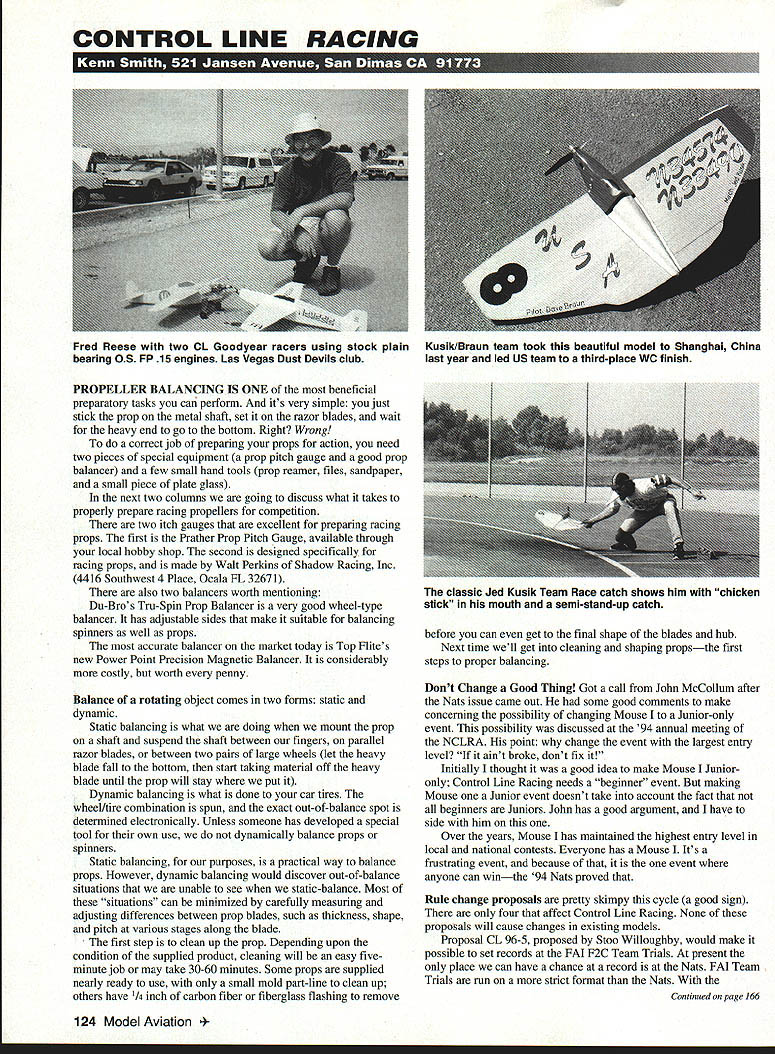
Fred Reese is a member of the new Dust Devils Model Aviation Club of Las Vegas, Nevada. They started about a year ago with nine members and are up to 26. They promote Control Line Racing in the Las Vegas area, flying Mouse I, a simple .15 Goodyear event, and they are starting a new Sport Moki .15 Goodyear event. The simple Goodyear event is based on the rules change proposal they submitted for an AMA supplemental event. The Sport Moki event is more open, allowing hot gloves, fast-fills and shutoffs. They plan to run a Thompson Trophy Dash for plain-bearing .15s, using Thompson racers from the .30s. They plan to fly four up for 25 laps with an engine-running start. Sounds to me like a bunch of guys are having fun with CL Racing in Las Vegas!
Are you "into" CL Racing? As a beginner? Just fly the local fun racing events? Or are you in it a big way? It doesn't matter! We need your support in the National Control Line Racing Association. Yearly dues are only $10, and you get a bimonthly newsletter. Send your name, address, phone number, and AMA number to NCLRA, 8 S. Grace St., N. Aurora IL 60542.
I need your support to let me know how I'm doing. Send me your comments, how-tos, helpful hints, pictures, etc. to the address at the head of this column. Thanks.
Transcribed from original scans by AI. Minor OCR errors may remain.

