
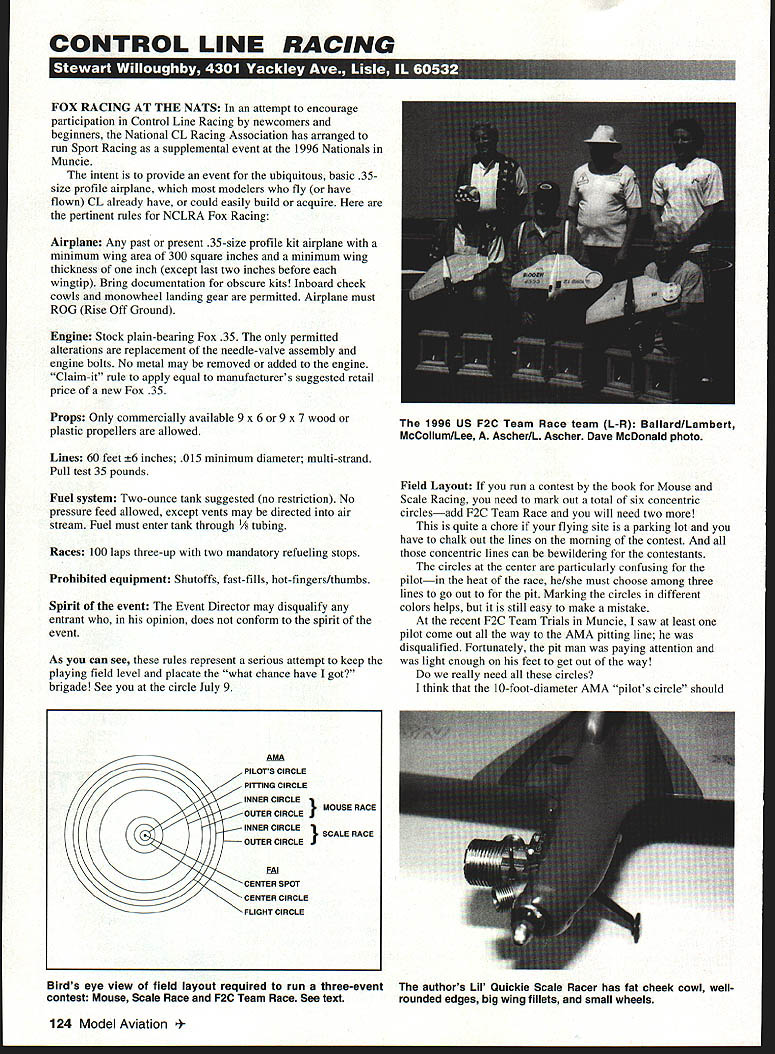
CONTROL LINE RACING
Stewart Willoughby 4301 Yackley Ave., Lisle, IL 60532
FOX RACING AT THE NATS
In an attempt to encourage participation in Control Line Racing by newcomers and beginners, the National CL Racing Association (NCLRA) has arranged to run Sport Racing as a supplemental event at the 1996 Nationals in Muncie.
The intent is to provide an event for the ubiquitous, basic .35-size profile airplane, which most modelers who fly (or have flown) CL already have, or could easily build or acquire. Here are the pertinent rules for NCLRA Fox Racing:
- Airplane: Any past or present .35-size profile kit airplane with a minimum wing area of 300 square inches and a minimum wing thickness of one inch (except the last two inches before each wingtip). Bring documentation for obscure kits. Inboard cheek cowls and monowheel landing gear are permitted. Airplane must ROG (rise off ground).
- Engine: Stock plain-bearing Fox .35. The only permitted alterations are replacement of the needle-valve assembly and engine bolts. No metal may be removed or added to the engine. "Claim-it" rule to apply equal to manufacturer's suggested retail price of a new Fox .35.
- Props: Only commercially available 9x6 or 9x7 wood or plastic propellers are allowed.
- Lines: 60 feet ± 6 inches; .015" minimum diameter; multi-strand. Pull test 35 pounds.
- Fuel system: Two-ounce tank suggested (no restriction). No pressure feed allowed, except vents may be directed into the airstream. Fuel must enter tank through 1/8" tubing.
- Races: 100 laps, three-up, with two mandatory refueling stops.
- Prohibited equipment: Shutoffs, fast-fills, hot-fingers/thumbs.
- Spirit of the event: The Event Director may disqualify any entrant who, in his opinion, does not conform to the spirit of the event.
As you can see, these rules represent a serious attempt to keep the playing field level and placate the "what chance have I got?" brigade! See you at the circle July 9.
FIELD LAYOUT
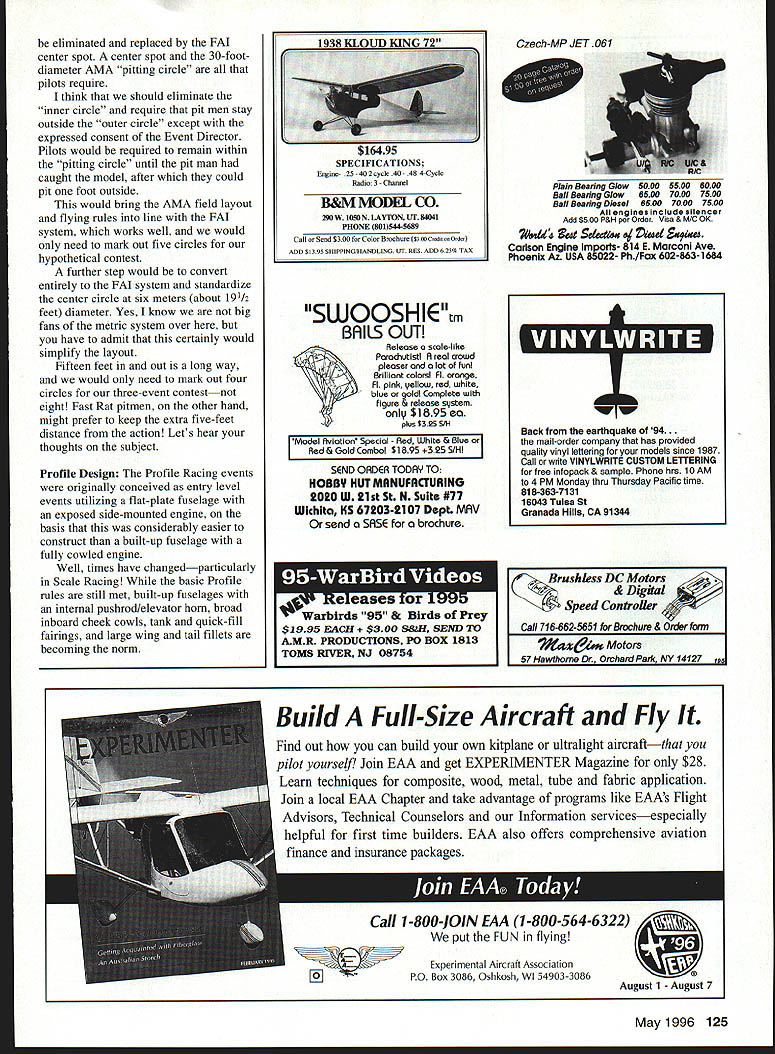
If you run a contest by the book for Mouse and Scale Racing, you need to mark out a total of six concentric circles—add F2C Team Race and you will need two more!
This is quite a chore if your flying site is a parking lot and you have to chalk out the lines on the morning of the contest. All those concentric lines can be bewildering for the contestants. The circles at the center are particularly confusing for the pilot—in the heat of the race, he or she must choose among three lines to go out to for the pit. Marking the circles in different colors helps, but it is still easy to make a mistake.
At the recent F2C Team Trials in Muncie, I saw at least one pilot come out all the way to the AMA pitting line; he was disqualified. Fortunately, the pit man was paying attention and was light enough on his feet to get out of the way!
Do we really need all these circles? I think that the 10-foot-diameter AMA "pilot's circle" should be eliminated and replaced by the FAI center spot. A center spot and the 30-foot-diameter AMA "pitting circle" are all that pilots require.
I think that we should eliminate the "inner circle" and require that pit men stay outside the "outer circle" except with the expressed consent of the Event Director. Pilots would be required to remain within the "pitting circle" until the pit man had caught the model, after which they could pit one foot outside.
This would bring the AMA field layout and flying rules into line with the FAI system, which works well, and we would only need to mark out five circles for our hypothetical contest.
A further step would be to convert entirely to the FAI system and standardize the center circle at six meters (about 19.5 feet) diameter. Yes, I know we are not big fans of the metric system over here, but you have to admit that this certainly would simplify the layout.
Fifteen feet in and out is a long way, and we would only need to mark out four circles for our three-event contest—not eight! Fast Rat pitmen, on the other hand, might prefer to keep the extra five feet' distance from the action. Let's hear your thoughts on the subject.
PROFILE DESIGN
The Profile Racing events were originally conceived as an entry-level event utilizing a flat-plate fuselage with an exposed side-mounted engine, on the basis that this was considerably easier to construct than a built-up fuselage with a fully cowled engine.
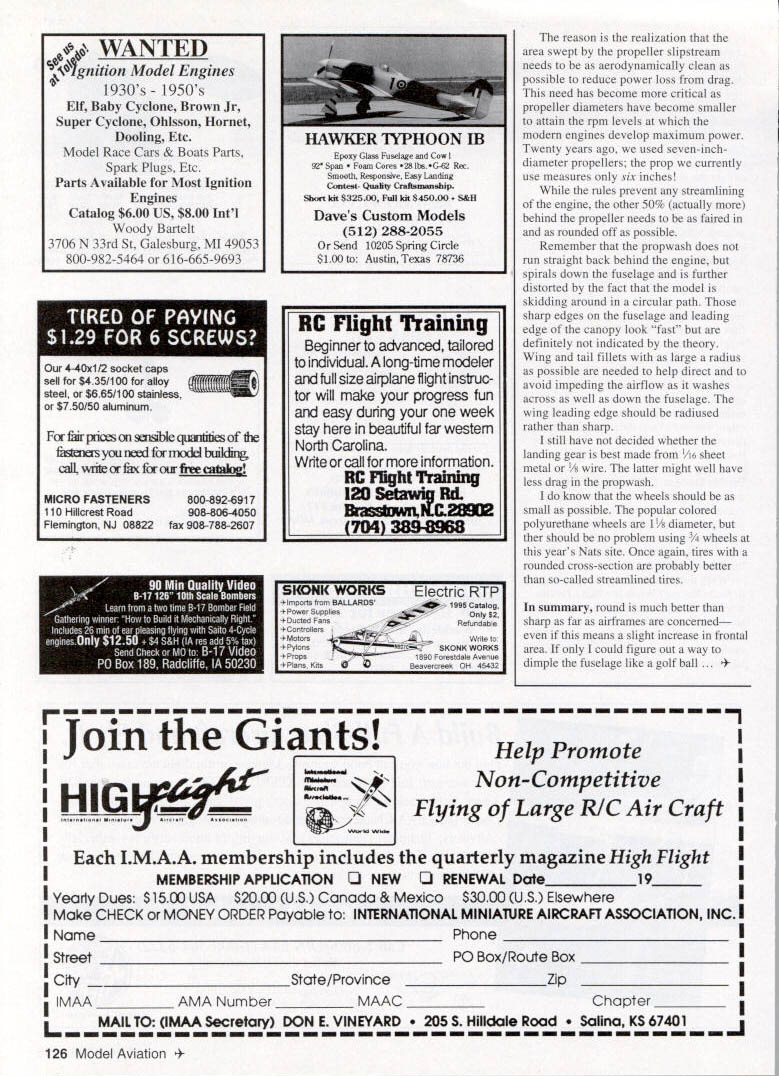
Well, times have changed—particularly in Scale Racing. While the basic Profile rules are still met, built-up fuselages with an internal pushrod/elevator horn, broad inboard cheek cowls, tank and quick-fill fairings, and large wing and tail fillets are becoming the norm.
The reason is the realization that the area swept by the propeller slipstream needs to be as aerodynamically clean as possible to reduce power loss from drag. This need has become more critical as propeller diameters have become smaller to attain the RPM levels at which modern engines develop maximum power. Twenty years ago we used seven-inch-diameter propellers; the prop we currently use measures only six inches!
While the rules prevent any streamlining of the engine, the other 50% (actually more) behind the propeller needs to be as faired in and as rounded off as possible.
Remember that the propwash does not run straight back behind the engine, but spirals down the fuselage and is further distorted by the fact that the model is skidding around in a circular path. Those sharp edges on the fuselage and leading edge of the canopy look "fast" but are definitely not indicated by the theory. Wing and tail fillets with as large a radius as possible are needed to help direct and avoid impeding the airflow as it washes across as well as down the fuselage. The wing leading edge should be radiused rather than sharp.
I still have not decided whether the landing gear is best made from 1/16-inch sheet metal or 1/8-inch wire. The latter might well have less drag in the propwash.
I do know that the wheels should be as small as possible. The popular colored polyurethane wheels are 1-1/8 inches in diameter, but there should be no problem using 3/4-inch wheels at this year's Nats site. Once again, tires with a rounded cross-section are probably better than so-called streamlined tires.
In summary, round is much better than sharp as far as airframes are concerned—even if this means a slight increase in frontal area. If only I could figure out a way to dimple the fuselage like a golf ball...
Transcribed from original scans by AI. Minor OCR errors may remain.

