
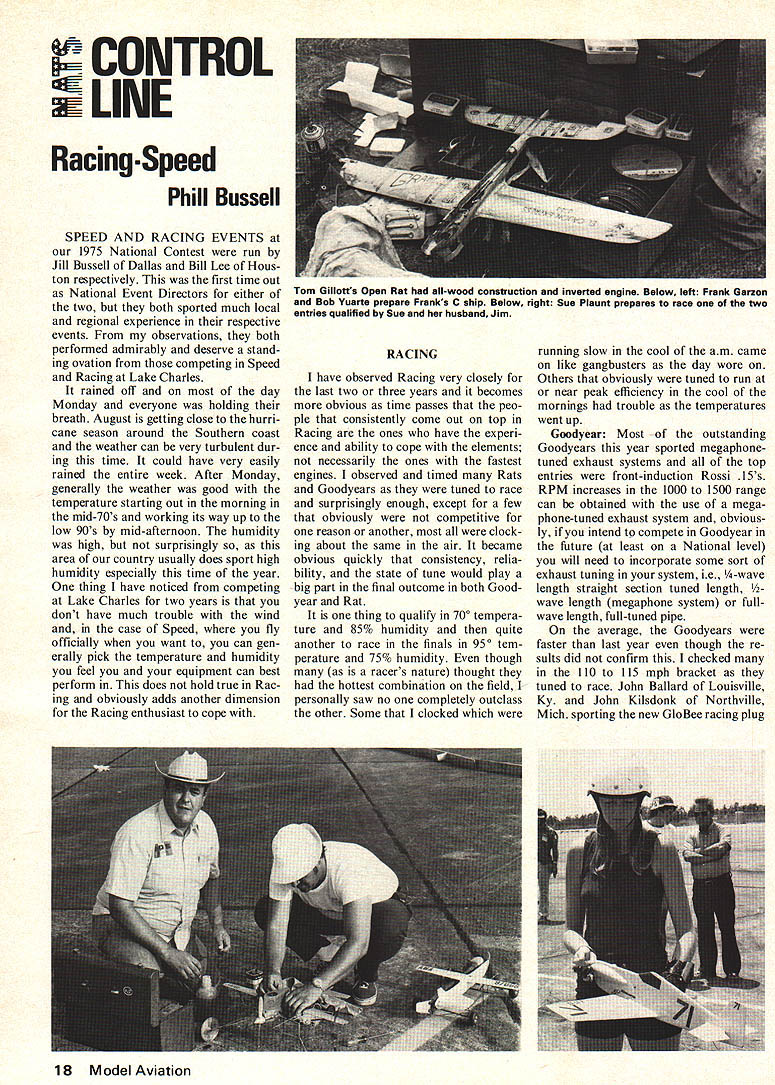
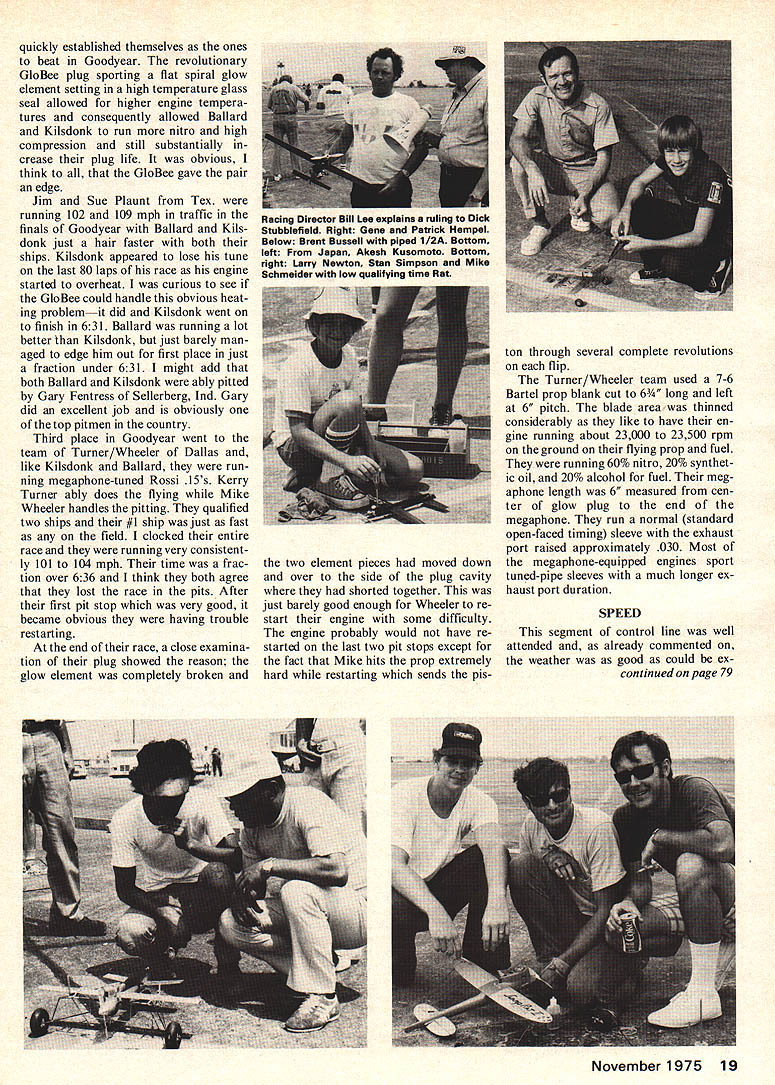
CONTROL LINE: Racing-Speed
Phill Bussell
SPEED AND RACING EVENTS at our 1975 National Contest were run by Jill Bussell of Dallas and Bill Lee of Houston respectively. This was the first time out as National Event Directors for either of the two, but they both sported much local and regional experience in their respective events. From my observations, they both performed admirably and deserve a standing ovation from those competing in Speed and Racing at Lake Charles.
It rained off and on most of the day Monday and everyone was holding their breath. August is getting close to the hurricane season around the Southern coast and the weather can be very turbulent during this time. It could have very easily rained the entire week. After Monday, generally the weather was good with the temperature starting out in the morning in the mid-70's and working its way up to the low 90's by mid-afternoon. The humidity was high, but not surprisingly so, as this area of our country usually does sport high humidity, especially this time of the year. One thing I have noticed from competing at Lake Charles for two years is that you don't have much trouble with the wind and, in the case of Speed, where you fly officially when you want to, you can generally pick the temperature and humidity you feel you and your equipment can best perform in. This does not hold true in Racing and obviously adds another dimension for the Racing enthusiast to cope with.
RACING
I have observed Racing very closely for the last two or three years and it becomes more obvious as time passes that the people that consistently come out on top in Racing are the ones who have the experience and ability to cope with the elements; not necessarily the ones with the fastest engines. I observed and timed many Rats and Goodyears as they were tuned to race and surprisingly enough, except for a few that obviously were not competitive for one reason or another, most all were clocking about the same in the air. It became obvious quickly that consistency, reliability, and the state of tune would play a big part in the final outcome in both Goodyear and Rat.
It is one thing to qualify in 70° temperature and 85% humidity and then quite another to race in the finals in 95° temperature and 75% humidity. Even though many (as is a racer's nature) thought they had the hottest combination on the field, I personally saw no one completely outclass the other. Some that I clocked which were running slow in the cool of the a.m. came on like gangbusters as the day wore on. Others that obviously were tuned to run at or near peak efficiency in the cool of the mornings had trouble as the temperatures went up.
Goodyear: Most of the outstanding Goodyears this year sported megaphone-tuned exhaust systems and all of the top entries were front-induction Rossi .15's. RPM increases in the 1000 to 1500 range can be obtained with the use of a megaphone-tuned exhaust system and, obviously, if you intend to compete in Goodyear in the future (at least on a National level) you will need to incorporate some sort of exhaust tuning in your system, i.e., 1/4-wave length straight section tuned length, 1/4-wave length (megaphone system) or full-wave length, full-tuned pipe.
On the average, the Goodyears were faster than last year even though the results did not confirm this. I checked many in the 110 to 115 mph bracket as they tuned to race. John Ballard of Louisville, Ky., and John Kilsdonk of Northville, Mich., sporting the new GloBee racing plug.
The revolutionary GloBee plug, sporting a flat spiral glow element set in a high temperature glass seal, allowed higher engine temperatures and consequently allowed Ballard and Kilsdonk to run high nitro and high compression and still substantially increase plug life. Obviously I think the GloBee gave the pair an edge. Jim and Sue Plaunt of Texas quickly established themselves as ones to beat in Goodyear, running in the 102–109 mph range in traffic finals. Ballard and Kilsdonk were just a hair faster; Kilsdonk appeared to lose tune in the last 80 laps of the race when the engine started to overheat. It will be curious to see if the GloBee could handle the obvious heating problem. Kilsdonk went to the finish in .631; Ballard was running a lot better and Kilsdonk just barely managed to edge him out for first place by a fraction under .631. I might add both Ballard and Kilsdonk were ably pitted by Gary Fentress of Sellersburg, Ind. Gary did an excellent job and is obviously one of the top pitmen in the country.
Third place Goodyear went to the team Turner/Wheeler of Dallas. Like Kilsdonk and Ballard, they were running megaphone-tuned Rossi .15s. Kerry Turner ably does the flying and Mike Wheeler handles the pitting. They qualified two ships; the #1 ship was just the fastest on the field, clocking the entire race and running very consistently 101–104 mph with a time fraction over .636. I think both agree they lost the race in the pits. After the first pit stop, which was very good, it became obvious they were having trouble restarting at the end. Close examination of the plug showed the reason — the glow element was completely broken into two pieces which had moved down over the side of the plug cavity shorting ... the two element pieces had moved down and over to the side of the plug cavity where they had shorted together. This was just barely good enough for Wheeler to restart the engine with some difficulty. The engine probably would not have restarted on the last two pit stops except for the fact that Mike hits the prop extremely hard while restarting which sends the piston through several complete revolutions on each flip.
The Turner/Wheeler team used a 7-6 Bartel prop blank cut to 6 3/4" long and left at 6° pitch. The blade area was thinned considerably as they like to have their engine running about 23,000 to 23,500 rpm on the ground on their flying prop and fuel. They were running 60% nitro, 20% synthetic oil, and 20% alcohol for fuel. Their megaphone length was 6" measured from center of glow plug to the end of the megaphone. They run a normal (standard open-faced timing) sleeve with the exhaust port raised approximately .030. Most of the megaphone-equipped engines sport tuned-pipe sleeves with a much longer exhaust port duration.
SPEED
This segment of control line was well attended and, as already commented on, the weather was as good as could be expected. Except for Tuesday when a front accompanied by wind and rain passed through about 4:00 p.m. Speed was shut down for about 30 minutes, but was reopened in time for most contestants to get in their final flights in 1/2A Profile Proto and 1/2A Proto Speed. Being from Tex., we saw the front coming long before it hit and had our pit area completely cleared up and our gear stored before the wind hit. It was a good thing as the wind was quite violent and with as much equipment as we had on the field, we could never have recovered it all.
Since a complete breakdown of National results are contained elsewhere in Model Aviation, I will try to hold my repetitions to a bare minimum.
Junior Speed: Junior interest in Speed is definitely up and it showed at the Nationals. There were three events won by Juniors at over National Record Speeds and actually four Junior Records bested.
Brent Bussell of Dallas broke his own 1/2A Profile Proto Record in winning the event in the excellent time of 92.37 mph. Brent, the Junior member of "The Poohawk Racing Team" of Dallas, Tex., did not attempt to back his new record and therefore, the record remains at 91.94 mph. Second place went to Crosley of Cleveland, Ohio as he turned 86.46 mph and Barry Pate of Brookville, N.Y. took third place with an 85.40 mph speed. Half-A Profile is a very popular and one of the most hotly contested Junior events. Hopefully, further restrictions will be placed on the event this winter by the CL/C & B and the event will once again be attractive to the beginners.
Half-A Proto and 1/2A Speed were won by 8-year-old Quay Barber, Jr. of Ohio. Quay and his 7-year-old brother, David, were the two youngest Speed Flyers competing at Lake Charles. I have watched the young Barbers with more than just a passing interest for the last three years which would mean that Quay has been competing since he was five years old. The entire family has become involved in Speed and, both from a competitive and social standpoint, they are truly an inspiration to watch and are completely self-sufficient. Quay and David are ably "assisted" by their father, Quay, Sr., who also competes on a limited basis in the Open age group. Mrs. Barber can always be found somewhere close by and the entire family, including the family dog, travels to and from the contests in their self-contained camper. The Barber family is a good example of what can be accomplished in Speed with effort and patience. Obviously, Speed is a family affair with them.
Junior B Speed was hotly contested when Tommy Giertz of Houston broke the Junior B Record only to have the current Junior B Record holder, Mark Seigler also of Houston, come back and best Tommy's record later in the day. This is the kind of competition that keeps the young gents coming back. Both Tommy and Mark were flying "Poohawk Powered DJS .29's." Tommy's fastest flight was 180.65 mph and Mark's was 181.56 mph—not bad for Juniors! Both Tommy and Mark will be seniors in competition in 1976.
B Proto was won by Patrick Hempel of Garland, Tex. Junior C Speed was won by Mark Seigler when he set a new National Record of 167.69 mph while using a Super Tigre X40 with a mini-pipe. Mark was clocked on the test circle at 178+ mph, so he should be formidable competition in Class C, as well as B, when he moves to the Senior age group next year.
Patrick Hempel broke his own Junior Jet Record when he recorded a speed of 177.97 mph. Brent Bussell rounded out the Junior events when he won A Speed in the time of 121 (148.70 mph). Brent, who currently holds the Junior A Record at 157.97 mph, was using a Super Tigre X-15 with a 6-1/2 Rev-Up prop and a GloBee racing plug. His fuel was 75% nitro, 5% propylene oxide, and 20% ProLube.
Becky Yarger won AA Speed with a speed of 117.98 mph. Becky—quite a little charmer from Fresno, Calif.—is a credit to the fairer sex, especially as a Speed competitor and a monoplane pilot.
Senior Speed: Competition in Senior Speed seemed to be off both in numbers and performances from past years. Only one National Speed Record was broken, but some of the speeds turned by Seniors were very impressive and, in one event which combined all flyers, Mike Langlois, who is a Senior, took first place by almost 8 mph.
Half-A Proto was also won by Mike Langlois with a 94.80 mph flight with Brian Pardue claiming second place with a speed of 82.24 mph. Both of these young men live in Greensboro, N.C., and consistently turn up great performances. Glen Vannatt, Dale Elder and Greg Simson took the next three places in this event. In 1/2A Speed, the same two young men from N.C. took the first two places.
Only two official speeds were recorded in Senior C Speed. Glen Vansant's 156.60 mph and Mike Bussell's 148.21 mph were a little slow considering the speeds turned by the Junior flyers. Mike does, however, hold the Senior C record at well over 165 mph and did turn in the 160's while on the test circle only to come back and lose his test official flights due to tank failure.
Jet Speed, which combined all flyers, had 15 entries and was won by Senior Mike Langlois flying his own "Super Burp" with a 198.16 mph flight which is only about 2 mph below his own Jet Record. Mike's speed was almost 8 mph better than the second place speed which was turned by an Open flyer. Another Senior, Dennis McGraw of Memphis, Tenn., recorded a 163.27 mph flight — but this was not good enough to place in the event. Second and Third Place in Jet went to Charlie and Geneva Davis from Hallsville, Tex. who turned 190.40 mph and 187.62 mph respectively. This is really a family affair and sometimes Charlie is not too sure he wants to beat Geneva at the Nats because there are 364 other days in the year!
Senior B Speed was won by Mike Bussell, Senior member of "The Powahawk Racing Team", who bettered his own national record by over 5 mph with a time of 184.35 mph. Mike Langlois took second and Max Snyder of Fresno, Calif., took third. A speed of 146.11 mph was turned by Max Snyder to take first place in B Proto; he also took first place in FAI with a speed of 122.04 mph.
The Haus/Murphy team from Calif. claimed First Place in A Speed with a time of 136.21 mph.
Open Speed: Competition on the Open level was, as usual, fast and furious. Half-A Speed was a typical example with first place going to the team of Bussell/Jett with a near record speed of 116.99 mph. Warren Ruhl took second with 113.73 mph and Al Stegans with 112.31 mph placed third. The Bussell/Jett team was using a home-built 3-port cylinder and tuned exhaust system on a Cox T.D. lower end. Both Kurth and Stegans were running production Cox T.D. parts and no exhaust tuning.
Half-A Proto was won by Al Stegans of Cleveland, Ohio followed by the Kirn/Newton team from the Los Angeles area and Warren Kurth placed third.
A Speed was won by Glenn Lee when his Super Tigre X-15 powered ship turned 168.31 mph which is less than 2 mph off the Open A record. This event was a real tug of war as the teams of Finn/McDonald of Arlington, Tex. (who finished second with 167.69 mph) and Kirn/Newton of Calif. (who finished third with 165.99) tried throughout the day to catch Mr. Lee. The Bussell/Jett team stayed on the test circle the entire day and just as it seemed we might mount a threat, we were beset by minor problems. The truth is, we never did record an official flight. I think Glenn Lee was as happy over the fact that he won A Speed with a Super Tigre X-15 as he was with winning. He kept referring to the fact that his speed was turned with a $25 engine and a $4 hop-up. Evidently, he had to replace one of the shaft bearings in his engine or some other relatively minor part. At any rate, the X-15 won first in both Junior and Open A Speed.
Open C Speed was dominated by the Arlie Fridley/Richard Shannon team using their own VHP .65 engine which is a rear exhaust tuned pipe mill featuring an aluminum piston and Dykes ring. They turned 196.21 mph to barely edge out Richard's Dad — Doc Shannon who turned 195.79 mph also using a VHP .65. The Finn/McDonald team took Third with a speed of 189 mph.
Open B and B Proto were won by the Bussell/Jett team. Open members of "The Powahawk Racing Team" from Dallas. We turned 192.85 mph in B and 162.90 mph in B Proto using our own "Powahawk Powered DJS .29s". In B, we were using a Top-Flite 7-10% prop and 75% nitro, 5% propylene and 20% Poolube for fuel. We were using the GloBee racing plug and a Rossi .29 pipe stretched to 14" from the center of the plug to the end of the pipe and surgical tubing for our tank. Our B Proto was set up the same except we used a 7-10 Top Flite prop. The GloBee plug gives us more leeway on the needle settings and stays with us longer and we feel we had more consistency in our effort as a result.
Formula 40 Speed drew 32 entries which was very much up from 1974 and it does indeed seem to be catching on. The event was won by Bob Brogdon using the new K&B .40 and reportedly the engine was bolted right off a Formula I Pylon Racer and bolted right to Bob's Formula 40 Speed Ship to record a 150.51 mph speed. Second Place went to the Turner/Wheeler team using a Super Tigre X-40 and a new design mid-range tuned pipe scaled down from a Yamaha motorcycle expansion chamber. I had to look all the way to fourth place before I could find a Speed flyer listed. This is rather embarrassing and hopefully some of the Speed flyers participating in this event will take it more seriously in 1976 — less the Pylon flyers get the big head.
Open FAI Speed drew 13 entries with first place going to Akesh Kusumoto of Tokyo, Japan in the time of 134.43 mph.
Transcribed from original scans by AI. Minor OCR errors may remain.

