
Control Line: Scale
Electric Control Line flight
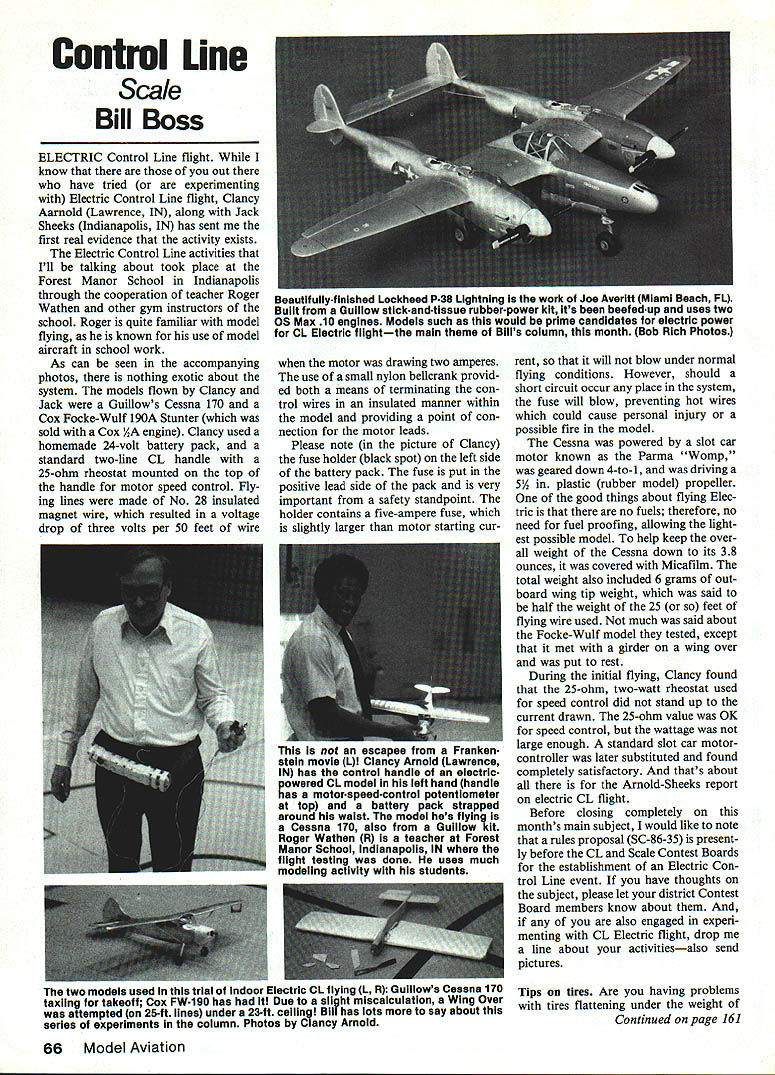
Electric control-line flight is being experimented with by modelers. Clancy Arnold (Lawrence, IN) and Jack Sheeks (Indianapolis, IN) documented activity at Forest Manor School, Indianapolis, with cooperation from teacher Roger Wathen and other gym instructors. Roger is experienced with model flying and the use of model aircraft in school work.
As shown in accompanying photos, the system and models were simple. The models flown were a Guillow's Cessna 170 and a Cox Focke-Wulf 190A Stunter (the latter was sold with a Cox 1/4A engine). Equipment and setup included:
- Homemade 24-volt battery pack.
- Standard two-line control-line handle with a 25-ohm rheostat mounted on top for motor speed control (later replaced).
- Flying lines made of No. 28 insulated magnet wire; measured voltage drop about 3 volts per 50 feet at a motor draw of 2 amperes.
- Small nylon bellcrank to provide insulated termination for control wires inside the model and a connection point for the motor leads.
- Fuse holder mounted on the left side of the battery pack containing a five-ampere fuse placed in the positive lead; protects against shorts and potential fires.
The Cessna was powered by a slot-car motor (Parma "Womp"), geared down 4:1 and driving a 5½-inch plastic (rubber-model) propeller. One advantage of electric power is no fuels and therefore no fuel-proofing, allowing very light construction. The Cessna was covered with Micafilm and weighed 3.8 ounces total; it also carried 6 grams of outboard wing-tip weight (said to be about half the weight of the roughly 25 feet of flying wire used). The Focke-Wulf received heavy damage when it struck a gym girder during a wing-over.
During initial flights, the 25-ohm, two-watt rheostat proved underspecified for the current drawn—the resistance value worked for speed control but the wattage rating was insufficient. A standard slot-car motor controller was later substituted and found to be completely satisfactory.
A rules proposal (SC-86-35) is presently before the CL and Scale Contest Boards to establish an Electric Control Line event. If you have opinions, contact your district Contest Board members. If you are experimenting with CL electric flight, send correspondence and photos to share your activities.
Tips on tires
If your scale model tires are flattening under weight, try this tip from Wing Tips (newsletter of the Wingbusters MAC, Hanson, MA): with Robart (or similar) tires, buy the next smaller tire and install it (without its rim) inside the tire to be mounted on the model. The resulting double-thickness tire should reduce flat-spotting.
U.S. FAI Scale team selection (1986)
The U.S. FAI Scale team selection program for the 1986 R/C and CL Scale World Championships has begun. AMA President John Grimes appointed John Guenther, president of the National Association of Scale Aeromodellers (NASA), as Chairman of the FAI Team Selection Committee. The committee should include a member from each AMA district; to date districts 1, 3, 5, 8, and 10 have not named members. Full district representation is needed to help choose a flying site, judges, support personnel, and event dates.
The last selection program was held in Louisville, KY, run by NASA with cooperation from the Kentucky Department of State Parks and the Southern Indiana R/C Modelers, Inc. NASA seeks committee members from the unrepresented districts and any individuals or organizations willing to assist. If interested, contact your AMA district VP or NASA President John Guenther. If you plan to participate as a competitor, notify NASA so they can estimate entries and inform you of program details (date, place, fees, etc.) when finalized.
Send correspondence to: John Guenther Box 715, RR #1 Borden, IN 47106
Support scale modeling by joining NASA. Dues are $6.00 yearly; send payment to John Guenther at the above address.
Mustang lovers
Charles Neely (Visalia, CA) offers detailed material on North American Mustang models. He has three-quarter-inch-to-the-foot drawings (four sheets, 24 x 36 inches) of the P-51B/C models and will have drawings of the D and later K versions soon. The set costs $15.00 and includes notes explaining differences based on production location and aircraft development.
To order, send $15.00 and a self-addressed stamped envelope to: Charles Neely 1918 W. Noble Ave. Visalia, CA 93277
Transcribed from original scans by AI. Minor OCR errors may remain.

