
Control Line: Scale
Bill Boss
WRAMS Show
Each year, in late February, the Westchester Radio Aeromodellers, Inc. holds its annual hobby-industry radio control show at the County Center, White Plains, NY. In addition to manufacturers' and suppliers' booths, the show includes a swap shop and a static contest featuring RC airplanes and boats of all types.
While the show is aimed at the RC modeler, many of my Control Line friends and I make it a point to attend to see what is being offered and what can be used in our control line models. It is also a good opportunity for the modeler—especially newer modelers—to collect brochures and catalogs as he visits each concessionaire's booth. These catalogs can serve as a product reference library during the ensuing year for model and hardware selection.
I didn't find any new model designs worth mentioning, but I did see a few items that may interest control line scale builders.
Major Decals
Major Decals (21 Fisher Ave., E. Longmeadow, MA 01028) has an excellent assortment of hard-to-find insignias, lettering, mission and kill markings. They offer water-transfer decals in sizes suitable for most .40- and .60-size models. They also produce decals of propeller insignias/markings such as those seen on Hamilton and Pratt & Whitney propellers.
Radio Controlled Models, Inc.
At the Radio Controlled Models, Inc. booth (4736 N. Milwaukee Ave., Chicago, IL 60630) I saw a series of vacuum-formed plastic pilots ideal for most .60-size scale models common among control liners today. There are five pilot types available:
- Old Timer
- WWII Army
- WWII Navy
- WWII German
- Jet
The pilots come in two pieces that are easily joined and can be painted with standard plastic model paints. A big plus is that when completed and installed they add only a little more than an ounce of weight to the model.
Fiberglass Master
Fiberglass Master (Rt. 1, Box 530, Goodview, VA 24095) now lists more than one hundred fiberglass cowls in their brochure, many of which fit .40- and .60-size models used for Sport Scale events. If you are not already aware of these items, consider writing to these manufacturers for catalogs and price lists.
Scale documentation source
My January 1985 column on lozenge-pattern fabric was well received; I received several complimentary letters. One came from Leonard E. Opdycke, editor of W.W.I. AERO, The Journal of the Early Aeroplane, who enclosed a copy of the journal containing considerable information on pattern fabric and its coloring.
W.W.I. AERO is published by World War I Aeroplanes, Inc., a service organization devoted to gathering and publishing information on aircraft of 1900–1919. The journal contains technical drawings and data, photographs, scale-modeling material, historical research, news of WWI air shows, and much more of interest to restorers, builders, museums, historians, and modelers. It also includes ads and listings of many aviation publications useful to model builders.
- A sample issue of W.W.I. AERO can be obtained for $4. Send payment to:
World War I Aeroplane, Inc. 15 Crescent Road Poughkeepsie, NY 12601, U.S.A.
- A one-year membership in World War I Aeroplanes, Inc. (which includes five issues of the journal) is available for a contribution of $16 or more (tax-deductible in the U.S.A.). For full details and a membership form, write to the address above.
Brakes
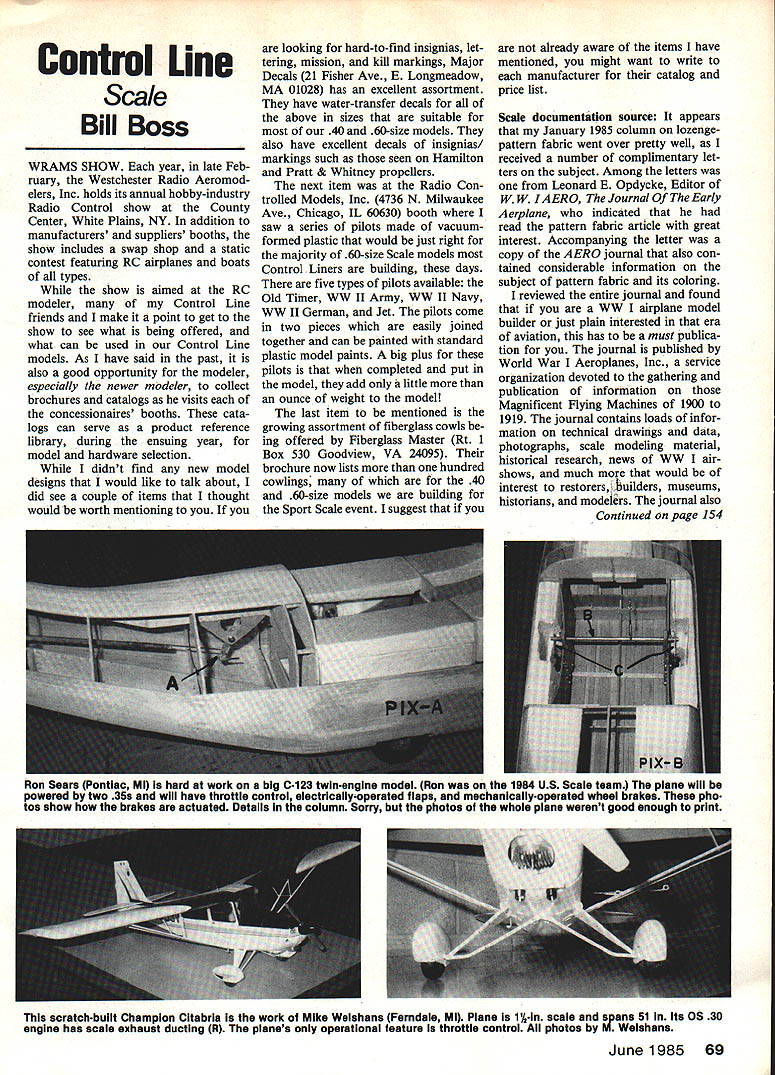
The accompanying photos in the original article show Ron Sears' latest project, a C-123 with an 85 in. wingspan, powered by two McCoy .35 engines, and featuring electric flap operation, throttle control, and brakes. If you're thinking about brakes for your model, you might get ideas from Ron's installation.
Ron used wheel-hub friction-type brakes (available under the Du-Bro and Rocket City labels). The brake actuation in his model is tied to the elevator control: full down elevator applies the brakes.
- PIX-A shows the elevator pushrod and a bellcrank (A). A brake-actuating cable is attached to this bellcrank.
- When Down elevator is applied, the bellcrank pulls the cable, which is attached to a horn on an aluminum shaft (B — shown in PIX-B). This lifts two horns (C) attached at 90° at each end of the shaft.
- The cables on these horns are attached to the brake units, which apply pressure to the wheel hubs.
- When Up elevator is applied, the brake operating cable relaxes and the brakes are released.
In this system, no spring-type release mechanism is required.
Paint color formula correction
Pettit Paint Co., makers of Hobbypoxy paints, has issued a correction for their previously published Royal Air Force Sky Type S paint formula. A clerical error omitted the yellow component from the printed formula. If mixed according to the incorrect formula, the paint will be a light blue instead of the intended light greenish-blue.
The correct formula for Sky Type S is:
- 11 parts H10 White
- 3 parts H70 Gray
- 1 part H26 Light Blue
- 1 part H47 Bright Yellow
Send ideas, photos, etc.
Send ideas, photos, and contributions on CL Scale to: Bill Boss 77-06 269th St. New Hyde Park, NY 11040
Transcribed from original scans by AI. Minor OCR errors may remain.

