
Control Line: Scale
Bill Boss
West Coast CL Electric Activities
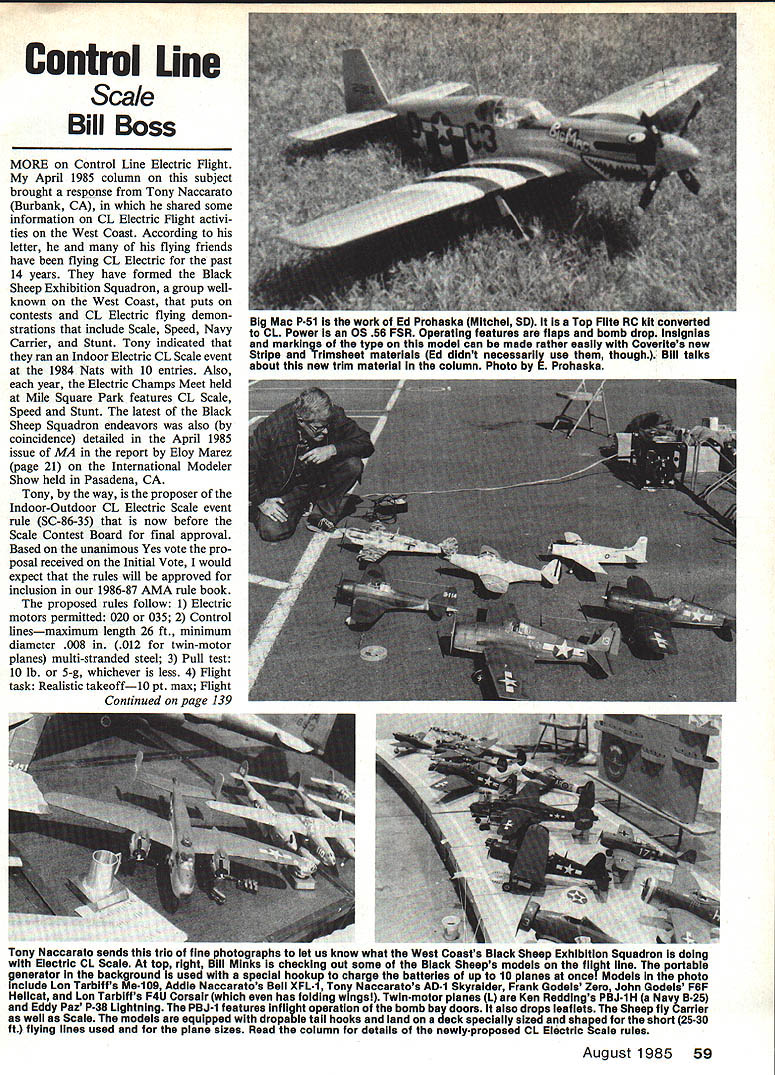
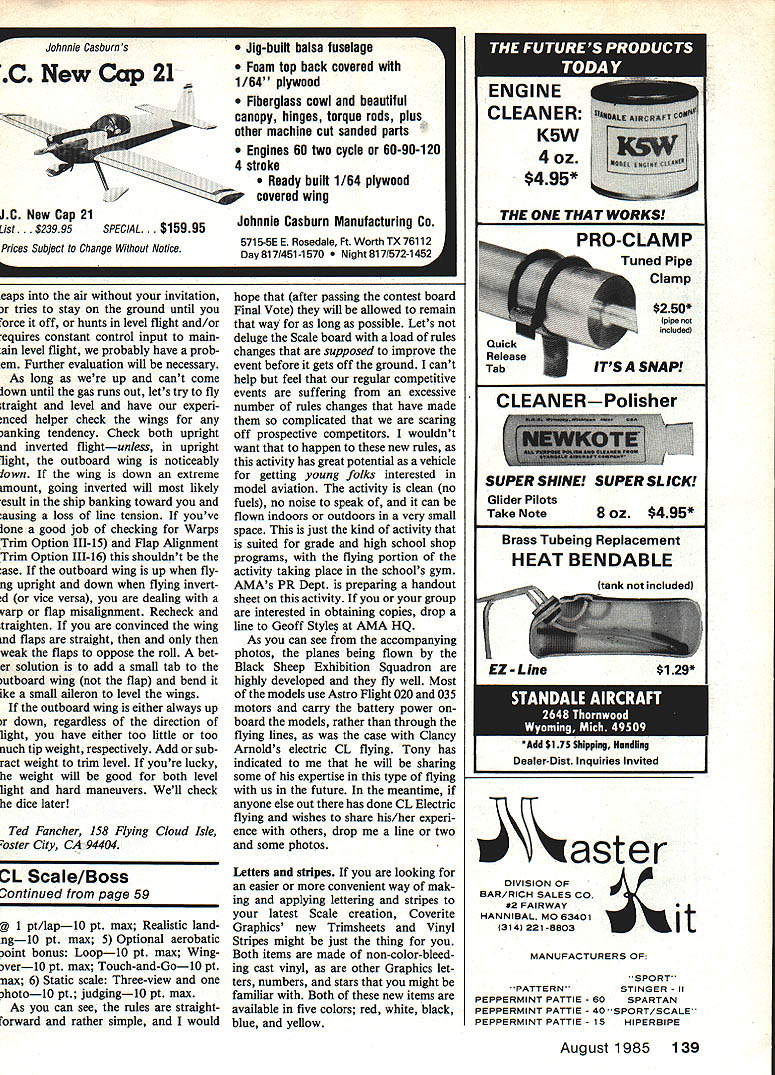
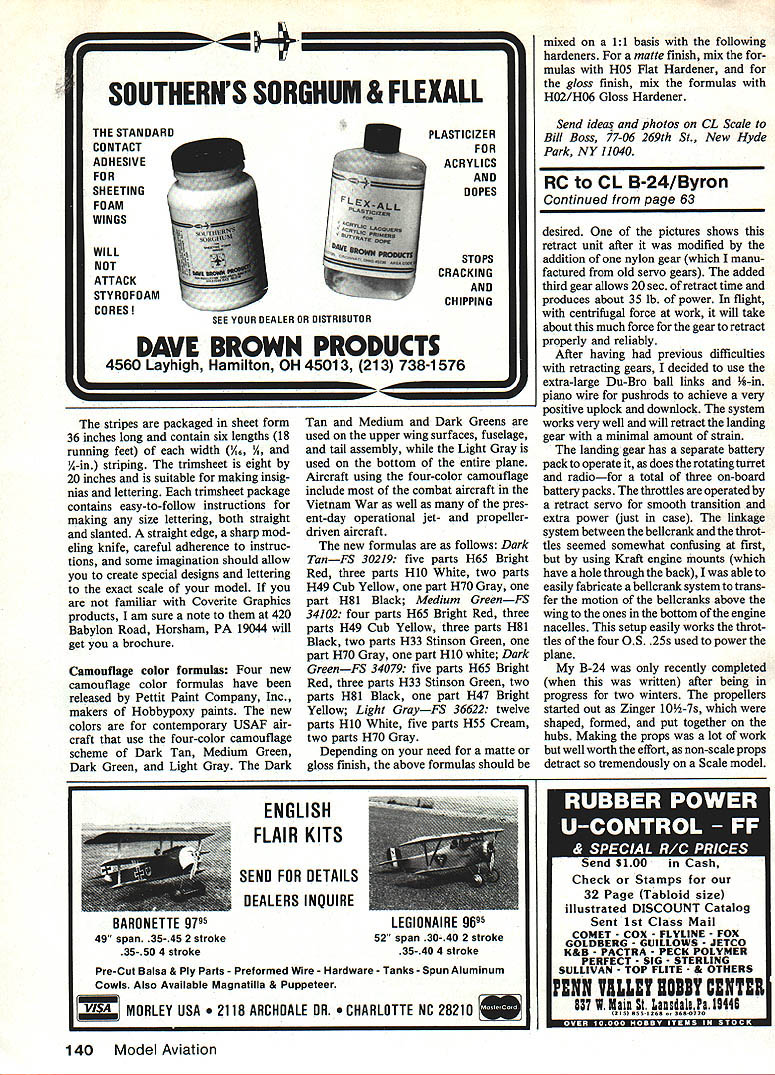
More on control line (CL) electric flight. My April 1985 column on this subject brought a response from Tony Naccarato (Burbank, CA), who shared information on CL electric activities on the West Coast. He and many of his flying friends have been flying CL electric for the past 14 years. They formed the Black Sheep Exhibition Squadron, a group well-known on the West Coast that puts on contests and CL electric flying demonstrations including Scale, Speed, Navy Carrier, and Stunt.
Tony indicated they ran an indoor electric CL Scale event at the 1984 Nats with 10 entries. Each year, the Electric Champs Meet held at Mile Square Park features CL Scale, Speed, and Stunt. The latest of the Black Sheep Squadron endeavors was also (by coincidence) detailed in the April 1985 issue of MA in the report by Eloy Marez on the International Modeler Show held in Pasadena, CA.
Tony is the proposer of the Indoor-Outdoor CL Electric Scale event rule (SC-86-35) that is before the Scale Contest Board for final approval. Based on the unanimous Yes vote on the Initial Vote, I would expect the rules will be approved for inclusion in the 1986–87 AMA rule book.
Proposed Indoor-Outdoor CL Electric Scale Rules (SC-86-35)
- Electric motors permitted: .020 or .035.
- Control lines: maximum length 26 ft.; minimum diameter .008 in. (.012 in. for twin-motor planes); multi-stranded steel.
- Pull test: 10 lb. or 5-g, whichever is less.
- Flight task:
- Realistic takeoff — 10 pt. max.
- 1 pt per lap — 10 pt. max.
- Realistic landing — 10 pt. max.
- Optional acrobatic point bonus:
- Loop — 10 pt. max.
- Wing-over — 10 pt. max.
- Touch-and-Go — 10 pt. max.
- Static scale:
- Three-view and one photo — 10 pt. judging — 10 pt. max.
As you can see, the rules are straightforward and rather simple. I would hope that, after passing the Scale Board Final Vote, they will be allowed to remain that way for as long as possible. Let's not deluge the Scale Board with a load of rules changes before the event gets off the ground. Our regular competitive events have suffered from an excessive number of rules changes that have made them so complicated they are scaring off prospective competitors. I wouldn't want that to happen to these new rules; this activity has great potential as a vehicle for getting young folks interested in model aviation. The activity is clean (no fuels), has little noise, and can be flown indoors or outdoors in a very small space. This is suited for grade and high school shop programs, with the flying portion taking place in the school's gym. AMA's PR Department is preparing a handout on this activity. If you or your group are interested in copies, drop a line to Geoff Styles at AMA HQ.
Black Sheep Exhibition Squadron models
As you can see from the accompanying photos, the planes flown by the Black Sheep Exhibition Squadron are highly developed and fly very well. Most models use Astro Flight .020 and .035 motors and carry the battery power on board the models (rather than through the flying lines, as in earlier experiments). Tony indicated he will be sharing some of his expertise in this type of flying with us in the future. If anyone else has done CL electric flying and wishes to share experience or photos, drop me a line.
Trimming and Flight Checks
If the model leaps into the air without your invitation, refuses to take off until you force it, hunts in level flight, or requires constant control input to maintain level flight, we probably have a problem. Further evaluation will be necessary.
While flying (and unable to land until the fuel or power runs out), try to fly straight and level and have an experienced helper check the wings for any banking tendency. Check both upright and inverted flight—unless, in upright flight, the outboard wing is noticeably down. If the wing is extremely down, going inverted will most likely result in the ship banking toward you and causing a loss of line tension.
If you've checked for warps and flap alignment carefully and the outboard wing is up when flying upright and down when inverted (or vice versa), you are dealing with a warp or flap misalignment. Recheck and straighten. If you are convinced the wings and flaps are straight, add a small tab to the outboard wing (not the flap) and bend it like a small aileron to level the wings.
If the outboard wing is always up or always down regardless of flight direction, you have either too little or too much tip weight, respectively. Add or subtract weight to trim level. If you're lucky, the weight will be good for both level flight and hard maneuvers. We'll check the details later.
Ted Fancher 158 Flying Cloud Isle, Foster City, CA 94404
Letters and Stripes
If you are looking for an easier way to make and apply lettering and stripes to your latest Scale creation, Coverite Graphics' new Trimsheets and Vinyl Stripes may be just the thing. Both items are made of non-color-bleeding cast vinyl, as are other Coverite Graphics letters, numbers, and stars you may know.
- Stripe sheets: 36 inches long, contain six lengths (18 running feet) of each width (1/16, 1/8, and 1/4 in.).
- Trimsheet: 8 by 20 inches, suitable for making insignias and lettering. Each package includes easy-to-follow instructions for making any size lettering, straight or slanted.
A straight edge, a sharp modeling knife, careful adherence to instructions, and some imagination should allow you to create special designs and lettering to exact scale. For a brochure, write Coverite Graphics, 420 Babylon Road, Horsham, PA 19044.
Camouflage Color Formulas
Pettit Paint Company, Inc. (makers of Hobbyopoxy paints) released four camouflage color formulas for contemporary USAF four-color schemes: Dark Tan, Medium Green, Dark Green, and Light Gray. The Dark Tan and Medium/Dark Greens are used on upper surfaces, fuselage, and tail; Light Gray is used on the bottom.
Formulas (parts):
- Dark Tan — FS 30219:
- 5 parts H65 Bright Red
- 3 parts H10 White
- 2 parts H49 Cub Yellow
- 1 part H70 Gray
- 1 part H81 Black
- Medium Green — FS 34102:
- 4 parts H65 Bright Red
- 3 parts H49 Cub Yellow
- 3 parts H81 Black
- 2 parts H33 Stinson Green
- 1 part H70 Gray
- 1 part H10 White
- Dark Green — FS 34079:
- 5 parts H65 Bright Red
- 3 parts H33 Stinson Green
- 2 parts H81 Black
- 1 part H47 Bright Yellow
- Light Gray — FS 36622:
- 12 parts H10 White
- 5 parts H55 Cream
- 2 parts H70 Gray
Mix the above paint formulas on a 1:1 basis with the appropriate hardener: H05 Flat Hardener for a matte finish, or H02/H06 Gloss Hardener for a gloss finish.
Contact
Send ideas and photos on CL Scale to: Bill Boss 77-06 269th St. New Hyde Park, NY 11040
Transcribed from original scans by AI. Minor OCR errors may remain.

