
Control Line: Scale
Bill Boss
RULES—RULES—RULES. While I realize that we have just completed a rules-making cycle that will provide us with a set of rules for competition in 1986–87, we are also starting another cycle (January 1986) that will result in rules for the years 1988–89. Based on ideas, thoughts, and questions presented to me via mail and verbally at local contests since the ’85 Nats, I believe there are some areas of the CL Scale rules that might need attention during this next rules-making cycle. I would like to share some of those ideas and questions with you.
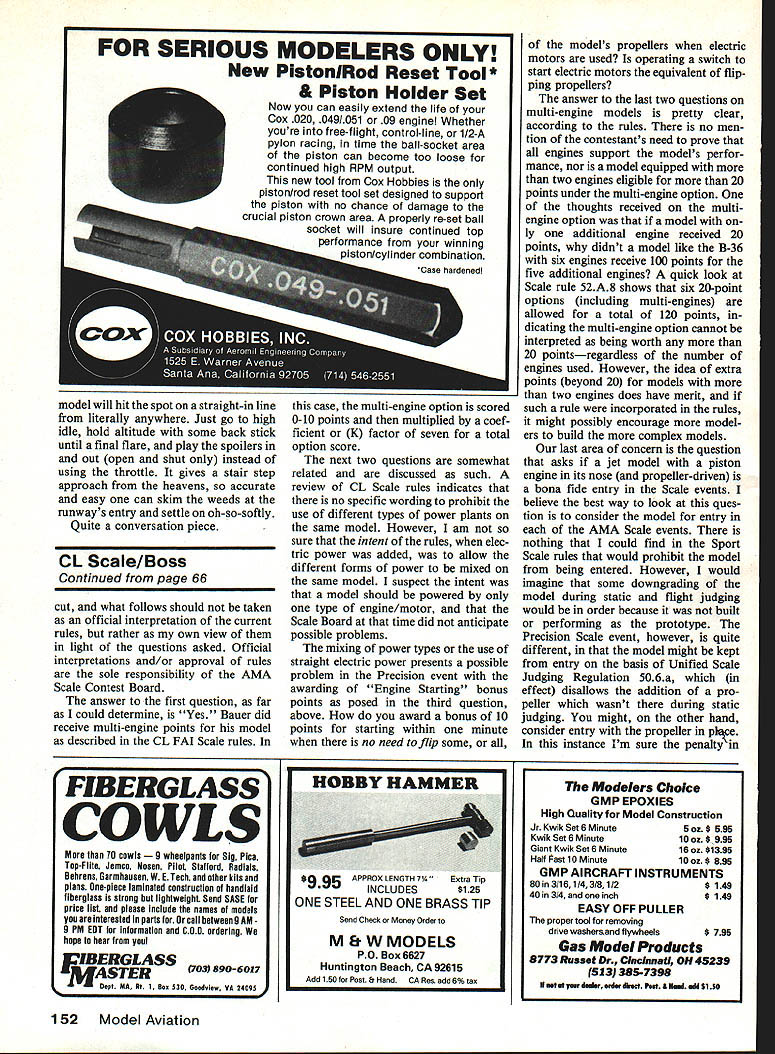
The Savoia-Marchetti SM.79 trimotor (see the December 1985 MA for a photo) flown by Mathew Bauer of Chicago in FAI Scale at the 1985 Nats—and in which he used a combination of electric motors and a piston engine for power—has caused several of you to ask the following questions:
- Was the model flown by Bauer awarded multi-engine points?
- If such a model were entered in the CL Precision Scale event, would it be eligible for "Engine Starting" bonus points as described in Rule 52.A.9.d?
- Is a model with two different types of powerplants legal according to our rules?
- Should a contestant have to prove that all engines/motors are contributing to the flight performance of the model?
- Should multi-engine models using three, four, five, or six engines be awarded more points than a model using only two?
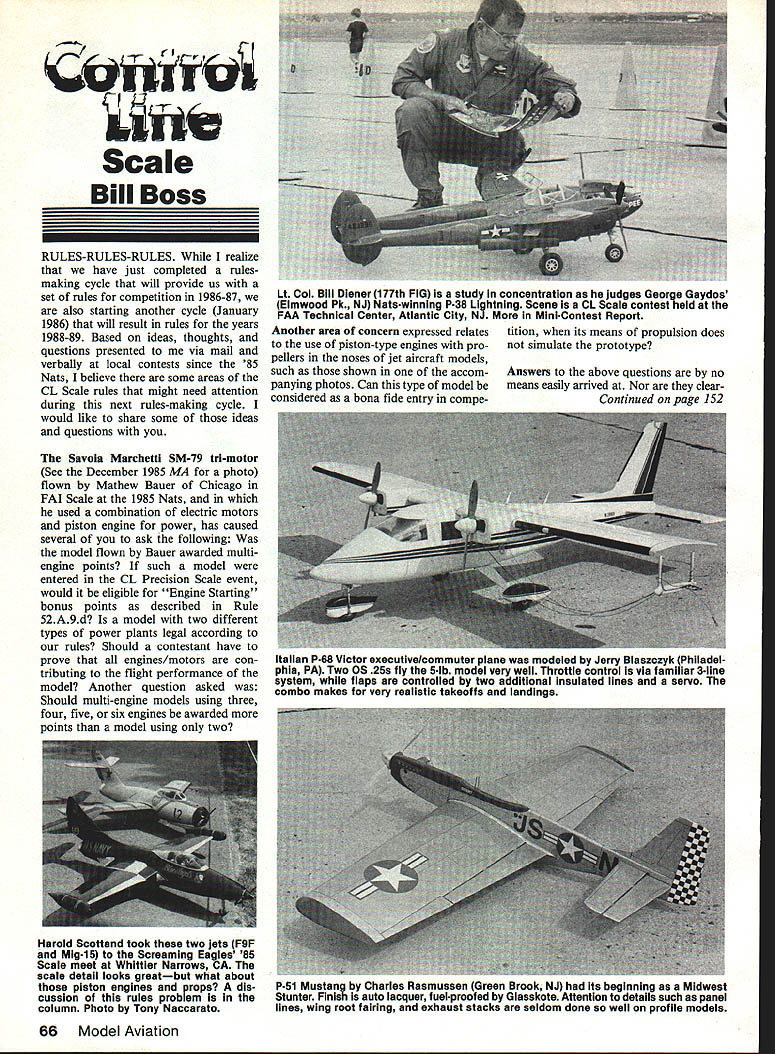
Another area of concern expressed relates to the use of piston-type engines with propellers in the noses of jet aircraft models (as shown in one of the accompanying photos). Can this type of model be considered a bona fide entry in competition when its means of propulsion does not simulate the prototype?
The answers to the above questions are by no means easily arrived at, nor are they clear.
Continued (from page 66)
What follows should not be taken as an official interpretation of the current rules, but rather as my own view of them in light of the questions asked. Official interpretations and/or approval of rules are the sole responsibility of the AMA Scale Contest Board.
The answer to the first question, as far as I could determine, is "Yes." Bauer did receive multi-engine points for his model as described in the CL FAI Scale rules. In this case, the multi-engine option is scored 0–10 points and then multiplied by a coefficient (K) factor of seven for a total option score.
The next two questions are somewhat related and are discussed together. A review of CL Scale rules indicates that there is no specific wording to prohibit the use of different types of powerplants on the same model. However, I am not so sure that the intent of the rules, when electric power was added, was to allow different forms of power to be mixed on the same model. I suspect the intent was that a model should be powered by only one type of engine/motor, and that the Scale Board at that time did not anticipate possible problems.
The mixing of power types or the use of straight electric power presents a possible problem in the Precision event with the awarding of "Engine Starting" bonus points. How do you award a bonus of 10 points for starting within one minute when there is no need to flip some or all of the model’s propellers when electric motors are used? Is operating a switch to start electric motors the equivalent of flipping propellers?
The answer to the last two questions on multi-engine models is pretty clear, according to the rules. There is no mention of the contestant’s need to prove that all engines support the model’s performance, nor is a model equipped with more than two engines eligible for more than 20 points under the multi-engine option. One thought received on the multi-engine option was that if a model with only one additional engine received 20 points, why didn’t a model like the B-36 with six engines receive 100 points for the five additional engines? A quick look at Scale Rule 52.A.8 shows that six 20-point options (including multi-engines) are allowed for a total of 120 points, indicating the multi-engine option cannot be interpreted as being worth any more than 20 points—regardless of the number of engines used. However, the idea of extra points (beyond 20) for models with more than two engines does have merit, and if such a rule were incorporated it might encourage more modelers to build more complex models.
Our last area of concern is whether a model with a piston engine in its nose (and propeller-driven) is a bona fide entry in Scale events. The best way to look at this is to consider the model’s entry in each of the AMA Scale events.
- Sport Scale: There is nothing in the Sport Scale rules that would prohibit the model from being entered. However, one would expect some downgrading in static and flight judging because it was not built or performed as the prototype.
- Precision Scale: This event is quite different. The model might be kept from entry on the basis of Unified Scale Judging Regulation 50.6.a, which effectively disallows adding a propeller that wasn’t present during static judging. If the model were entered with the propeller in place, the static-judging penalty would likely be so severe as to discourage entry.
Now that I have posed the questions and made an attempt to provide some answers, what does it all really mean? I believe it points up the need for a careful review of our CL Scale rules for possible modification during the 1988–89 rules-change cycle. There is a strong need to examine how electric power fits into current Scale rules and what (if any) changes need to be made for its acceptance without question.
Questions to consider for the rules-change cycle include:
- If a set of rules for an electric event were approved, should electric power be removed from the Precision and Sport rules?
- Should there be extra points for models with more than two engines?
- What about prop-driven jet models—how should they be handled?
As you can see, there are many rules that could be considered for change. I hope the above discussion (which really only scratches the surface) has illustrated some of the problems. To those of you who have asked the questions and generated some of the thoughts and ideas in this column, I hope you will follow through with well-thought-out proposals during the next rules-change cycle.
Mini-contest report
Congratulations to CD Bill Force (Sweetwater, NJ) for his perseverance in trying to bring CL Scale contest activity to southern New Jersey. After three years of getting only three or four entries, Bill finally made the grade with 14 entries at his September 22, 1985 meet. The meet was run this year with the cooperation of Lt. Col. Bill Diener of the 177th FIG (Fighter-Interceptor Group) located at the FAA Technical Center, Atlantic City.
In addition to normal trophy awards in Sport and Profile Scale events, a special Best Air Force Aircraft award was presented by Lt. Col. Diener to George Gaydos, Elmwood Park, NJ, for his Nats-winning P-38 Lightning. To those of you in the southern New Jersey and Philadelphia areas who did not make this meet, be sure to watch for it in 1986.
1985 Directory of CL Scale Subjects
January:
- Lozenge-pattern fabric application to WW I planes.
February:
- Operation of 3-line control system (includes problems when mixing Roberts, G-S, or L-R units).
March:
- Flying in the wind by O. Humphries.
- Correction to U/Tronics encoder schematic.
April:
- CL Electric Flight by C. Arnold.
- How to avoid flat tires.
May:
- Paint-filler-sealer compatibility.
- How to make a face, by J. Kaman.
- Hobbyoxy Fast Fill product test.
June:
- WRAMS show report 1985.
- Scale documentation sources for WW I planes.
- Installing brakes.
July:
- Installation of 3-line system in a P-51 designed basically for RC (article stresses special strengthening of wing for CL).
August:
- CL Electric Flight—Black Sheep Squadron.
- Graphics—vinyl stripes and trim sheets.
- New Hobbyoxy camouflage paint formulas.
September:
- Rudder construction made easy.
- Cradle of Aviation show and library as Scale data source.
- Setting glue faster via heat application.
October:
- Make your own instruments.
- Improved biplane wing attachment.
November:
- Nationals coverage.
December:
- Comment on CL Electric Flight rules failure.
- Mounting plastic pilots in cockpits.
- 1982–83 Directory of CL Scale subjects.
Transcribed from original scans by AI. Minor OCR errors may remain.

