
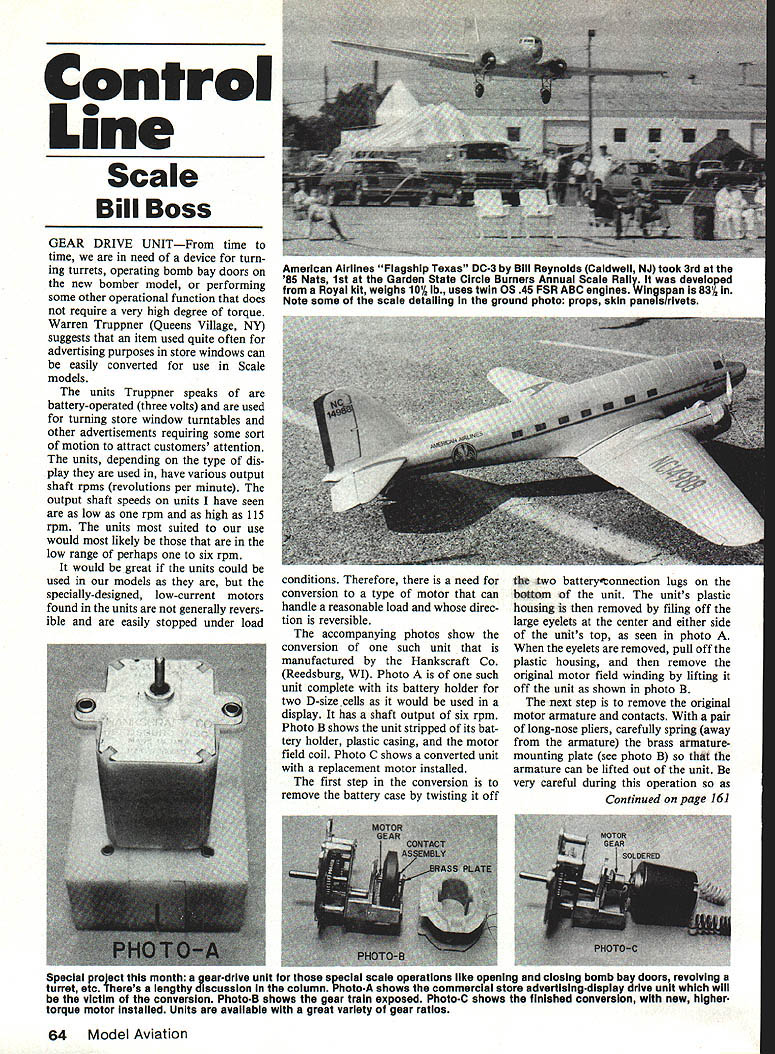
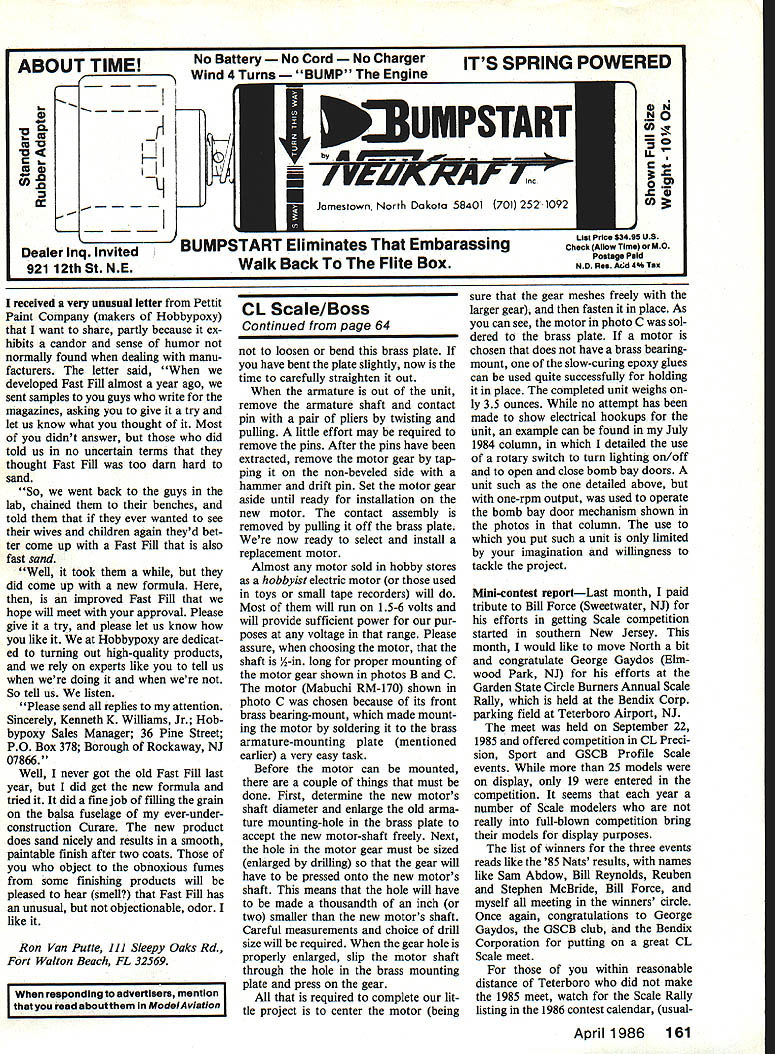
Control Line: Scale
Bill Boss
Gear Drive Unit — Conversion for Scale Models
From time to time we need a device for turning turrets, operating bomb-bay doors on a bomber model, or performing other functions that do not require a very high degree of torque. Warren Truppner (Queens Village, NY) suggests that a battery-operated store-window drive unit (three volts) — used to turn display turntables and other advertising motion devices — can be converted for use in scale models.
These units come with various output-shaft speeds. Speeds seen range from about 1 rpm up to 115 rpm. The units most suited for model use are those in the low range, perhaps 1–6 rpm (many common units are around 6 rpm).
The stock motors in these displays are often specially designed, low-current types that are not generally reversible and will stall easily under load. For model use you should replace the internal motor with one that can handle a reasonable load and whose direction is reversible.
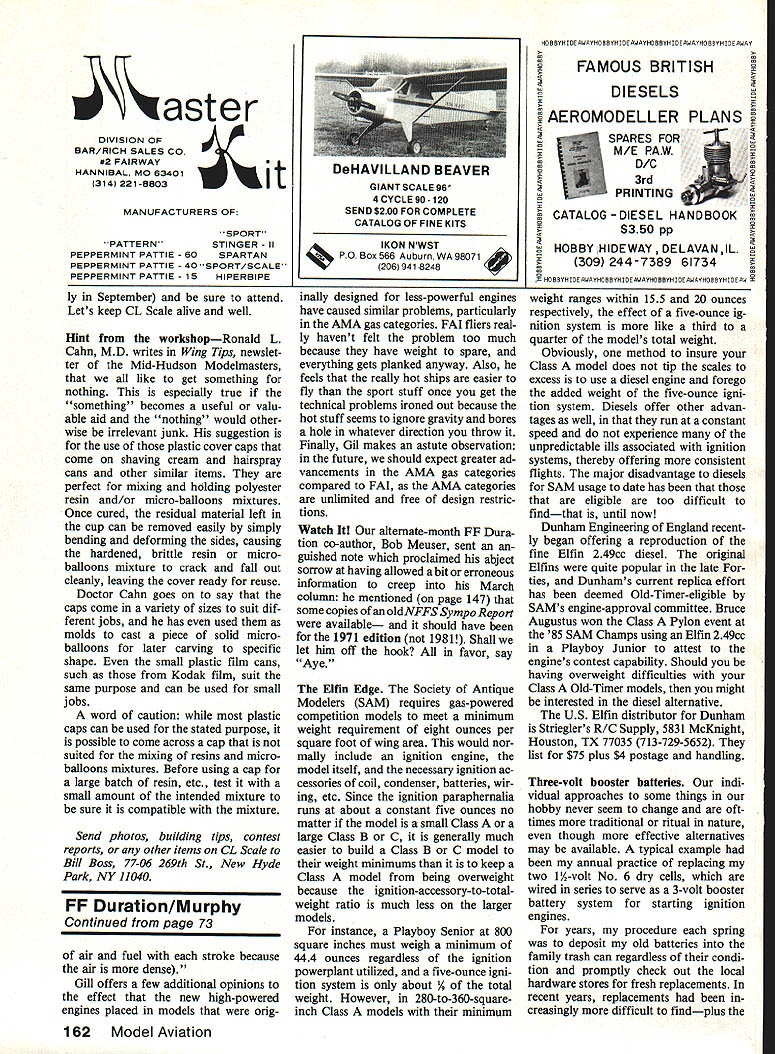
The example conversion below was done on a Hankscraft Co. unit (Reedsburg, WI) that originally used two D cells and had about a 6 rpm output. Photos referenced in the original article show: Photo A — complete unit with battery holder; Photo B — unit stripped of casing and field coil; Photo C — converted unit with replacement motor installed.
Disassembly and preparation
- Remove the battery case by twisting it off the two battery-connection lugs on the bottom of the unit.
- Remove the plastic housing:
- File off the large eyelets at the center and on either side of the unit's top (see Photo A).
- Pull off the plastic housing.
- Lift off and remove the original motor field winding (see Photo B).
- Remove the original armature and contacts:
- With long-nose pliers, carefully spring the brass armature-mounting plate away from the armature so the armature can be lifted out.
- Take care not to loosen or bend the brass plate. If it is slightly bent, straighten it carefully now.
- Once the armature is out, remove the armature shaft and contact pin by twisting and pulling with pliers. Some effort may be required.
- Remove the motor gear:
- Tap the gear on the non-beveled side with a hammer and drift pin to drive it off the armature shaft.
- Set the motor gear aside for later installation on the new motor.
- Remove the contact assembly by pulling it off the brass plate.
You are now ready to select and install a replacement motor.
Motor selection
- Almost any hobby motor sold in hobby shops (or motors from toys or small tape recorders) will work. Most run on 1.5–6 volts and provide sufficient power.
- Ensure the motor shaft length is about 1/8 inch for proper mounting of the motor gear (as shown in Photos B and C).
- The example motor used was a Hammond RM-170 chosen for its front brass-bearing mount, which made mounting simple by soldering to the brass armature-mounting plate.
Preparing the motor and gear
- Determine the new motor's shaft diameter.
- Enlarge the old armature mounting hole in the brass plate to accept the new motor shaft.
- Enlarge the hole in the motor gear so it will press onto the new motor shaft:
- Make the gear hole a thousandth or two smaller than the motor shaft so it must be pressed on.
- Choose drill size carefully and measure accurately.
- Slip the motor shaft through the hole in the brass mounting plate and press the gear onto the shaft.
Mounting the motor and finishing up
- Center the motor so its gear meshes freely with the larger gear.
- Fasten the motor to the brass mounting plate:
- If the motor has a brass bearing mount, soldering to the brass plate is easy and effective (as in Photo C).
- If the motor lacks a brass-bearing mount, a slow-curing epoxy works well.
- The completed converted unit weighs about 3.5 ounces.
No wiring diagram is provided here, but an example electrical hookup using a rotary switch for lights and bomb-bay doors appeared in my July 1984 column. A similar unit with a 1-rpm output was used to operate the bomb-bay door mechanism shown in that column. Use of such a unit is limited only by your imagination and willingness to tackle the project.
Mini-contest report
Last month I paid tribute to Bill Force (Sweetwater, NJ) for helping get Scale competition started in southern New Jersey. This month I congratulate George Gaydos (Elmwood Park, NJ) for his efforts at the Garden State Circle Burners Annual Scale Rally held at the Bendix Corp. parking field at Teterboro Airport, NJ.
The meet was held on September 22, 1985, and offered competition in CL Precision, Sport, and GSCP Profile Scale events. More than 25 models were entered overall, with 19 in contest classes. Each year a number of scale modelers bring models for display rather than full competition. The list of winners read like the '85 Nats' results, with names such as Sam Abbott, Bill Reynolds, Reuben and Stephen McBride, Bill Force, and myself among the winners. Congratulations to George Gaydos, the GSCB club, and the Bendix Corporation for putting on a great CL Scale meet.
For those within reasonable distance of Teterboro who did not make the 1985 meet, watch for the Scale Rally listing in the 1986 contest calendar.
Hint from the workshop
Ronald L. Cahn, M.D., in Wing Tips (newsletter of the Mid-Hudson Modelmasters), suggests reusing plastic cover caps from shaving cream and hairspray cans for mixing and holding polyester resin and micro-balloon mixtures. Advantages:
- Caps come in various sizes for different jobs.
- Once the mixture cures, the hardened residue can be removed by bending/deforming the cap sides so the brittle material cracks and falls out, leaving the cap ready for reuse.
- Small plastic film cans (Kodak-style) are also useful for small jobs.
- Caps can even be used as molds to cast solid micro-balloon pieces for later carving.
Caution: Some caps may not be compatible with a given resin or mixture. Test a cap with a small amount of the intended mixture before using it for a large batch.
Contact
Send photos, building tips, contest reports, or other items on CL Scale to: Bill Boss, 77-06 269th St., New Hyde Park, NY 11040.
Transcribed from original scans by AI. Minor OCR errors may remain.

