
Control Line: Scale
Bill Boss
Remote Needle Valve Operation
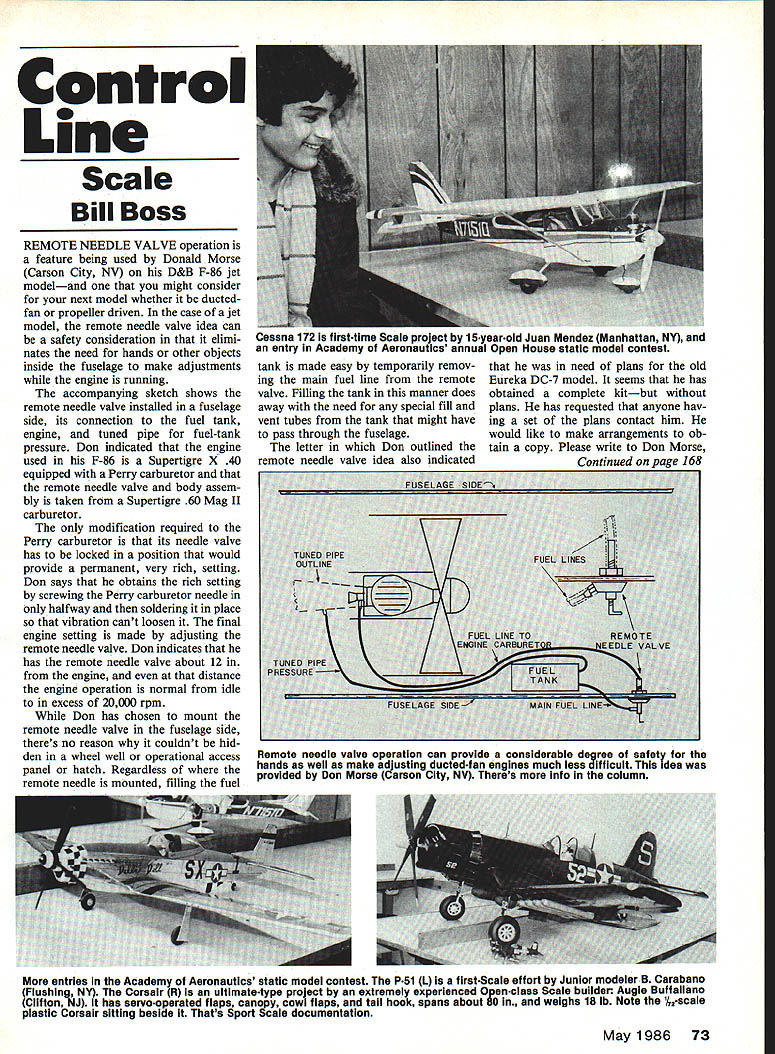
Remote needle valve operation is a feature being used by Donald Morse (Carson City, NV) on his D&B F-86 jet model — and one you might consider for your next model, whether ducted-fan or propeller driven. On a jet model, the remote needle valve can be a safety consideration because it eliminates the need for hands or other objects inside the fuselage to make adjustments while the engine is running.
The accompanying sketch (not shown) depicts the remote needle valve installed in a fuselage side and its connection to the fuel tank, engine, and tuned pipe for fuel-tank pressure. Don indicated that the engine in his F-86 is a Supertigre X .40 equipped with a Perry carburetor, and that the remote needle valve and body assembly is taken from a Supertigre .60 Mag II carburetor.
The only modification required to the Perry carburetor is locking its needle valve in a permanently very-rich position. Don obtains this rich setting by screwing the Perry carburetor needle in only halfway and then soldering it in place so vibration can't loosen it. Final engine tuning is done by adjusting the remote needle valve. Don places the remote needle valve about 12 in. from the engine, and even at that distance the engine runs normally from idle up to in excess of 20,000 rpm.
Although Don mounted the remote needle valve in the fuselage side, it could just as well be hidden in a wheel well or under an access panel or hatch. Regardless of location, filling the fuel tank is simplified by temporarily removing the main fuel line from the remote valve. Filling the tank this way eliminates the need for special fill and vent tubes that would otherwise pass through the fuselage.
Seeking Plans: Eureka DC-7
In his letter outlining the remote needle valve idea, Don also said he needed plans for the old Eureka DC-7 model. He has obtained a complete kit but without plans and would like to obtain a copy. Please write to:
- Don Morse, 1630 Karin Dr., Carson City, NV 89701
Academy of Aeronautics: 12th Annual Model Airplane Contest
"Welcome to the Academy of Aeronautics" read the sign over the door. The Academy of Aeronautics, adjacent to LaGuardia Airport in Flushing, NY, offers associate degree programs preparing students for technical careers in aviation, aerospace, electronics, and related industries.
I attended the Academy's 12th Annual Model Airplane Contest on November 29, 1985 (the day after Thanksgiving), which is part of their Annual Open House for students, parents, and visitors. The contest is static and offers cash awards for first through third places in Junior, Intermediate, and Senior categories. Models of all types and materials, whether flying or for static display (including plastics), are permitted. The accompanying photos (not shown) are of some of the CL Scale models entered this year.
The Academy's interest in promoting model aviation goes back to the mid-1960s, when its current president, George W. Brush, worked with the then-Flushing Model Airplane Society to provide a flying site on school grounds for many years. The current contest format is the Academy's latest effort to support model aviation.
If you live in the New York, New Jersey, or Long Island areas and are looking for a fall modeling activity, look for the Academy's Open House contest in 1986 — remember, it's the day after Thanksgiving.
Hobbyopoxy Scale-Color Project: RAF Colors
Hobbyopoxy continues its scale-color project with three colors used in British Royal Air Force insignia: RAF Red, RAF Blue, and RAF Yellow. A fourth color used in RAAF insignia is white; straight Hobbyopoxy H10 White may be used.
A historical note: RAF Red is a dull, rust-red color. It was adopted by the United States in May 1942 to replace bright red in U.S. insignia, but that same month the Army Air Force and the U.S. Navy eliminated red from the national insignia, so the new color was short-lived. In the Ninth Air Force, RAF-style fin flashes were worn as theater recognition markings, but bright red was used rather than the proper dull red. When red returned to the star-and-bar insignia from July through September 1943, bright red was used on almost all aircraft, likely from older paint stocks. Some aircraft probably wore the proper dull red, so if your reference material shows dull red, the formula below will give an authentic match.
Formulas:
- RAF Red (also U.S. Insignia Red, May 1942 through the end of WWII) — 20 parts H56 Bright Red, 3 parts H66 Dark Red, 2 parts H57 Orange, 1 part H81 Black, 1 part H10 White.
- RAF Blue — 11 parts H24 Dark Blue, 2 parts H81 Black, 1 part H65 Bright Red.
- RAF Yellow — 9 parts H49 Cub Yellow, 7 parts H47 Bright Yellow, 3 parts H55 Cream, 2 parts H65 Dark Red.
Contact
Send ideas and photos on CL Scale to:
- Bill Boss, 77-06 269th St., New Hyde Park, NY 11040.
Transcribed from original scans by AI. Minor OCR errors may remain.

