
Control Line: Scale
Bill Boss
CG or not CG is the question. There are some basic control-line (CL) model-building concepts and techniques worth repeating from time to time. One such topic, suggested by Steve Tift of Midland, TX, concerns the bellcrank and its positioning with respect to the model's center of gravity (CG), and where to place the lead-out wires — within, below, or above the model's wingtip. A couple of modelers experienced in RC scale modeling who are now turning to CL scale also asked about bellcrank installation basics. I answered them individually, but thought it appropriate to share those comments here for others who are new to control-line flying.
Let's start with bellcrank placement relative to the model's center of gravity. The rule is simple: the bellcrank should be located in the immediate vicinity of the CG. I do not believe the precise location is as critical as we might think. From talking with many CL builders, I found that a slight variation in location, either ahead of or behind the CG, has little effect on the model's performance.
To put some measurements to that variation:
- On a model with about a 60-inch wingspan, mounting the bellcrank one inch either side of the CG makes little difference in flying performance.
- On smaller models (say a 30-inch wingspan), I would make every effort to observe and place the bellcrank as close to the CG as possible.
Equally important to bellcrank mounting is balancing the model. Placement of the bellcrank won't help much if you don't balance the model properly after it's finished.
Notice I said balance after the model is finished. During finishing we add paint and details to one side or the other, and if we balance before painting we might add enough weight to the tail to upset the balance. The CG is the point at which the model should be balanced. Don't be afraid to add lead to the nose or tail to achieve a well-balanced model. Experience among many scale modelers indicates that a moderately nose-heavy model is far better than one that is even the slightest bit tail-heavy.
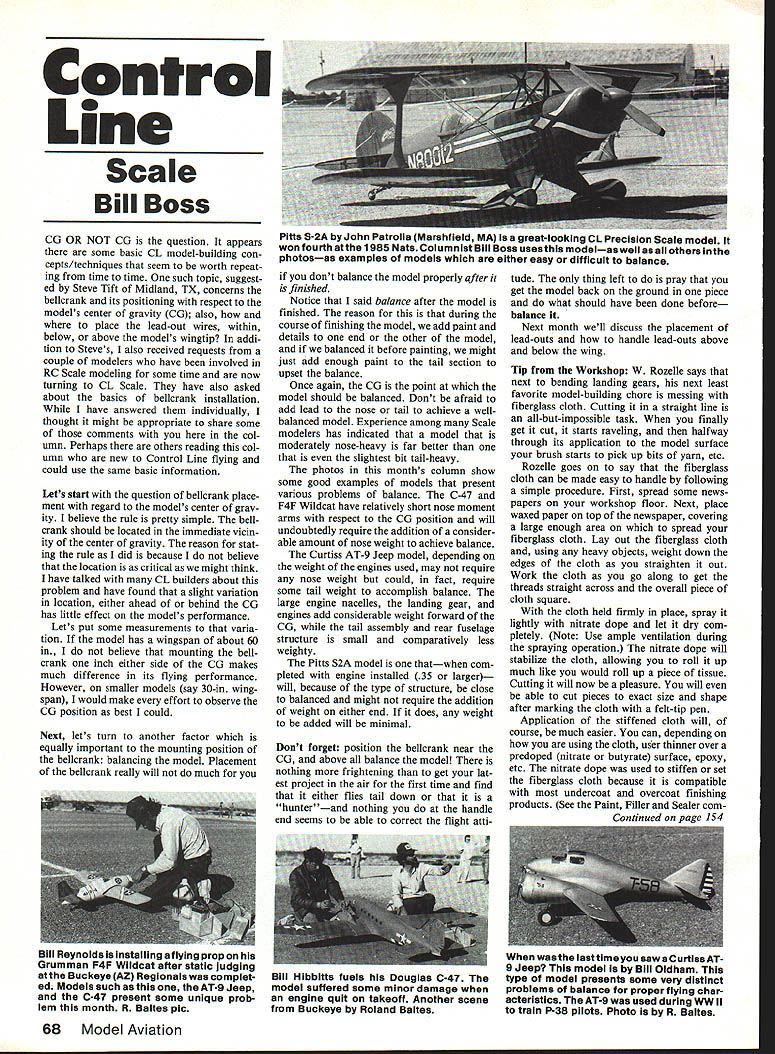
The photos in this month's column show examples of models with various balance issues:
- C-47 and F4F Wildcat — relatively short nose moment arms with respect to the CG; these will likely require a considerable amount of nose weight to achieve balance.
- Curtiss AT-9 "Jeep" — depending on engine weight, may not require nose weight and could require some tail weight. The large engine nacelles, landing gear, and engines add considerable weight forward of the CG, while the tail assembly and rear fuselage are comparatively light.
- Pitts S-2A — when completed with an engine installed (.35 or larger), because of its structure, it will likely be close to balanced and might not require added weight; if it does, any additional weight will be minimal.
Don't forget: position the bellcrank near the CG, and above all, balance the model. There is nothing more frightening than flying your latest project for the first time only to find it flies tail-down or "hunts" — and nothing you do at the handle end seems to correct the flight attitude. Pray you get the model back in one piece, then do what should have been done before — balance it.
Next month we'll discuss the placement of lead-outs and how to handle lead-outs above and below the wing.
CL Scale / Boss
Continued from page 68
(See the compatibility chart in my May 1985 column.) The stiffened cloth will not only be easier to work with but will look much neater. All the wrinkles will be straighter, instead of the wavy, squirrely look you can't avoid when using the standard application method.
This item by W. Rozelle was found in Wing Tips, the newsletter of the Mid-Hudson Modelmasters, and was reprinted by SAM in The Corsair.
Mini-contest report: Roland Baltes (San Pedro, CA) reports that the Southwestern Regionals held at Buckeye, AZ, once more saw a fair turnout in the CL Sport Scale event. This year's event, held in January, had nine entries, four of which were twin-engine types. Weather was good — temperatures in the seventies and minimal wind — an excellent day for scale flying.
Some of this month's photos (all by Roland) are of Buckeye entries. Roland commented that nine entries may not seem like much, but for an area that hadn't seen a scale meet in over a year, a turnout of nine is considered fairly good. Roland expects to be at next year's contest and hopes to report another increase in activity.
Please send all correspondence — and especially photos — relating to CL Scale to: Bill Boss 77-06 269th St. New Hyde Park, NY 11040
Transcribed from original scans by AI. Minor OCR errors may remain.

