

Scale
Mike Stott
TWO WEEKS before the CL Scale World Championships were held in Sweden I called up the U.S. Team members that were going to be representing us, to see how things were progressing for them. (By the time you read this, the Championships will have been held; see Competition News for results.)
In one of my past articles I mentioned that the team members for 1976 were: Mike Gretz, myself, and Ralph Burnstine. Well, as you know, we were chosen for the team at last year's Nats and many things have taken place since then, so I'd better give you a bit of an up-date.
As things turned out, I was not one of the team members who went to Sweden. My position I passed on to Bill Harney, who was an alternate, because my wife and I were expecting the birth of our first child at the same time the World Championships were being held, and I wanted to be home for that event. As soon as I found out when the World Championships were going to be held, I talked to Bill about accepting a spot on the team. But he felt he could not be prepared to go and so he passed the position on to the next alternate who was Cathy Burnstine, daughter of Ralph Burnstine. As you can see a few changes were made since the team was picked.
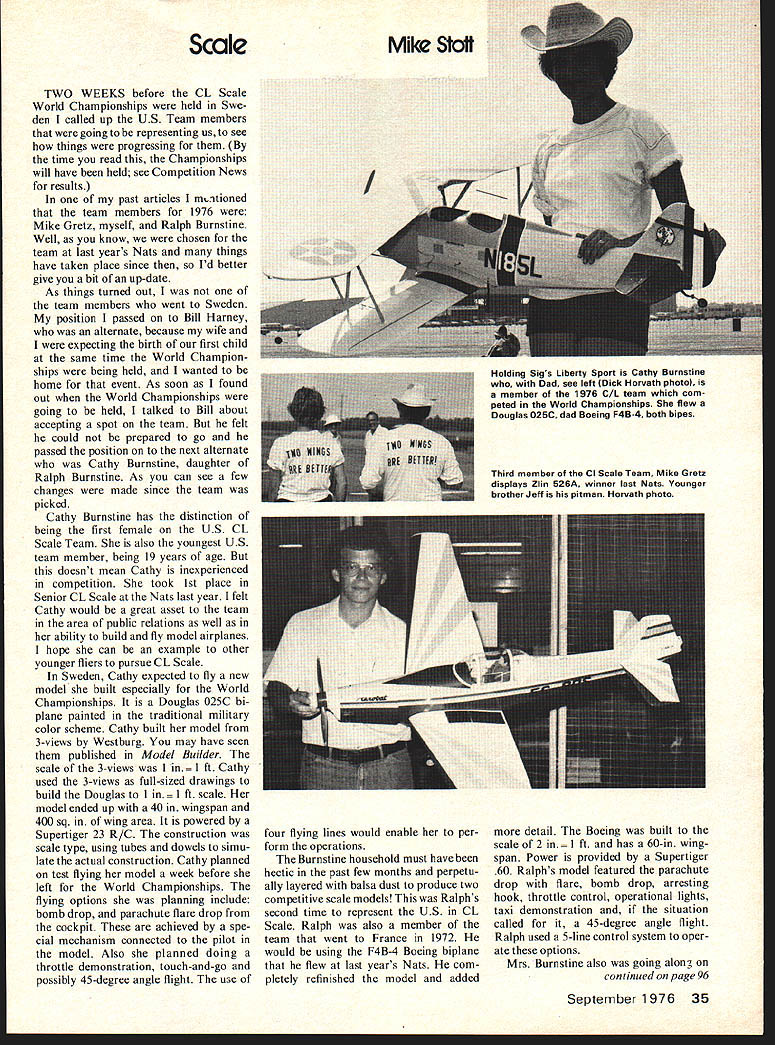
Cathy Burnstine has the distinction of being the first female on the U.S. CL Scale Team. She is also the youngest U.S. team member, being 19 years of age. But that doesn't mean Cathy is inexperienced in competition. She took 1st place in Senior CL Scale at the Nats last year. I felt Cathy would be a great asset to the team in the area of public relations as well as in her ability to build and fly model airplanes. I hope she can be an example to other younger fliers to pursue CL Scale.
In Sweden, Cathy expected to fly a new model she built especially for the World Championships. It is a Douglas 025C biplane painted in the traditional military color scheme. Cathy built her model from 3-views by Westburg. You may have seen them published in Model Builder. The scale of the 3-views was 1 in. = 1 ft. Cathy used the 3-views full-sized drawings to build the Douglas to 1 in. = 1 ft. scale. Her model ended up with a 40 in. wingspan and 400 sq. in. of wing area. It is powered by a Supertiger 23 R/C. The construction was scale type, using tubes and dowels to simulate the actual construction. Cathy planned on test flying her model a week before she left for the World Championships. The flying options she was planning include: bomb drop, and parachute flare drop from the cockpit. These are achieved by a special mechanism connected to the pilot in the model. Also she planned doing a throttle demonstration, touch-and-go and possibly 45-degree angle flight. The use of four flying lines would enable her to perform the operations.
The Burnstine household must have been hectic in the past few months and perpetually layered with balsa dust to produce two competitive scale models! This was Ralph's second time to represent the U.S. in CL Scale. Ralph was also a member of the team that went to France in 1972. He would be using the F4B-4 Boeing biplane that he flew at last year's Nats. He completely refinished the model and added more detail. The Boeing was built to the scale of 2 in. = 1 ft. and has a 60-in. wingspan. Power is provided by a Supertiger .60. Ralph's model featured the parachute drop with flare, bomb drop, arresting hook, throttle control, operational lights, taxi demonstration and, if the situation called for it, a 45-degree angle flight. Ralph used a 5-line control system to operate these options. The trip to Sweden—to keep everyone calm!
The third member of the team was Mike Gretz. Mike is also an experienced member as he was on the 1974 U.S. CL Scale Team at Lakehurst, N.J. He was taking the same Zlin 526A he used to win at the Nats last year. Mike did a little damage to it last year and had to do some refinishing to the bottom of the wing, cowl and landing gear. His Zlin is 2 in. = 1 ft. scale and weighs 8½ lbs. The Zlin is powered by a Webra .61 R/C. For his options Mike offered retractable landing gear, operating flaps, throttle demonstration with engine shut-off and 45-degree angle flight.
Mike told me he wouldn't attempt any stunts, such as looping the Zlin or flying inverted. I did not rule out these "stunts." Mike was using one of the electrical control systems I described in the July issue of Model Aviation.
Accompanying Mike as his pit man was his younger brother, Jeff Gretz.
Transcribed from original scans by AI. Minor OCR errors may remain.

