
Control Line: Scale
Bill Boss
Multi-Engine starting aid
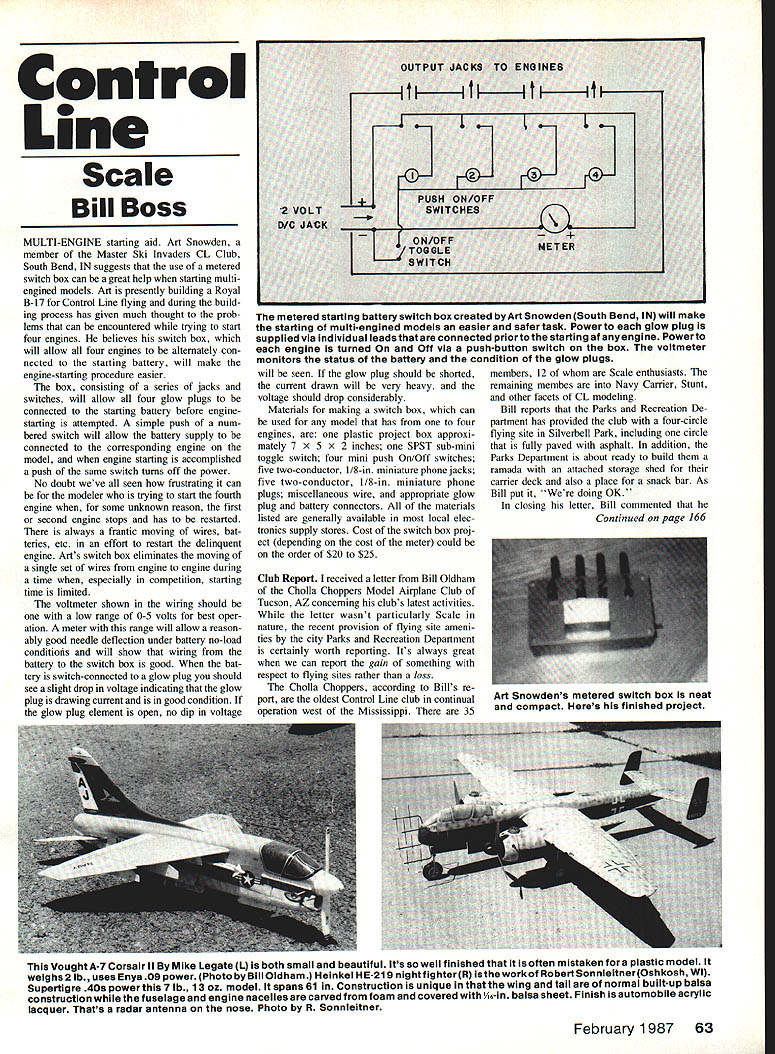
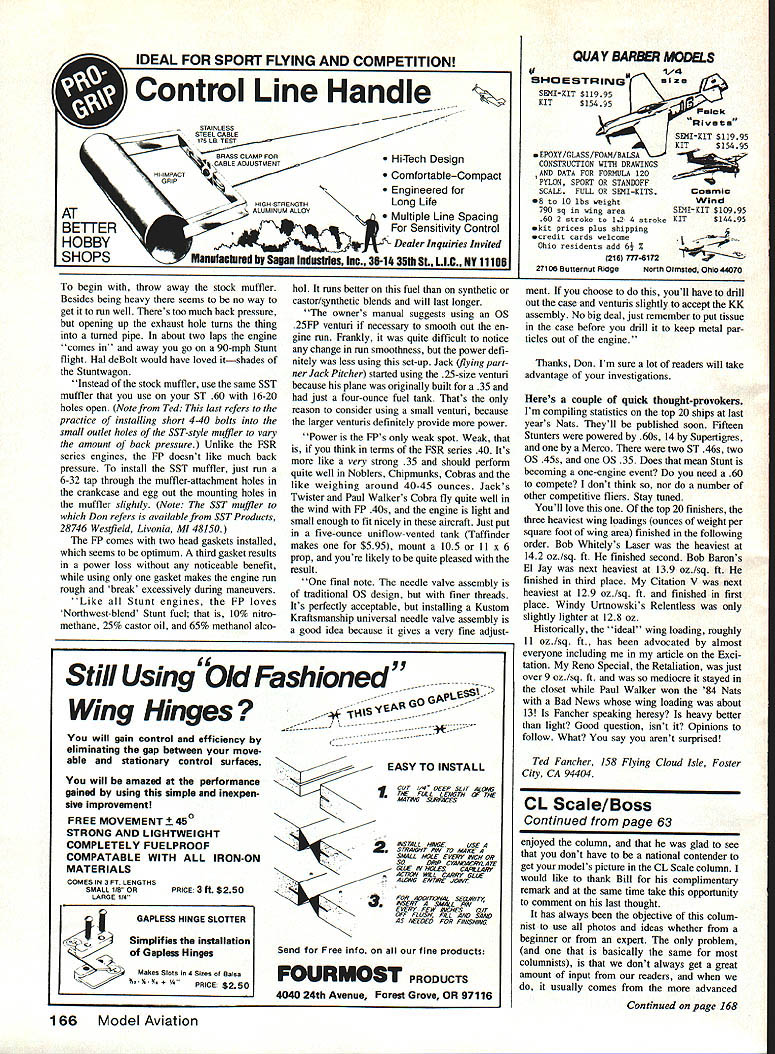
Art Snowden, a member of the Master Ski Invaders CL Club, South Bend, IN, suggests that a metered switch box can be a great help when starting multi‑engined models. Art is building a Royal B-17 for Control Line flying and, during the build, has given much thought to the problems of starting four engines. He believes his switch box, which will allow all four engines to be alternately connected to the starting battery, will make the engine‑starting procedure easier.
The box, consisting of a series of jacks and switches, will allow all four glow plugs to be connected to the starting battery before starting is attempted. A simple push of a numbered switch connects the battery supply to the corresponding engine; when that engine is started, a push of the same switch turns off the power.
We’ve all seen how frustrating it can be for a modeler trying to start the fourth engine when, for some unknown reason, the first or second engine stops and has to be restarted. There is frantic moving of wires and batteries in an effort to restart the delinquent engine. Art’s switch box eliminates moving a single set of wires from engine to engine during this time, which is especially helpful in competition where starting time is limited.
The voltmeter used in the wiring should have a low range of 0–5 volts for best operation. A meter with this range will give reasonable needle deflection under battery no‑load conditions and will show that wiring from the battery to the switch box is good. When the battery is switch‑connected to a glow plug you should see a slight drop in voltage indicating the plug is drawing current and is in good condition. If the glow plug element is open, no dip in voltage will be seen. If the glow plug is shorted, the current drawn will be very heavy and the voltage will drop considerably.
Materials for making a switch box usable for any model with one to four engines:
- One plastic project box, approximately 7 x 5 x 2 inches
- One SPST sub‑mini toggle switch
- Four mini push On/Off switches
- Five two‑conductor, 1/8‑in. miniature phone jacks
- Five two‑conductor, 1/8‑in. miniature phone plugs
- Miscellaneous wire and appropriate glow plug and battery connectors
All of the materials listed are generally available at local electronics supply stores. Cost of the switch box project (depending on the meter) could be on the order of $20 to $25.
Club Report
I received a letter from Bill Oldham of the Cholla Choppers Model Airplane Club of Tucson, AZ, concerning his club’s latest activities. While the letter wasn't particularly Scale in nature, the recent provision of flying‑site amenities by the city Parks and Recreation Department is worth reporting. It’s always great to report gains in flying sites rather than losses.
The Cholla Choppers, according to Bill’s report, are the oldest Control Line club in continual operation west of the Mississippi. There are 35 members, 12 of whom are Scale enthusiasts. The remaining members are into Navy Carrier, Stunt, and other facets of CL modeling.
Bill reports that the Parks and Recreation Department has provided the club with a four‑circle flying site in Silverbell Park, including one circle fully paved with asphalt. In addition, the Parks Department is about ready to build them a ramada with an attached storage shed for their carrier deck and a place for a snack bar. As Bill put it, “We're doing OK.”
In closing his letter, Bill commented that he enjoyed the column and was glad to see that you don’t have to be a national contender to get your model’s picture in the CL Scale column. I would like to thank Bill for his complimentary remark and take this opportunity to comment on his last thought.
It has always been the objective of this column to use as many photos and ideas as possible, whether from a beginner or an expert. The only problem (and one that is basically the same for most columnists) is that we don't always get a great amount of input from our readers, and when we do, it usually comes from the more advanced modeler. I (and I'm sure other columnists as well) would welcome any ideas or photos no matter what your level of modeling experience. It is only through input from all experience levels that we can hope to present material appealing to all model builders. If anyone, beginner or expert, has a photo, building tip, club or contest report they wish to share with other CL Scale modelers, please send it to me at the address given at the end of the column.
Hobbypoxy paint formulas (continued)
The latest in this series of Scale color formulas is called the "European One," a three‑color scheme used primarily on A‑10 Thunderbolts operating in Europe. Some background on the development of the "European One" color scheme is provided in U.S.A.F.A., A Primer of Modern Air Combat in Europe by Michael Skinner.
The aircraft’s camouflage scheme is another example of designers’ devotion to making everything exactly right. They started from scratch—after all, the USAF had no experience in painting battlefield jets. Their first efforts were shades of gray; these worked well in theory, but in practice the pale A‑10 stood out prominently against the thick green forests of Central Europe. The designers went back to the drawing board and came up with the mottled green and gray European One, the "lizard" camouflage now on the aircraft. The A‑10 was also one of the first aircraft to have its red, white and blue national insignia replaced by the new, low‑visibility black outline, the current standard.
Formulas:
- FS 34102 Light Green — four parts H65 Bright Red, three parts H49 Cub Yellow, three parts H81 Black, two parts H33 Stimson Green, one part H70 Gray, and one part H30 White.
- FS 34092 Dark Green — four parts H33 Stimson Green, four parts H81 Black, three parts H47 Bright Yellow, and two parts H70 Gray.
- FS 36081 Dark Gray — six parts H81 Black, two parts H70 Gray, one part H47 Bright Yellow, and one part H66 Dark Red.
- FS 37038 Black (markings) — use H81 Black.
Remember to use H05 Flat Hardener for these colors.
Please send all correspondence—and especially photos—relating to CL Scale to: Bill Boss 77‑06 269th St. New Hyde Park, NY 11040
Transcribed from original scans by AI. Minor OCR errors may remain.

