
Control Line: Scale
Bill Boss
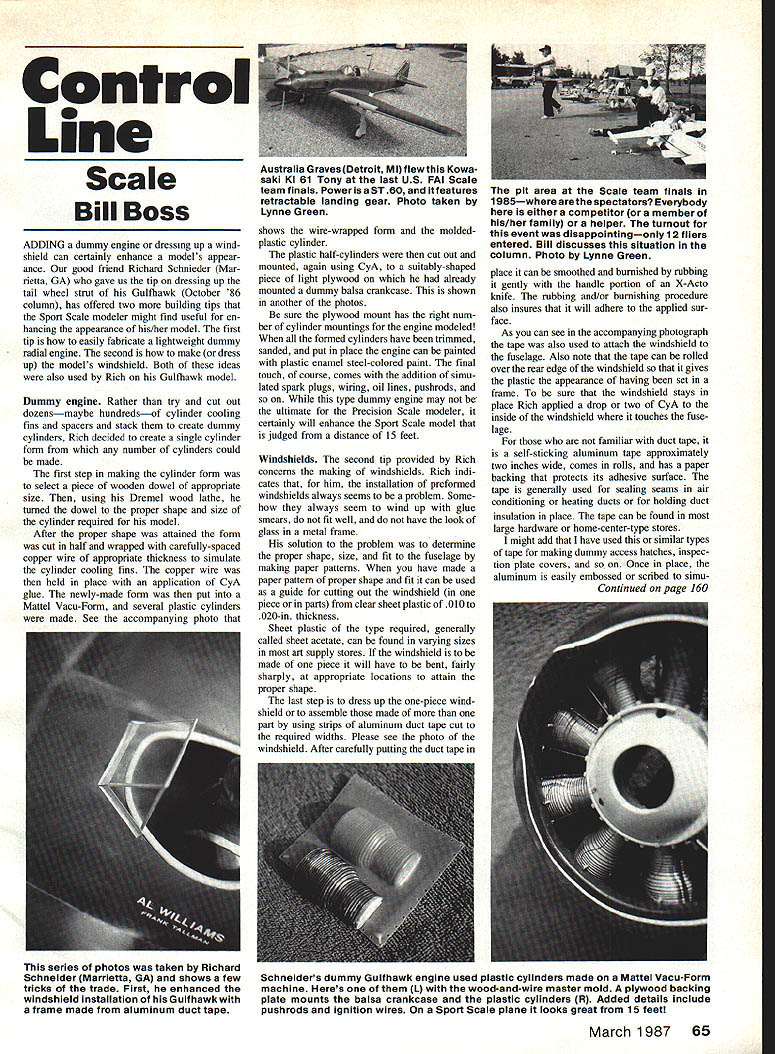
ADDING a dummy engine or dressing up a windshield can certainly enhance a model's appearance. Our good friend Richard Schneider (Marietta, GA), who gave us the tip on dressing up that tail wheel strut of his Gulfhawk (October '86 column), has offered two building tips the Sport Scale modeler might find useful for enhancing the appearance of his/her model. The first tip is how to easily fabricate a lightweight dummy radial engine. The second is how to make a dress-up windshield. Both ideas were used by Rich on his Gulfhawk model.
Dummy engine
Rather than cutting out dozens—maybe hundreds—of cylinder cooling fins and spacers and stacking them to create dummy cylinders, Rich decided to create a single cylinder form from which any number of cylinders could be made.
Steps:
- Select a piece of wooden dowel of the appropriate size.
- Using a Dremel wood lathe, turn the dowel to the proper shape and size for the cylinder required.
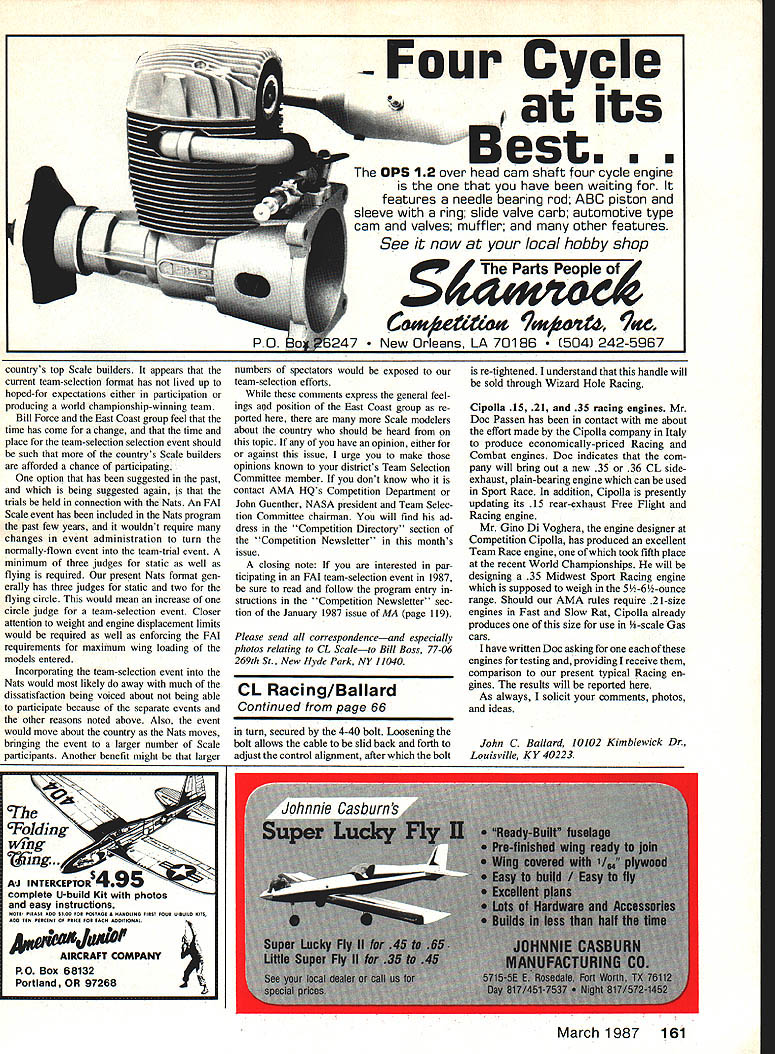
- Cut the formed dowel in half and wrap each half with carefully spaced copper wire of appropriate thickness to simulate the cylinder cooling fins.
- Hold the wire in place with a thin application of CyA (cyanoacrylate) glue.
- Put the wire-wrapped form into a Mattel Vacu-Form and make several plastic cylinders from sheet plastic.
After forming:
- Cut out the plastic half-cylinders and mount them (again using CyA) to a suitably shaped piece of light plywood on which a dummy balsa crankcase has been mounted. Be sure the plywood mount has the correct number of cylinder mountings for the engine being modeled.
- Trim and sand the formed cylinders, put them in place, and paint the engine with plastic enamel (steel color is typical).
- Add final details: simulated spark plugs, wiring, oil lines, pushrods, etc.
Notes:
- This method may not be ultimate for the Precision Scale modeler, but it will greatly enhance a Sport Scale model that is judged from a distance of 15 feet.
- The method is preferable to using "chicken sticks," since it eliminates the possibility of shattering props, which can become hazardous flying objects.
Windshields
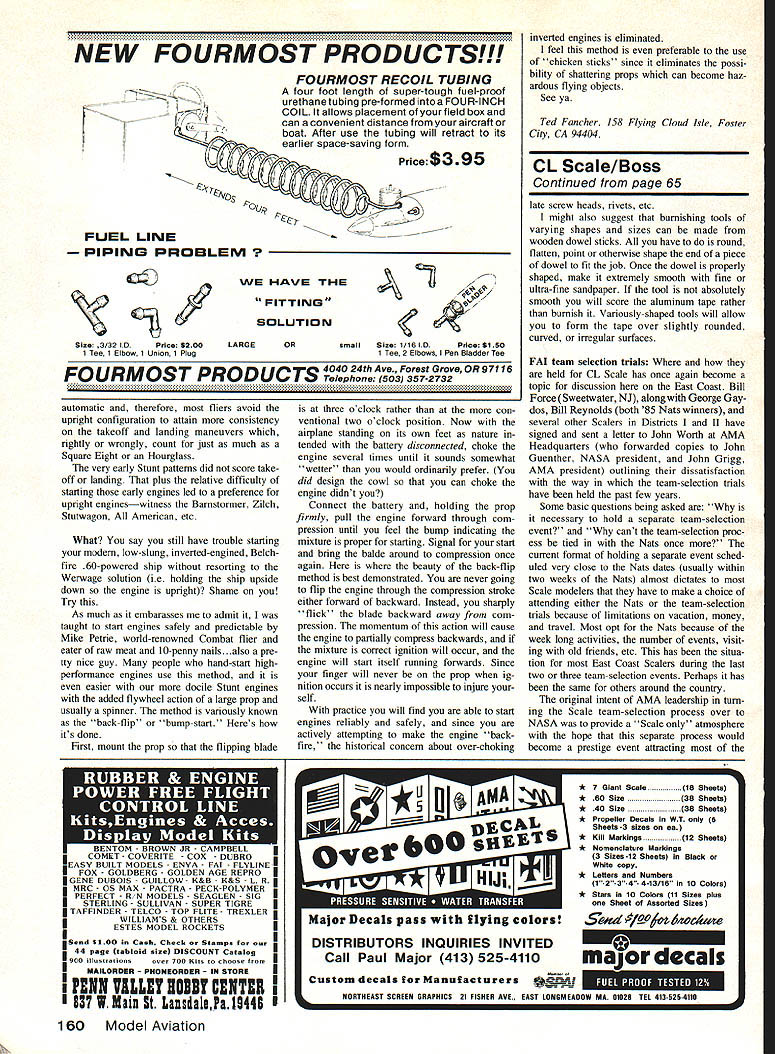
Rich finds preformed windshields often problematic: glue smears, poor fit, and a lack of the look of glass in a metal frame. His solution is to make patterns and build the windshield from sheet plastic.
Steps:
- Make paper patterns to determine the proper shape, size, and fit to the fuselage.
- Use the paper pattern as a guide to cut the windshield (one piece or multiple parts) from clear sheet plastic 0.010–0.020 in. thick (sheet acetate is commonly used and available at art-supply stores).
- If using one piece, bend it at the appropriate locations to attain the proper shape.
Dress-up and attachment:
- Cut strips of aluminum duct tape (aluminum HVAC tape, about 2 in. wide, with a paper backing) to the required widths and apply them as the windshield frame.
- Burnish the tape by rubbing gently with the handle of an X-Acto knife to ensure adhesion and a smooth finish.
- The tape can also be used to attach the windshield to the fuselage and can be rolled over the rear edge to give the plastic the appearance of being set in a frame.
- Apply a drop or two of CyA to the inside of the windshield where it touches the fuselage to help secure it.
Additional tips:
- The aluminum tape can be embossed or scribed to simulate screw heads, rivets, inspection plates, etc.
- Make burnishing tools from wooden dowel sticks: shape the end (round, flattened, pointed), then smooth with fine or ultrafine sandpaper. If the tool is not absolutely smooth you will score the aluminum tape rather than burnish it. Various shapes let you form the tape over rounded or irregular surfaces.
FAI team selection trials
FAI team selection trials for CL Scale have become a topic of discussion on the East Coast. Bill Force (Sweetwater, NJ), George Gaydos, Bill Reynolds (both '85 Nats winners), and several other Scalers in Districts I and II signed and sent a letter to John Worth at AMA Headquarters (copies forwarded to John Guenther, NASA president, and John Grigg, AMA president) outlining their dissatisfaction with recent team-selection trials.
Concerns raised:
- Why is it necessary to hold a separate team-selection event?
- Why can’t the team-selection process be tied more closely to the Nats?
Points made:
- The separate event is often held very close to the Nats (usually within two weeks), forcing many Scalers to choose between attending the Nats or the team-selection trials due to vacation, money, and travel limitations.
- Most Scalers come to the Nats for the week-long activities, the number of events, and visiting with friends—factors that have led many East Coast Scalers to skip separate trials.
- The original intent of turning Scale team-selection over to NASA was to create a "Scale-only" atmosphere and make the event a prestige attraction for top Scalers. If that result hasn’t been achieved, the format should be revisited.
See ya,
Ted Faucher 158 Flying Cloud Isle Foster City, CA 94404
Transcribed from original scans by AI. Minor OCR errors may remain.

