
Control Line: Scale
Bill Boss
SPRINGTIME is preparation time. Bob Emmett of the Seattle Skyraiders suggested in a recent Skywriter column that the spring months are a good time for reflection on last year's contest performance. He thought that perhaps the time could be used to consider some basic, non-rulebook rules for use both on and off the flying field: ones that could make the coming competition season more successful and enjoyable for you.
While the rules Bob spoke of were general in nature and would apply to most events, I have, with some modification, made them apply specifically to our Scale events. The rules are:
- Know the rules for your particular Scale event.
- Be sure to read and know the rules (AMA or local) for the event(s) being flown.
- Know the number of laps of flight it takes to make an official flight.
- Know the proper flying line size for the weight of your model.
- Are mufflers required at the particular contest site?
- Know your flight options and points for each, and so on.
- Have proper documentation for the Scale event in which you will be participating.
- Remember that there is a considerable difference in documentation requirements between Sport Scale and Precision Scale events. In Sport Scale there is only a maximum of six pages of documentation allowed, while the Precision event has no set limitation.
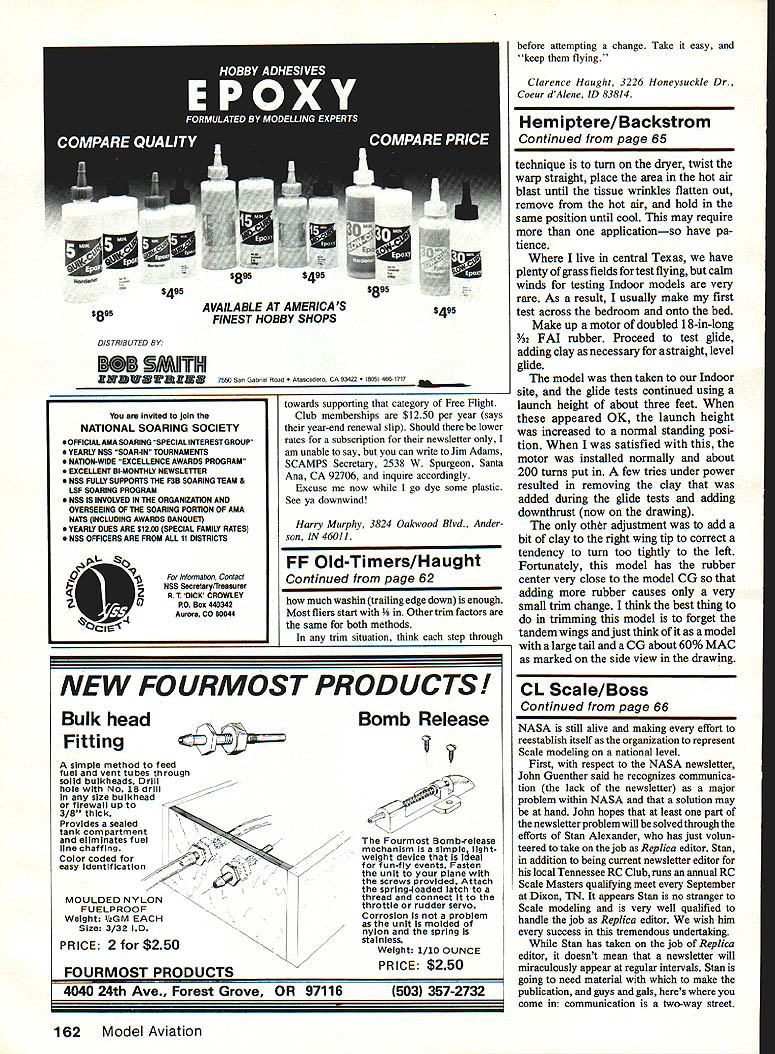
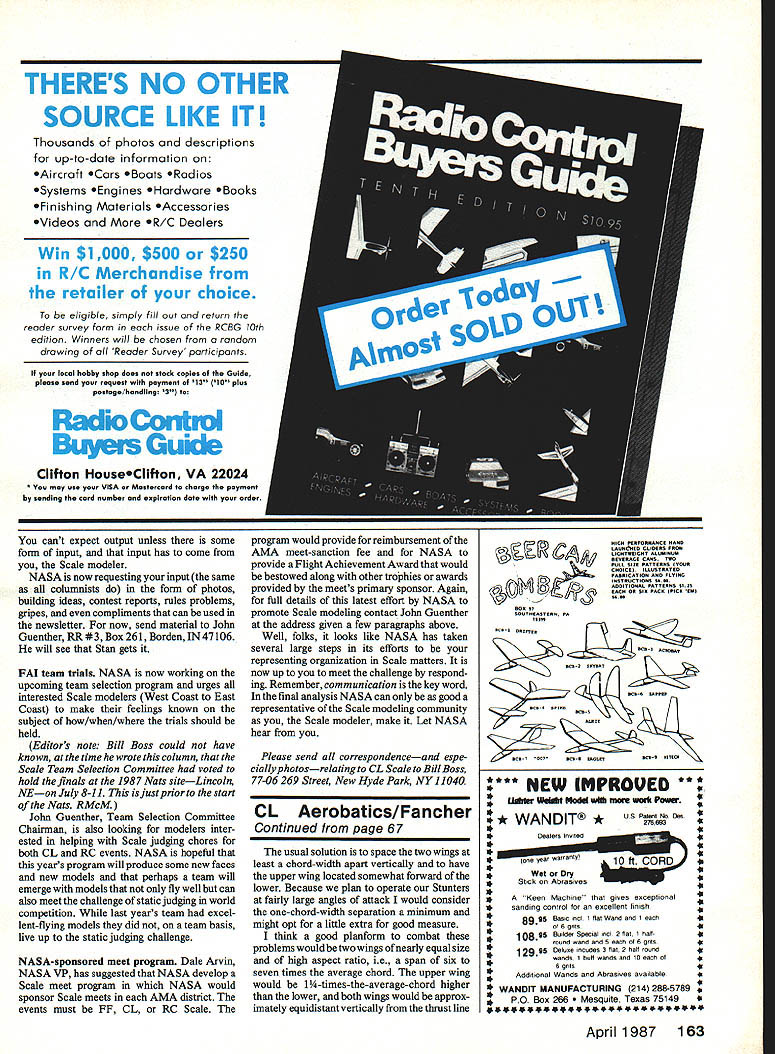
- Be sure to provide a good three-view (or more) drawing and appropriate proof of color and markings of the subject aircraft.
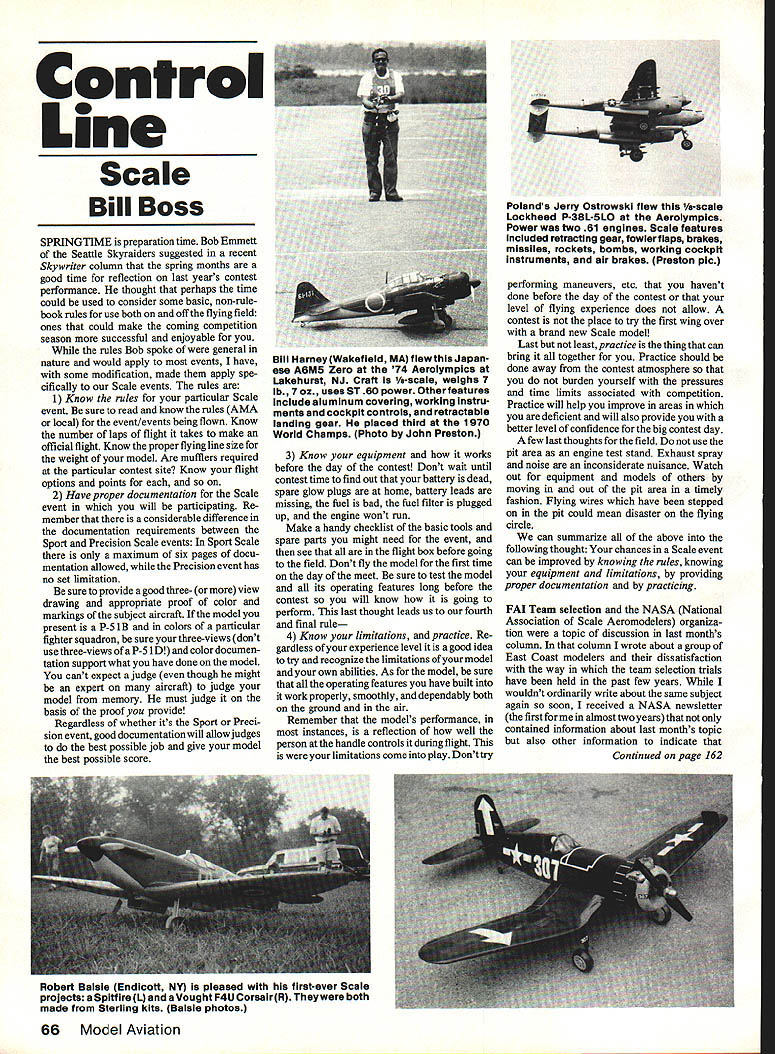
- If the model you present is a P-51B and in the colors of a particular fighter squadron, be sure your three-views (don't use three-views of a P-51D) and color documentation support what you have done on the model.
- You can't expect the judge (even though he might be an expert on many aircraft) to judge your model from memory. He must judge it on the basis of the proof you provide.
- Regardless of whether it's the Sport or Precision event, good documentation will allow judges to do the best possible job and give your model the best possible score.
- Know your equipment and how it works before the day of the contest!
- Don't wait until contest time to find out that your battery is dead, spare glow plugs are at home, battery leads are missing, the fuel is bad, the fuel filter is plugged up, and the engine won't run.
- Make a handy checklist of the basic tools and spare parts you might need at the event, and then see that all are in the flight box before going to the field.
- Don't fly the model for the first time on the day of the meet. Be sure to test the model and all its operating features long before the contest so you will know how it is going to perform.
- Know your limitations, and practice.
- Regardless of your experience level it is a good idea to recognize the limitations of your model and your own abilities.
- Be sure that all the operating features you have built into the model work properly, smoothly, and dependably both on the ground and in the air.
- Remember that the model's performance, in most instances, is a reflection of how well the person at the controls is during flight. Don't try performing maneuvers that you haven't practiced before the day of the contest or that your level of flying experience does not allow.
- A contest is not the place to try the first wing-over with a brand new Scale model.
- Practice should be done away from the contest atmosphere so that you do not burden yourself with the pressures and time limits associated with competition. Practice will help you improve in areas in which you are deficient and will also provide you with a better level of confidence for the big contest day.
A few last thoughts for the field:
- Do not use the pit area as an engine test stand. Exhaust spray and noise are an inconsiderate nuisance.
- Watch out for equipment and models of others moving in and out of the pit area in a timely fashion.
- Flying wires stepped into in the pit could mean disaster for the flying circle.
We can summarize all of the above into the following thought: your chances in a Scale event can be improved by knowing the rules, knowing the number of laps, knowing your equipment and limitations, by providing proper documentation, and by practicing.
NASA and FAI Team Selection
FAI team selection and the NASA (National Association of Scale Aeromodelers) organization were a topic of discussion in last month's column. In that column I wrote about a group of East Coast modelers and their dissatisfaction with the way in which the team selection trials have been held in the past few years. While I wouldn't ordinarily write about the same subject again so soon, I received a NASA newsletter (the first for me in almost two years) that not only contained information about last month's topic but also other information to indicate that NASA is still alive and making every effort to reestablish itself as the organization to represent Scale modeling on a national level.
First, with respect to the NASA newsletter, John Guenther said he recognizes communication (the lack of the newsletter) as a major problem within NASA and that a solution may be at hand. John hopes that at least one part of the newsletter problem will be solved through the efforts of Stan Alexander, who has just volunteered to take on the job as Replica editor. Stan, in addition to being current newsletter editor for his local Tennessee RC Club, runs an annual RC Scale Masters qualifying meet every September at Dixon, TN. It appears Stan is no stranger to Scale modeling and is very well qualified to handle the job as Replica editor. We wish him every success in this tremendous undertaking.
While Stan has taken on the job of Replica editor, it doesn't mean that a newsletter will miraculously appear at regular intervals. Stan is going to need material with which to make the publication, and guys and gals, here's where you come in: communication is a two-way street. You can't expect output unless there is some form of input, and that input has to come from you, the Scale modeler.
NASA now is requesting your input (the same as all columnists do) in the form of photos, building ideas, contest reports, rules problems, gripes, and even compliments that can be used in the newsletter. For now, send material to John Guenther, RR #3, Box 261, Borden, IN 47106. He will see that Stan gets it.
NASA is now working on the upcoming team selection program and urges all interested Scale modelers (West Coast to East Coast) to make their feelings known on the subject of how/when/where the trials should be held.
(Editor's note: Bill Boss could not have known, at the time we wrote this column, that the Scale Team Selection Committee had voted to hold the finals at the 1987 Nats site — Lincoln, NE — on July 8-11. This is just prior to the start of the Nats. R. McM.)
John Guenther, Team Selection Committee Chairman, is also looking for modelers interested in helping with Scale judging chores at both CL and RC events. NASA is hopeful that this year's program will produce some new faces and new models and that perhaps a team will emerge which will not only fly well but can also meet the challenge of static judging in world competition. While last year's team had excellent flying models they did not, on a team basis, live up to the static judging challenge.
NASA-sponsored Meet Program
Dale Arvin, NASA VPS, has suggested that NASA develop a Scale meet program in which NASA would sponsor Scale meets in each AMA district. The events must be FF, CL, or RC Scale. The program would provide for reimbursement of the AMA meet-sanction fee and for NASA to provide a Flight Achievement Award that would be bestowed along with other trophies or awards provided by the meet's primary sponsor. For full details of this effort to promote Scale modeling contact John Guenther at the address given above.
Well, folks, it looks like NASA has taken several large steps in its efforts to be your representing organization in Scale matters. It is now up to you to meet the challenge by responding. Remember, communication is the key word. In the final analysis NASA can only be as good a representative of the Scale modeling community as you, the Scale modeler, make it. Let NASA hear from you.
Contacts
- Send material for the NASA newsletter (photos, building ideas, contest reports, rules problems, etc.) to:
John Guenther RR #3, Box 261 Borden, IN 47106
- Please send all correspondence—and especially photos—relating to CL Scale to:
Bill Boss 77-06 269 Street New Hyde Park, NY 11040
Transcribed from original scans by AI. Minor OCR errors may remain.

