
Control Line: Scale
By Bill Boss
Guest Modeler: George Gaydos, Jr.
During the past few months you probably have noticed the name of George Gaydos, Jr. (Elmwood Park, NJ) in this column with respect to the Garden State Circle Burners' annual Scale contests, Profile Scale rules and, recently, in connection with comments on the U.S. FAI CL Scale team-selection program.
George is one of those modelers who, while not well-known as yet on the national level, is well-known in the Northeast as a tireless promoter of CL Scale modeling. On a national level, George recently fulfilled a longtime ambition by capturing first place in Precision Scale at the 1985 Westover Nationals.
With more than 25 years of Scale modeling and finally a Nationals victory, George has asked that he be able to pass on some of his thoughts and comments on the subject of CL Scale modeling in this column. His thoughts and comments follow.
"I have asked Bill Boss to allow me to speak to all of my fellow CL Scale modelers through this column on the subject of getting involved in the CL Scale events on a competition level. I am not an expert on the subject, but I feel that my 30 years of CL model building and flying (over 25 of those years in CL Scale) gives me knowledgeable insight where the hobby—and particularly Scale—is concerned.
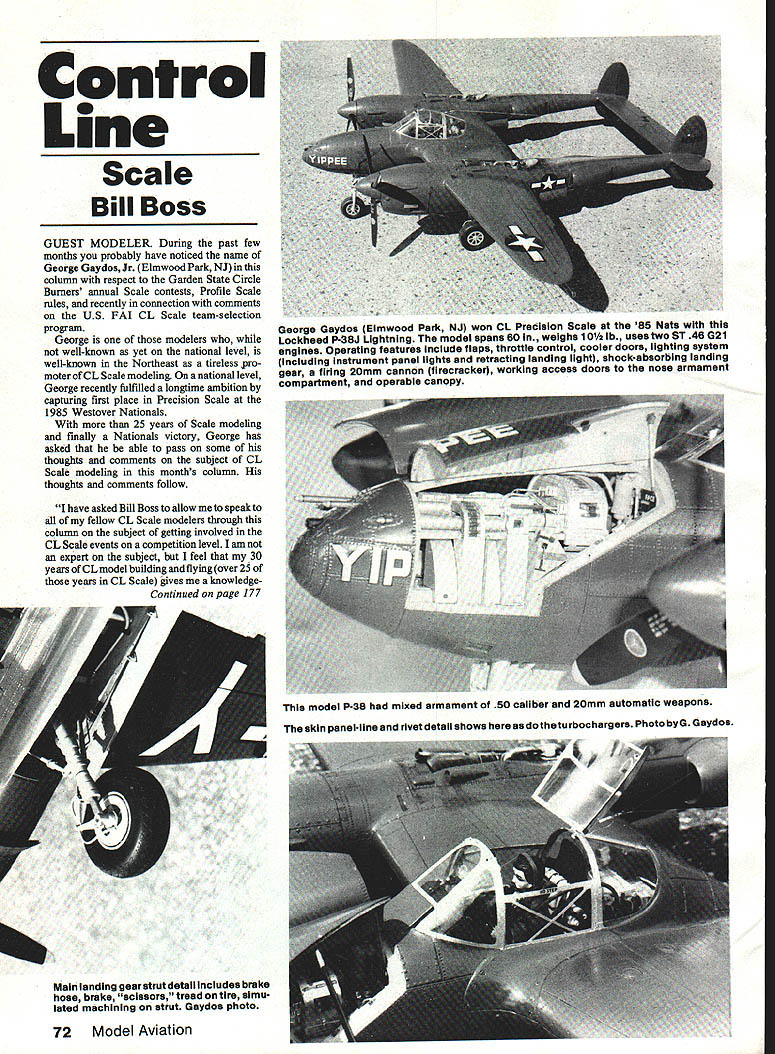
On these pages are some pictures of my 1985 Open-class, Precision Scale, Nats-winning P-38J Lightning known as YIPPEE! The airplane is bright red and the YIPPEE! name on the nose and under the wing signifies that this was P-38 number 5,000 to come off the assembly line during the 1940 war years.
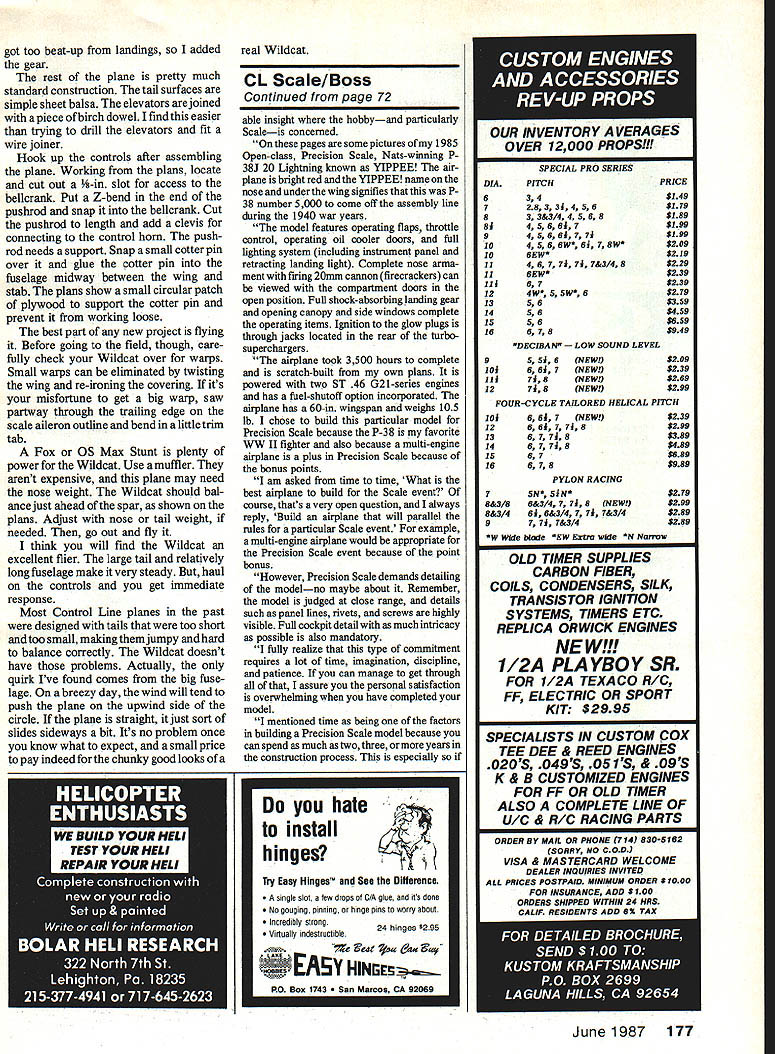
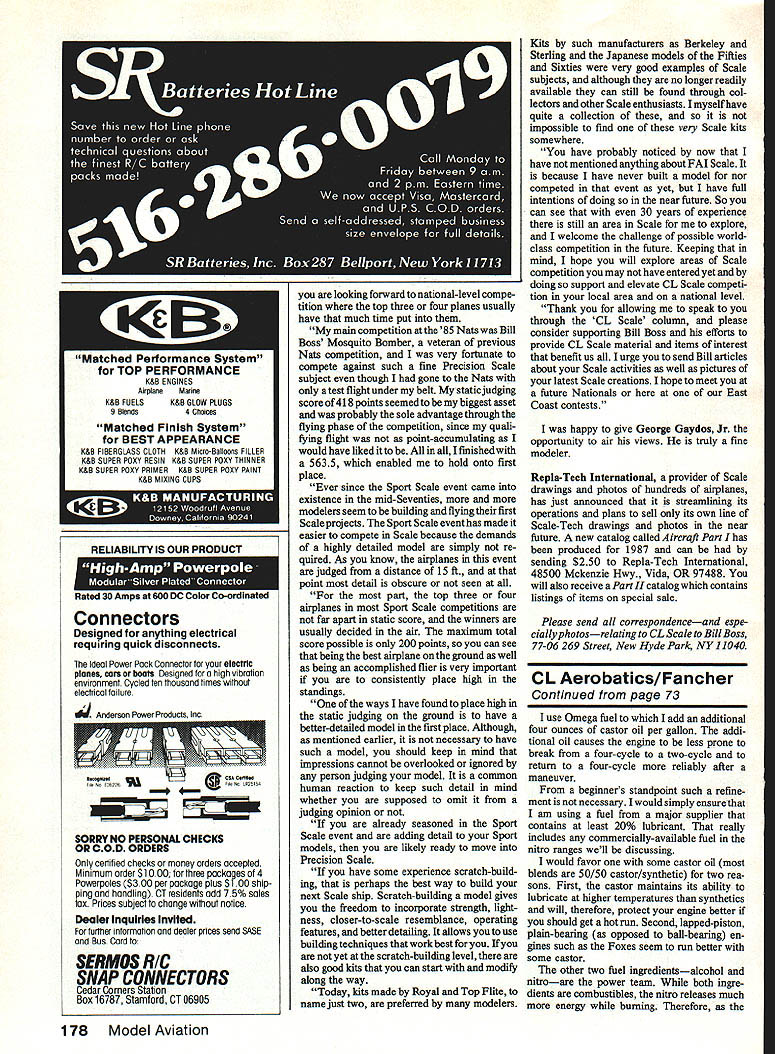
The model features operating flaps, throttle control, operating oil cooler doors, and a full lighting system (including instrument panel and retracting landing light). Complete nose armament with firing 20mm cannon (firecrackers) can be viewed with the compartment doors in the open position. Full shock-absorbing landing gear and opening canopy and side windows complete the operating items. Ignition to the glow plugs is through jacks located in the rear of the turbo-superchargers.
The airplane took 3,500 hours to complete and is scratch-built from my own plans. It is powered with two ST 46 G21-series engines and has a fuel-shutoff option incorporated. The airplane has a 60-inch wingspan and weighs 10.5 lb. I chose to build this particular model for Precision Scale because the P-38 is my favorite WWII fighter and also because a multi-engine airplane is a plus in Precision Scale because of the bonus points.
I am asked from time to time, "What is the best airplane to build for the Scale event?" Of course that's a very open question, and I always reply, "Build an airplane that will parallel the rules for a particular Scale event." For example, a multi-engine airplane would be appropriate for the Precision Scale event because of the point bonus.
However, Precision Scale demands detailing of the model—no maybe about it. Remember, the model is judged at close range and details such as panel lines, rivets, and screws are highly visible. Full cockpit detail with as much intricacy as possible is also mandatory.
I fully realize that this type of commitment requires a lot of time, imagination, discipline, and patience. If you can manage to get through all of that, I assure you the personal satisfaction is overwhelming when you have completed your model.
I mentioned time as being one of the factors in building a Precision Scale model because you can spend as much as two, three, or more years in the construction process. This is especially so if you plan to build a model that has many operating features.
I have found that the best advice for the person who plans to build a Precision Scale model is to plan the sequence of work and try to do a job that will keep the project moving forward—don't start a lot of small projects that will, in effect, dilute your effort and time.
Also, keep careful notes and photographs of the prototype airplane. I have found that my best information comes from period photographs and factory manuals. If you can get access to factory blueprints, so much the better.
Finally, try to get involved with other modelers who can offer advice and the benefit of their experience. Scale modelers are generally helpful people and will be glad to share their knowledge.
Kits by such manufacturers as Berkeley and Sterling and the Japanese models of the Fifties and Sixties were very good examples of Scale subjects, and although they are no longer readily available they can still be found through collectors and other Scale enthusiasts. I myself have quite a collection of these, and so it is not impossible to find one of these very Scale kits somewhere.
You have probably noticed by now that I have not mentioned anything about FAI Scale. It is because I have never built a model for nor competed in that event as yet, but I have full intentions of doing so in the near future. So you can see that with even 30 years of experience there is still an area in Scale for me to explore, and I welcome the challenge of possible world-class competition in the future. Keeping that in mind, I hope you will explore areas of Scale competition you may not have entered yet and by doing so support and elevate CL Scale competition in your local area and on a national level.
Thank you for allowing me to speak to you through the "CL Scale" column, and please consider supporting Bill Boss and his efforts to provide CL Scale material and items of interest to the benefit of us all. I urge you to send Bill articles about your Scale activities as well as pictures of your latest Scale creations. I hope to meet you at future Nationals or here at one of our East Coast contests."
I was happy to give George Gaydos, Jr. the opportunity to air his views. He is truly a fine modeler.
Please send all correspondence—and especially photos—relating to CL Scale to:
Bill Boss 77-06 269 Street New Hyde Park, NY 11040
Transcribed from original scans by AI. Minor OCR errors may remain.

