
Control Line: Scale
Bill Boss
New Items
As usual for me at this time of year (late February), I pay a visit to the WRAMS modeling trade show in Yonkers, NY to see what I can find in the great world of things RC that might be of some use to Control Line fliers in their Scale endeavors.
This year's show appeared much bigger — and perhaps better — than in past years due to being held at a new site: Yonkers Raceway. All displays were on one level and were pretty well accessible. Certainly a major improvement was the ample parking situation. It wasn't necessary to drive around for a half hour or so to find a parking space, and then have a six- or seven-block walk to the show.
One of the very nice things about this type of show is that you have the opportunity to see and visit, at least for a few minutes, with some Scale modeling friends not ordinarily seen unless at a Nats or similar competition. In my case this show usually gives me the chance to see people like Mike Gretz at the Sig booth, Charlie Bower at Top Flite, Harry Higley, and the several people manning the AMA Headquarters booth.
The only disappointing aspect of this particular trade show is that little (if anything) on display is presented with the idea of drawing or appealing to the Control Line aspects of model aviation. The management of the show even prohibits the entry of Control Line Scale models in any of the Scale model competition categories.
I would like to point out to the show management and manufacturers alike that the CL Scale modeler buys, builds, and flies RC Scale kits, as well as engines, wheels, control horns, hinges, covering materials, paints, and numerous other accessories used in our Control Line models. It appears the only thing RC we don't use is the radio, and even in that department more and more of us are turning to digital-type systems for controlling operating features of our models.
I would like to request that the WRAMS reconsider their non-CL participation policy and perhaps have CL included in some way in future shows.
Hobby Lobby had a couple of items that should be of particular interest. The first item is a series of Graupner "Super" three-bladed props that range in size from 9x7 to 16x8. The props are made of rigid nylon, are said to almost equal the stiffness of hardwood blades, and are specially made for use on two- and four-stroke engines from .40 to 2.40 cu. in. displacement. The props range in price from about $5 for the smaller size to about $16 for the 16-inch diameter.
In addition, there are spinners to match the three-bladed props. The spinners come in two sizes, 60 mm (2.36 in. diameter) and 78 mm (3.07 in. diameter), and have short and long nylon cones with pre-cut prop-blade cutouts. The cutouts allow a series of pre-scored breakaway segments which permit an almost perfect fit of the prop blades. The cost of the smaller spinners is just under $9 each, while the larger size is slightly over $9. Both of these items, in addition to being usable for flight, should also look great when properly painted.
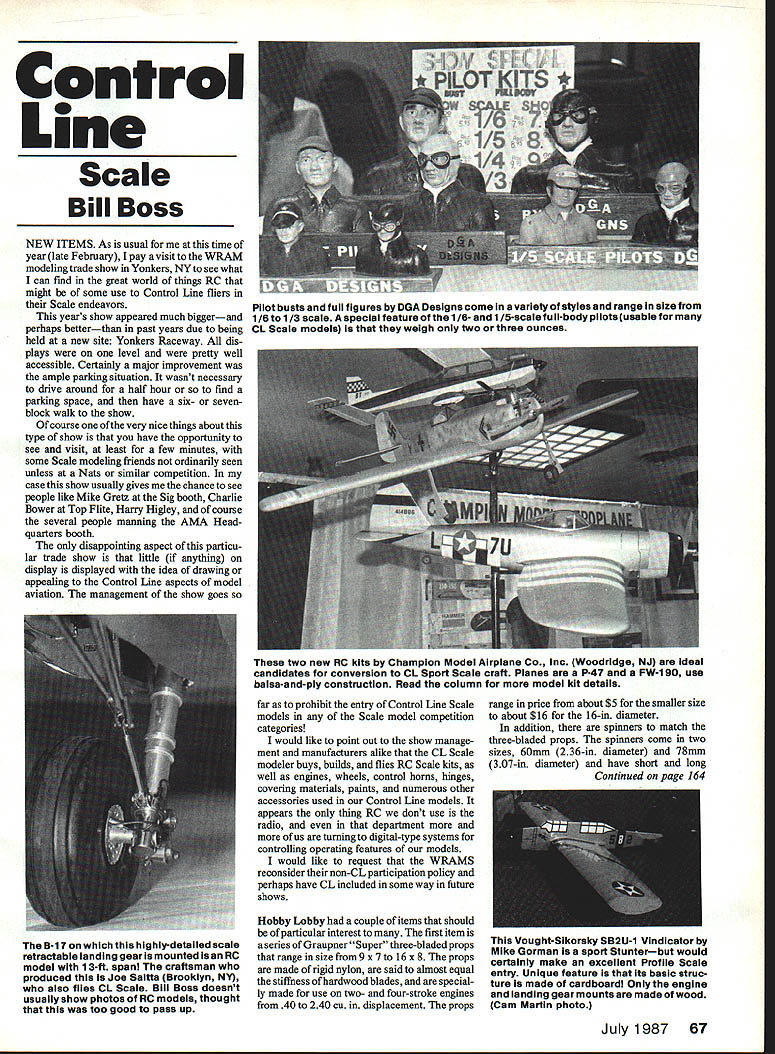
Pilot busts and full figures from DGA Designs come in a variety of styles and range in size from 1/6 to 1/3 scale. A special feature is that the 1/6- and 1/5-scale full-body pilots usable on CL Scale models weigh only two to three ounces.
Two new RC kits from Champion Model Airplane Co., Inc., Woodridge, NJ, are ideal candidates for conversion to CL Sport Scale craft. Planes include the P-47 and FW-190 and use balsa-and-ply construction. (See column for model kit details.)
A B-17 highly detailed scale model with retractable landing gear is a 13-ft span, craftsman-produced kit by Joe Saitta, Brooklyn, NY. It also flies CL Scale.
I don't usually show photos of RC models, but a couple were too good to pass up. The Vought-Sikorsky SB2U-1 Vindicator from Mike Gorman is a sport stunter but would certainly make an excellent profile-scale entry. A unique feature of his model is that its basic structure is made of cardboard; only the engine and landing gear mounts are wood (Cam Martin photo).
Workshop Pamphlets
Robert A. has pamphlets covering wing incidence and several other angle-setting operations pertaining to a model's flying surfaces. If you don't already have these pamphlets, try your local hobby shop or write directly to Robert A., P.O. Box 1247, 310 N. 5th Street, St. Charles, IL 60174. These pamphlets make excellent additions to the workshop reference library.
Champion Model Airplane Co.
Champion Model Airplane Co. (Woodridge, NJ) had on display three examples of RC model kits suitable for Control Line use. The three kits look like good candidates for the Sport Scale event:
- P-47
- F8F Bearcat
- Focke-Wulf FW-190
They are produced as RC kits, have approximately 52-inch wingspans suitable for .40- to .60-size engines, are all of balsa-and-plywood construction, and are said to accept most readily available retract systems.
Scale Colors
Campbell (Cam) Martin of Virginia Beach, VA sent in a note after reading about Hobbypoxy's USAF European One-Color Scheme paint formulas in the February 1987 issue of this column. He had some additional color data on the use of Dark Gray (FS 36801). Cam pointed out that Scale builders might be interested to know that this color was also utilized in U.S. Navy color schemes. The color is also known, in its glossy form, as FS 16081, ANA 513 — Engine Gray or Seaplane Gray. He also noted that the color appears on a variety of Navy aircraft, e.g., the Kaman SH-2A Seasprite, Boeing/Vertol H-46 Sea Knight, and patrol aircraft like the P2V Neptune.
Hobbypoxy has just added Israeli Air Force marking colors to its list of authentic color formulas. The colors are Pale Green (FS 34227), Tan (FS 30129), Sand (FS 33531), and Light Gray (FS 36622).
Two of the colors, Tan and Light Gray, are the same as those used on contemporary USAF aircraft; formulas for them appeared in my August 1985 column.
The other color formulas follow:
- Pale Green (FS 34227): 1 part H70 Gray, 7 parts H47 Bright Yellow, 1 part H24 Dark Blue, 1 part H10 White, and 1 part H57 Bright Orange.
- Sand (FS 33531): 14 parts H55 Pale Cream, 2 parts H70 Gray, 1 part H65 Bright Red, and 1 part H10 White.
When mixing the formulas for the above colors be sure to use the formulas 1:1 with H05 Flat Hardener for the proper matte finish.
In connection with Cam Martin's suggestion regarding alternate uses for some of the published Hobbypoxy formulas, I would be glad to hear from anyone else who has discovered such uses so that I might pass the information on via the column. You might also want to pass such information on to the Pettit Paint Co., 36 Pine Street, Rockaway, NJ 07866.
Contact
Please send all correspondence — especially photos — relating to CL Scale to: Bill Boss 77-06 269th Street New Hyde Park, NY 11040
Transcribed from original scans by AI. Minor OCR errors may remain.

