

Control Line: Scale
Bill Boss 77-06 269th Street New Hyde Park, NY 11040
PROFILE SCALE activity update
During the past several years the Profile Scale event has grown considerably in popularity. Most clubs that consistently promote CL Scale now include Profile Scale on their contest schedules, and the Profile Scale category is also appearing in many mall and trade shows around the country. Rules governing the event still vary regionally, but George Gaydos of the Garden State Circle Burners (GSCB) in New Jersey has worked to bring stability and commonality to many of the rules being used.
In April 1984 I introduced a set of Profile Scale event rules created by the GSCB. The rules were written to entice Stunt fliers (and fliers of other events) to join Scale modelers in Profile Scale. After publication many requested copies of the rules and the score sheet; the GSCB supplied them gladly. While the Profile event has become more popular, some of the hoped-for goals of the original rules did not materialize.
George Gaydos reports that in late 1986 he saw the need to revise the rules. He notes that the expected Stunt interest never developed as hoped — the event quickly settled into being primarily of interest to Scale-minded modelers. Another concern that arose was the desire by several East Coast Scale modelers (especially those active in AMA Precision Scale) for bonus points for multiengine models. Because multiengine models typically require longer construction time and more ingenuity (flaps, throttles, nacelle work, etc.), and because they bear extra risk of engine failure, Gaydos agreed it made sense to include a multiengine bonus.
Other changes were simply clearer definitions and refinements in the rules regarding weight, engine requirements, proof of scale, color and markings, and flight options. Considerable attention has also been given to defining acceptable profile fuselage construction.
PLEASE NOTE: under the GSCB rules the definition of "profile" is as follows: any solid-material fuselage and nacelles with a thickness between 1/4 in. and 1 in. Built-up or former-type construction is not permitted even if it could be kept within the thickness limits. This rule preserves the traditional Control Line profile concept and therefore excludes certain scale construction techniques and operations.
Example model
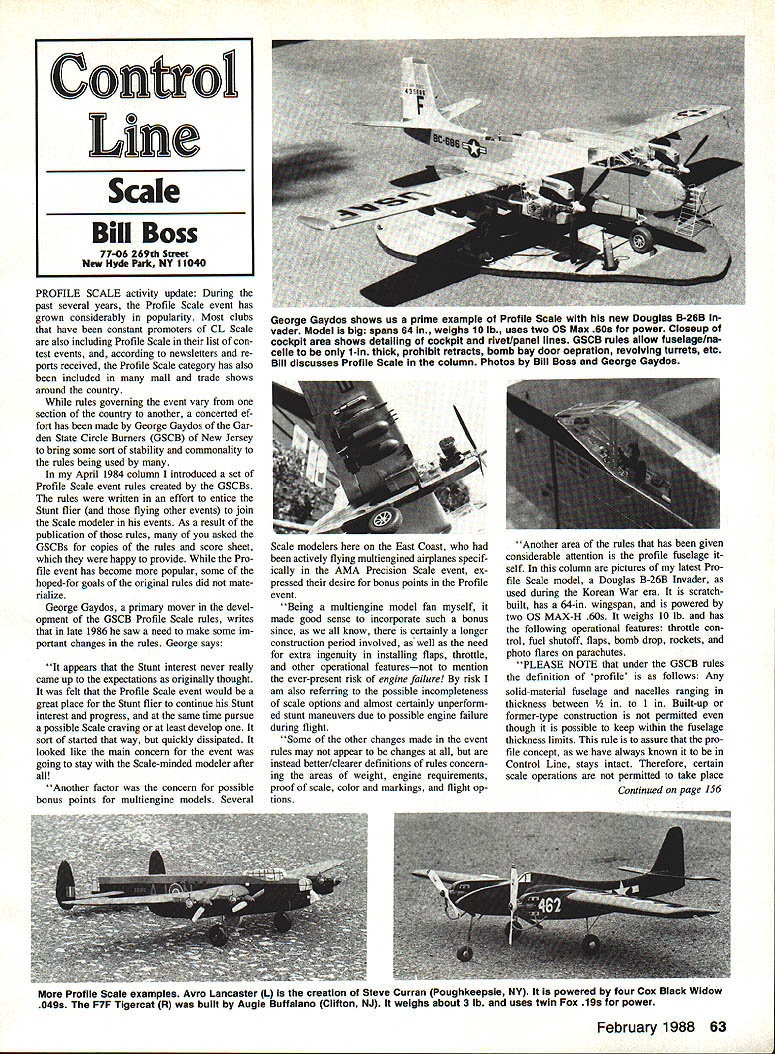
George Gaydos shows a scratchbuilt Profile Scale model of a Douglas B-26B Invader (Korean War era). Specifications and features:
- Wingspan: 64 in.
- Power: two OS MAX-H .60 engines
- Weight: about 10 lb.
- Operational features: throttle control, fuel shutoff, flaps, bomb drop, rockets, photo flares or parachutes
Profile kit availability
A profile kit survey run by Cam Martin of Virginia Beach, VA, on the possibility of producing Bob Spurlin's excellent profile kits (Grumman F8F-2 Bearcat, Douglas A-1G Skyraider, and Chance Vought F4U-5 Corsair) has been completed. Spurlin will be making a limited production run of these kits.
Ordering information:
- Send orders to: P.O. Box 2947, La Grande, OR 97850.
- Prices: Bearcat and Skyraider — $36 each; Corsair — $42.
- Shipping: $2 per model.
- Payment: Visa and MasterCard accepted. No CODs. Allow four to six weeks for delivery.
All three kits are well suited to the Profile Scale event.
Workshop hint: propeller storage and balancing
From Bob Furr (Orbiting Eagles Newsletter, Omaha, NE): Wood propellers contain moisture that can migrate if stored vertically, making one blade heavier over time. In full-size practice wood props are stored horizontally to avoid moisture migration. For best results balance your wooden props just before use, or store them horizontally if they will not be used for an extended period.
Please send all correspondence — and especially photos — relating to CL Scale to the address shown at the beginning of the column.
Fuel-tank and uniflow notes
A fuel tank exhibits higher head pressure at the start of a flight (when full) and much lower pressure at the end (when nearly empty). Because the engine's needle valve setting is fixed, an engine will run richer at the start and leaner at the end unless the tank/feed system compensates. Many fliers set the needle a bit rich at the start to avoid an overly lean condition at the finish.
The uniflow principle helps maintain consistent feed pressure throughout a run. In a uniflow tank the vent tube extends deep into the container, nearly to the fluid outlet (fuel pickup) tube. The result: as long as no other air enters the system, the pressure at the fluid outlet equals the head (distance) between the end of the uniflow tube and the fluid outlet, regardless of the total fuel amount. This keeps engine rpm steady throughout the flight instead of leaning off as the tank empties.
Practical notes on uniflow tanks:
- Position the uniflow tube very close to the fuel pickup tube (about 3/16 in. forward of and directly inboard of the pickup tube) so the system retains its constant feed pressure.
- If the fuel level drops below the uniflow tube the system reverts to straight suction.
- If the uniflow tube is located outboard of the outlet (below it), there will be no head pressure and flow becomes engine-suction dependent. The effective "tank" location is at the end of the uniflow tube — move it and the engine "thinks" the tank moved.
Use of delivery systems to trim performance:
- Suction (overflow open, uniflow capped) tends to give a bit more power at the end of the flight — useful if the model is a bit heavy.
- Uniflow (overflow capped, uniflow open) yields steady engine speed throughout — useful when a steady speed is preferred or when using a larger venturi for more power without worrying about end-of-run starvation.
Practical construction tips:
- Set tanks up so they can be arranged as uniflow or suction by capping the appropriate tube. For uniflow to work, the overflow must be capped. If both tubes are uncapped the system acts as pure suction.
- Bend tanks into the slipstream so airflow doesn't create a siphoning action that could draw out raw fuel. If a commercial tank has short vents, add a short piece of fuel tubing cut at 45° facing into the wind. Siphoning seen on the ground will be worse in the air, possibly creating negative tank pressure and a lean engine.
- Muffler pressure can help by keeping a more constant pressure at the vent tube; it may improve consistency, especially for suction systems, but is not a cure-all.
- High-pressure systems (bladders, crankcase pressure taps) are generally not useful in precision Stunt ships; they are for maximum-rpm applications that need intake sizes too large for adequate suction.
- Mount tanks solidly. Fuel foaming shouldn't be a problem if the nose is properly constructed and vibration is minimized. If a tank can move, it eventually will — secure it.
Fly Stunt!
Transcribed from original scans by AI. Minor OCR errors may remain.

