
Control Line: Scale
Bill Boss 77-06 269th Street New Hyde Park, NY 11040
Bonding and Adhesives
Bonding and adhesives are subjects for which Chris Shearer, member of the Orbiting Eagles of Omaha, has some words for us. While Chris appears to be more into Combat than Scale, his comments on bonding and adhesives apply to all of us.
Chris begins by noting that most of us are certainly aware of the importance of adhesives, but are we all aware of the importance of a bond? A bond is made up of an adhesive and the contact between the surfaces being bonded. Most modern adhesives are extremely good at bonding two materials as long as the materials make good contact. Problems occur when the two materials being bonded do not make good contact.
From his own experience, Chris relates that poor bonding can be costly. Some time ago he built a number of Slow Combat planes, some of which had spots where surfaces to be glued did not make good contact. He later found that the planes with poor bonds did not stand up to the stresses of hard landings and crashes, thus limiting some of the models' flying times.
The lesson, whether you're a novice or an experienced builder, is to make sure that surfaces to be bonded make proper contact. Don't assume the adhesive will fill the gaps between the surfaces.
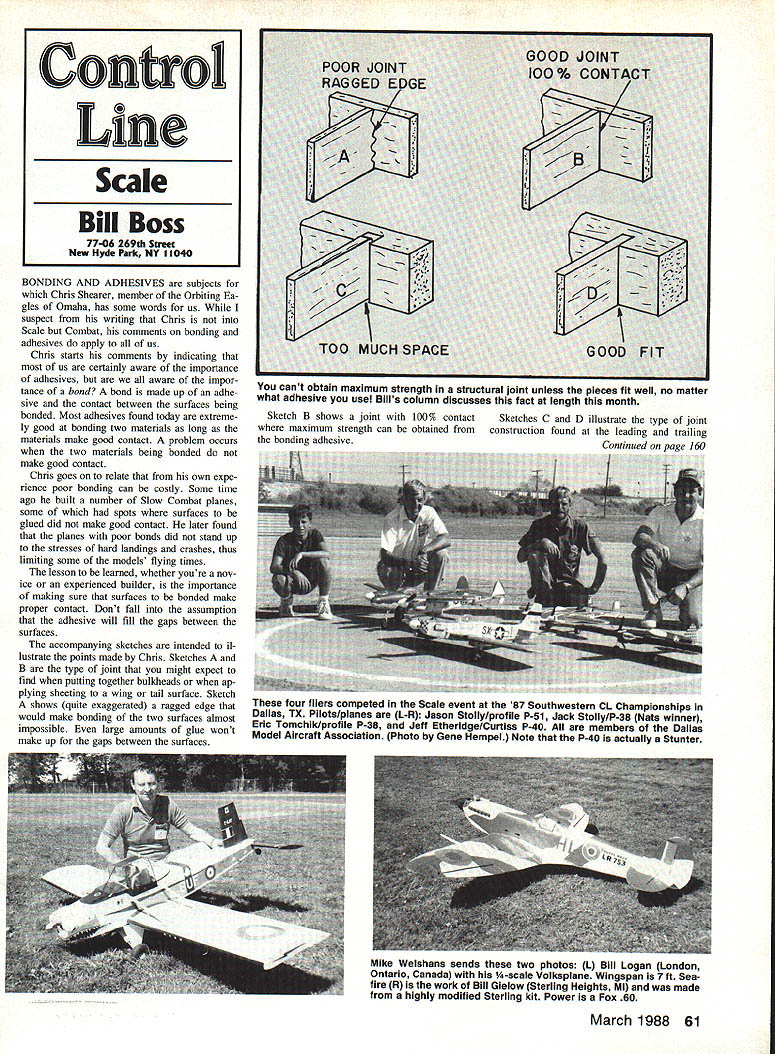
The accompanying sketches are intended to illustrate Chris's points. Sketches A and B are the type of joint you might expect when putting together bulkheads or when applying sheeting to a wing or tail surface. Sketch A shows (quite exaggerated) a ragged edge that would make bonding the two surfaces almost impossible. Even large amounts of glue won't make up for the gaps between the surfaces. You can't obtain maximum strength in a structural joint unless the pieces fit well, no matter what adhesive you use. Bill's column discusses this fact at length this month.
Sketch B shows a joint with 100% contact where maximum strength can be obtained from the bonding adhesive. Sketches C and D illustrate the type of joint construction found at the leading and trailing edge of a wing or tail surface. The gap shown in Sketch C would produce a joint of poor strength and make rib alignment in the wing difficult. Sketch D shows the same joint properly made to provide maximum strength.
The three most-used adhesives modelers work with today are:
- Aliphatic resins ("white glue") — e.g., Elmer's Carpenter Glue, Titebond.
- Cyanoacrylate (CyA).
- Epoxy resin.
Chris observes that modelers are using more epoxy and cyano at the expense of aliphatic resins. We seem to assume epoxy and cyano are better because of their strength and speed of curing. However, aliphatic resins can be just as strong if given proper curing time. In most cases, aliphatic glues will set sufficiently in one hour to permit handling of the bonded structure.
One distinct advantage of aliphatic resins is cost. Using a base cost of approximately $0.10, you can get roughly:
- Four ounces of cyano,
- About 16 ounces of epoxy,
- More than a quart of aliphatic resin.
Chris isn't saying you should stop using epoxy and cyano, but he suggests that aliphatic adhesives certainly have their place in modeling activities.
Hobbypoxy paint formula
The Petit Paint Co. has recently issued another set of its Hobbypoxy Military Color formulas. The new colors are Lemon Yellow and Willow Green, which were used by the U.S. Navy for carrier aircraft identification during the 1930s.
From about the mid-1930s, each aircraft carrier was assigned a particular identifying color painted on the tail surfaces of all the planes from that carrier. The carrier colors were:
- CV-2 Lexington — Lemon Yellow (FS 13555)
- CV-3 Saratoga — White (FS 17875)
- CV-4 Ranger — Willow Green (FS 14187)
- CV-5 Yorktown — Insignia Red (FS 11136)
- CV-6 Enterprise — True Blue (FS 11052)
- CV-7 Wasp — Black (FS 17038)
Reference: U.S. Naval Fighters 1922 to 1950, Aero Publishers.
The new formulas are as follows:
- Lemon Yellow (FS 13555): 3 parts H49 Cub Yellow, 2 parts H47 Bright Yellow, 1 part H40 White, and 2 drops H33 Stinson Green per 3 ounces of base mixed colors.
- Willow Green (FS 14187): 10 parts H47 Bright Yellow, 3 parts H49 Cub Yellow, and 2 parts H24 Dark Blue.
All identification colors were gloss. Use Hobbypoxy H02 Gloss or H06 Quick Spray hardener when mixing these colors.
If the base noted above is used for Hobbypoxy, the color mix is sometimes referred to as "ANA 501 Light Blue" (FS 15102). Insignia Red and Insignia White were originally published by the Petit Co. in 1984 and are also used by the U.S. Navy for carrier aircraft identification. Hobbypoxy formulas for the early colors may be obtained by writing to:
Hobbypoxy Products Petit Paint Co., Inc. 36 Pine St. Rockaway, NJ 07866
Transcribed from original scans by AI. Minor OCR errors may remain.

