
Control Line: Scale
Bill Boss
77-06 269th Street New Hyde Park, NY 11040
Craftsmanship and Static Judging
Craftsmanship is one of the items that all models are judged on when entered in any of the Scale events: CL, RC, or FF. It is also one of the most difficult, subjective, and perhaps least understood areas of the Scale judging process. This was brought out clearly in a recent article by National Association of Scale Aeromodelers (NASA) President John Guenther that appeared in the organization's January–February 1988 newsletter.
John's commentary was lengthy and was prompted, at least in part, by problems he encountered while judging the Craftsmanship category at a recent Scale Masters Championships. While I can't reproduce everything John said (due to column space limits), I want to cover what I see as the heart of his argument about craftsmanship and how it relates to the other two areas of static judging:
- Craftsmanship
- Accuracy of Outline
- Finish, Color, and Markings
John indicated that craftsmanship cannot be treated as an entity unto itself; it must be considered in relation to Accuracy of Outline and Finish, Color, and Markings.
For example, if a model presented for static judging has an outline that does not conform to the three-view drawings, how should the entry be downgraded? For Accuracy of Outline alone? Or should the entry also be downgraded in Craftsmanship?
It would seem appropriate to downgrade for Accuracy of Outline, but shouldn't the modeler's failure to follow the three-view outline also reflect on the level of craftsmanship applied to the model? In other words, doesn't it deserve a downgrade in Craftsmanship as well?
A similar analogy applies to Finish, Color, and Markings. If a modeler applies insignia in accurate colors but in an obviously incorrect size, you would downgrade under Finish, Color, and Markings—but what about the craftsmanship aspects of that work?
In both examples, John believes the modeler should be downgraded in both relevant categories. While I have judged many CL Sport Scale events and tended to consider static categories independently, I now see considerable merit in John's approach.
Part of the problem in judging Craftsmanship stems from the varied ways individuals approach the subject and from the lack of any definition or guidelines for "craftsmanship" in our Scale rules. According to the NASA article, our rule-making cycle will likely address this issue. You should think about this area of judging now, and be prepared to let your AMA district's Scale Contest Board member know your views when the time comes. John Guenther and I would also welcome your comments. Send correspondence to:
- John Guenther, RR #3 Box 281, Borden, IN 47106
- Bill Boss, 77-06 269th Street, New Hyde Park, NY 11040
Fuel Tank Filler Tube Placement
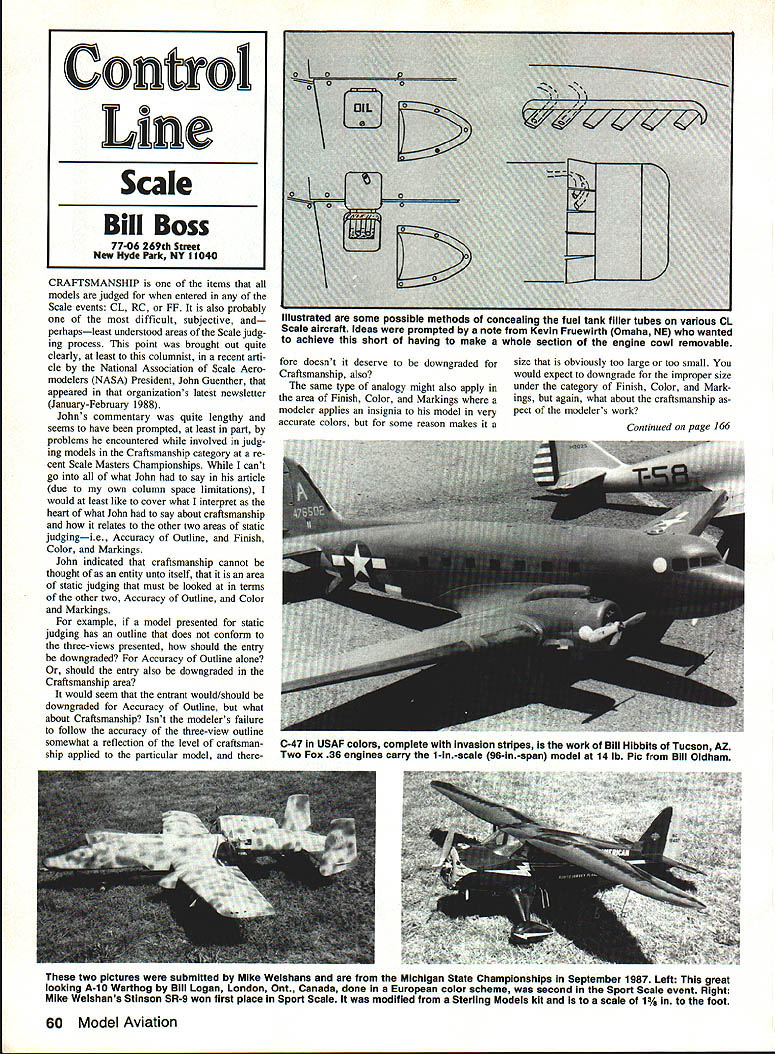
Fuel tank filler tube placement can be a considerable problem when trying to preserve a Scale model's overall appearance. Often a modeler will detail and finish a model extensively, then leave fuel tank filler tubes sticking out somewhere on the cowling. This is similar to an item I covered previously where a plain piano wire was used for a tail-wheel strut after detailed work had been applied to the main landing gear.
This topic was prompted by a note from Kevin Fruewirth, Omaha, NE, asking if there is an easier way to hide fuel tank filler tubes than completely enclosing them in the cowling, as he had done on a PT-19. Removing part of the cowling to access the filler is hardly convenient.
One easy solution is to make the plane's scale-detail oil-filler access door operable and install the fuel tank filler tubes behind it. This works on exhaust-pipe-type filler tubes found on models such as the Fairchild PT-19, North American AT-6, or B-25, which have the exhaust-pipe style behind the cowling. Some late-war fighters had similar provisions.
A close examination of the prototype's tank-filler areas will often reveal some access panel or door that can be made removable and used to conceal the filler tubes. You may need extra work routing the filler lines to the operable access point, and you might need to make a fuel tank of a specific size or shape, but the effort results in a much better-looking model.
Workshop Tip: Carbide Disks
Hint from the workshop of Bob Furr (Orbiting Eagles Newsletter, Omaha, NE): Many of us use carbide cutoff disks in Dremel-type tools to cut music wire and similar materials. Disks sometimes shatter, but Bob says treating the disk with a fast-setting cyanoacrylate glue will make it much stronger. Even after treatment, use safety glasses and exercise care when cutting.
Scale Model Research (SMR) Update
Scale Model Research has added several hundred items to its list of Foto-Paaks, three-view drawings, and other documentation useful to Scale modelers. The latest catalog (about 40 pages) lists over 1,800 Foto-Paaks and claims an inventory of over 50,000 photos. The 3 x 5 in. photo studies cover antiques, Golden Age, military, civilian, helicopters, aerobatic, experimental, sailplanes, racing planes, and prototypes, often showing details modelers need such as landing gear, instrument panels, surface hinging, paint schemes, and markings.
Other SMR services:
- Photo enlargement service, fee based on desired size.
- Research service for information on specific aircraft: $10 per aircraft search, plus 50¢ per photocopied page of data. If a search yields no additional data, half the initial fee ($5) is returned.
To obtain an SMR catalog and full service details, send $3 to: Scale Model Research, 2334 Ticonderoga Way, Costa Mesa, CA 92626.
Call for Contributions
To all CL Scale modelers: One of the most important aspects of this column is the presentation of ideas and photos relating to your activity. Share them with your fellow Scale modelers. Send ideas, comments, or photos to me at the address above.
Transcribed from original scans by AI. Minor OCR errors may remain.

