
Control Line: Scale
Scale documentation is one of the most talked-about and written-about subjects in competitive Scale modeling. In spite of all that has been said or written, some modelers still show up at a contest with documentation that does not match the model presented, or with a model presented with little or no documentation. All your efforts in building a superb model can be negated by not providing proper documentation.
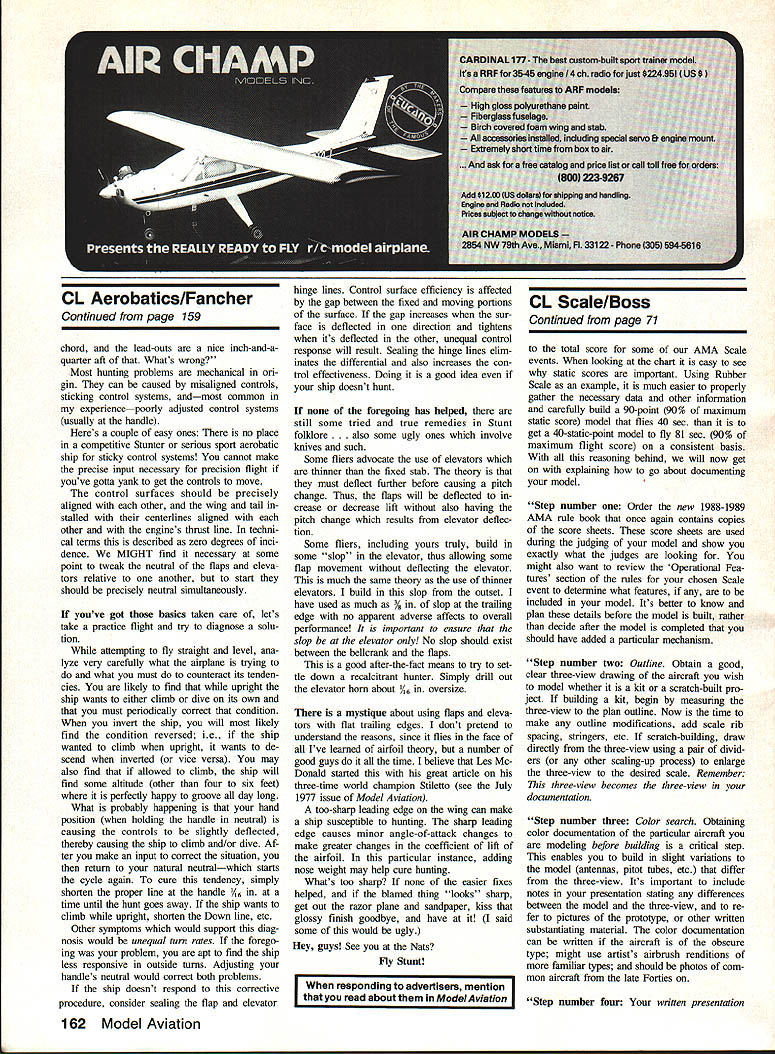
Mike Welshans, a major contributor to this column, sent in his thoughts on Scale documentation that appeared in his club's newsletter. Mike's ideas were prompted by a comment from a fellow Cloudbuster member who said that Scale is not built more widely because documenting a Scale model "is too hard." It is hoped Mike's article will reduce apprehension modelers might feel toward building Scale models and will help modelers understand the importance of proper documentation.
Mike Welshans on Documentation
Mike stated that Scale documentation can be difficult if the subject chosen is rare or obscure, but in many cases the difficulties are created by the modelers themselves.
Although much has been written about gathering information before you begin, many model builders continue to build a beautiful airplane and then begin searching for a three-view drawing and possibly even a color scheme to match. This is not the point to begin looking for the information that will be used for static judging of your model! Keep in mind that as much as 50% to 66% (depending on the AMA Scale event) of your total score is dependent upon the documentation you present with your model.
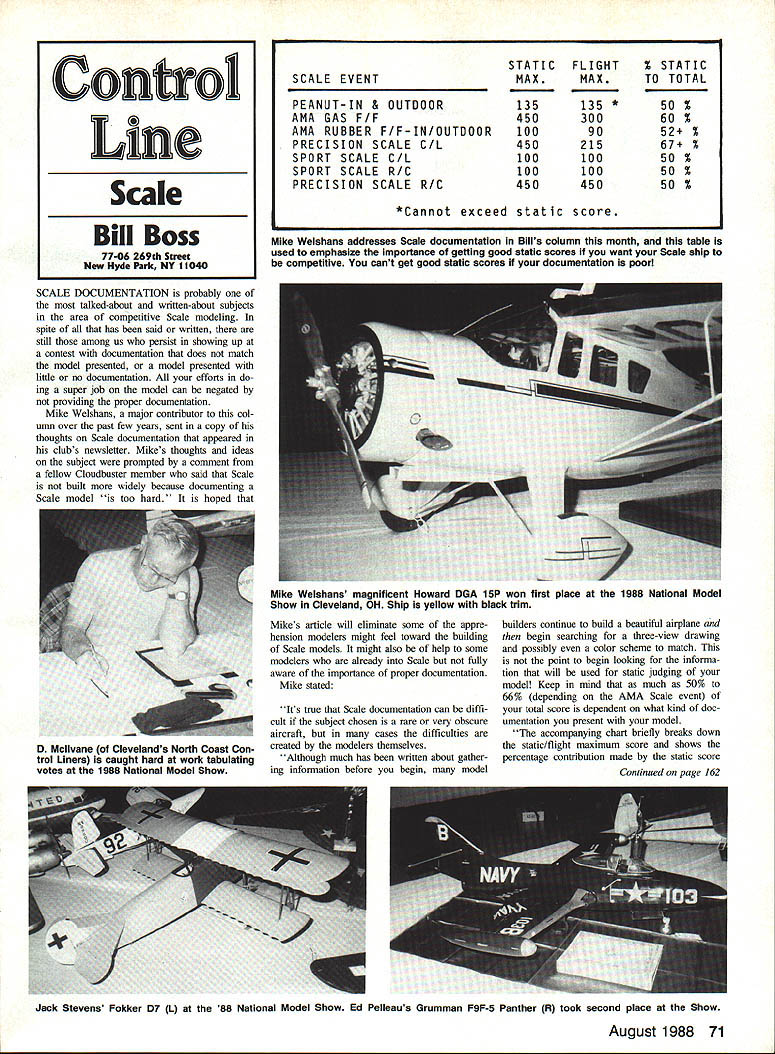
The following chart briefly breaks down the static/flight maximum score and shows the percentage contribution made by the static score.
Scale event scores
- PEANUT-IN & OUTDOOR: Static Max. 135, Flight Max. 135* — 50%
- AMA GAS F/F: Static Max. 450, Flight Max. 300 — 60%
- AMA RUBBER F/F-IN/OUTDOOR: Static Max. 100, Flight Max. 90 — 52%
- PRECISION SCALE C/L: Static Max. 450, Flight Max. 215 — 67%
- SPORT SCALE C/L: Static Max. 100, Flight Max. 100 — 50%
- SPORT SCALE R/C: Static Max. 100, Flight Max. 100 — 50%
- PRECISION SCALE R/C: Static Max. 450, Flight Max. 450 — 50%
*Cannot exceed static score.
It is easy to see why static scores are important. Using Rubber Scale as an example, it is much easier to properly gather the necessary data and carefully build a 90-point (90% of maximum static score) model that flies 40 seconds than it is to get a 40-point model to fly 81 seconds (90% of maximum flight score) on a consistent basis. With that in mind, here is how to go about documenting your model.
Steps to prepare documentation
- Order the rule book
- Order the current AMA rule book (for example, the 1988–1989 rule book) that contains copies of the score sheets. These score sheets are used during judging and show exactly what the judges are looking for.
- Review the "Operational Features" section of the rules for your chosen Scale event to determine what features, if any, should be included in your model. It’s better to plan these details before the model is built.
- Outline
- Obtain a good, clear three-view drawing of the aircraft you wish to model, whether it is a kit or a scratch-built project.
- If building a kit, measure the three-view to the plan outline and make any outline modifications you want (rib spacing, stringers, etc.).
- If scratch-building, draw directly from the three-view using dividers or another scaling method to enlarge the three-view to the desired scale.
- Remember: this three-view becomes the three-view in your documentation.
- Color search
- Obtain color documentation of the particular aircraft before building. This lets you include small details (antennas, pitot tube, etc.) that may differ from the three-view.
- Include notes in your presentation stating any differences between the model and the three-view, and reference photos or other written substantiating material.
- Color documentation may be written descriptions for obscure types, artist airbrush renditions for familiar types, or photos for common aircraft (especially from the late 1940s on).
- Written presentation
- Keep your written presentation clean and simple. Type it if possible, or print neatly.
- Keep it short; judges do not have time to read a long history. State clearly: what the model is, the scale, the power source, information sources, structure, special notations, and the required declaration (a declaration of what was not built by the modeler is required in AMA events). Sign the page.
- AMA Precision Scale events require a ruler for measuring the model. This can be prepared while doing Step Two. (Sport Scale and Peanut do not require a ruler as part of the presentation.)
- Putting it all together
- Use a cheap loose-leaf binder, divider tabs, and page protectors to make an economical, neat presentation.
- Most AMA Scale events have a page limit for documentation; refer to the current rule book for the number of pages allowed for your event. For example, Sport Scale now has a limit of eight pages.
- A sample Sport Scale presentation might consist of:
- Tab/Section 1 — Craftsmanship: The written portion. Specific notes about any differences between your model and the three-view. Keep it short; one page (two pages maximum).
- Tab/Section 2 — Outline: The three-or-more view drawing of the plane in the scale used. (See the rule book or referenced magazine corrections for required information.)
- Tab/Section 3 — Color and Markings: Color presentation of paint schemes or photos of the prototype. Ensure this data matches exactly what you have done on the model.
- Don’t forget your signed declaration of parts you didn’t make, or the required ruler in the Precision Scale event. If you need instructions for making the ruler, consult the "Unified Scale Judging Regulations" section of the rule book.
- Where to find information
- Ask club members and fellow modelers; many maintain extensive collections of magazines and aviation books and can be a great source.
- If you must pay for reproductions of photos or documents, it’s often a small price to get what you need.
- Reliable sources include:
- Scale Plans and Photo Service, 3209 Madison Avenue, Greensboro, NC 27403
- Scale Model Research, 418 E. Oceanfront #B, Newport Beach, CA 92661
- Sending a self-addressed stamped envelope to scale model shops often produces free literature and promotional brochures from manufacturers.
- Above all, don’t get discouraged if your first models don’t win trophies. Practice and perseverance will pay off. A good, clean, and precise presentation accompanying your model is half the battle. Good luck!
Once again, thanks to Mike Welshans for sharing his words of wisdom.
Please send ideas, comments, and especially photos of CL Scale activity to me at the address listed at the top of my column.
Transcribed from original scans by AI. Minor OCR errors may remain.

