
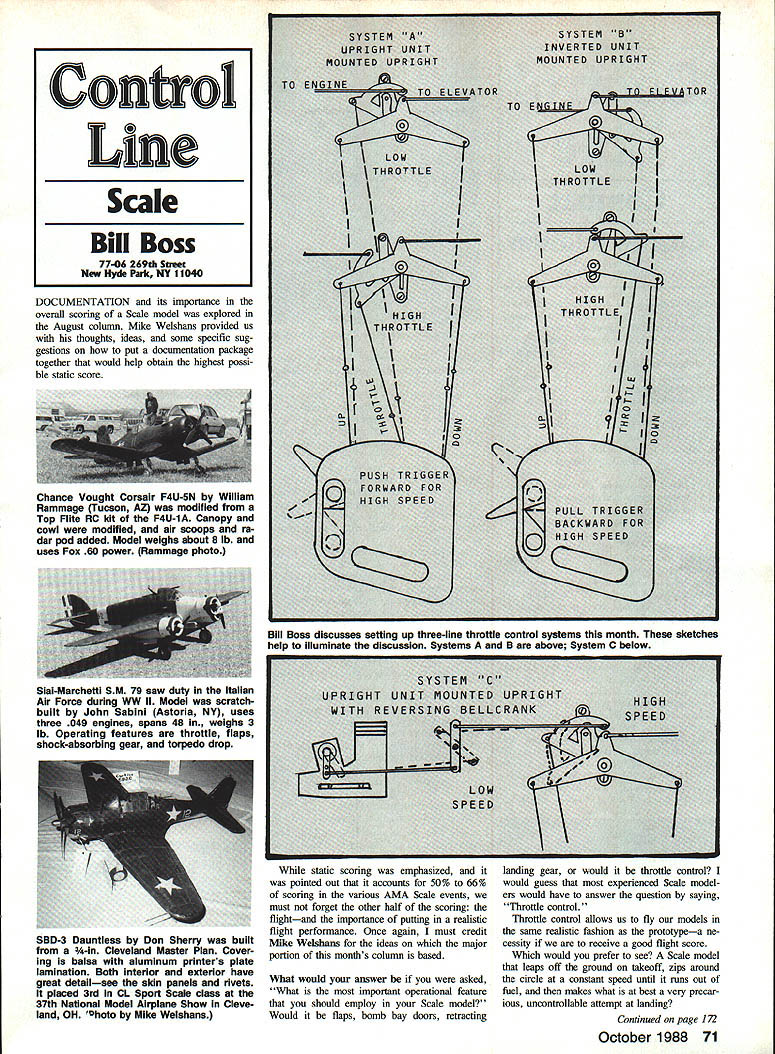
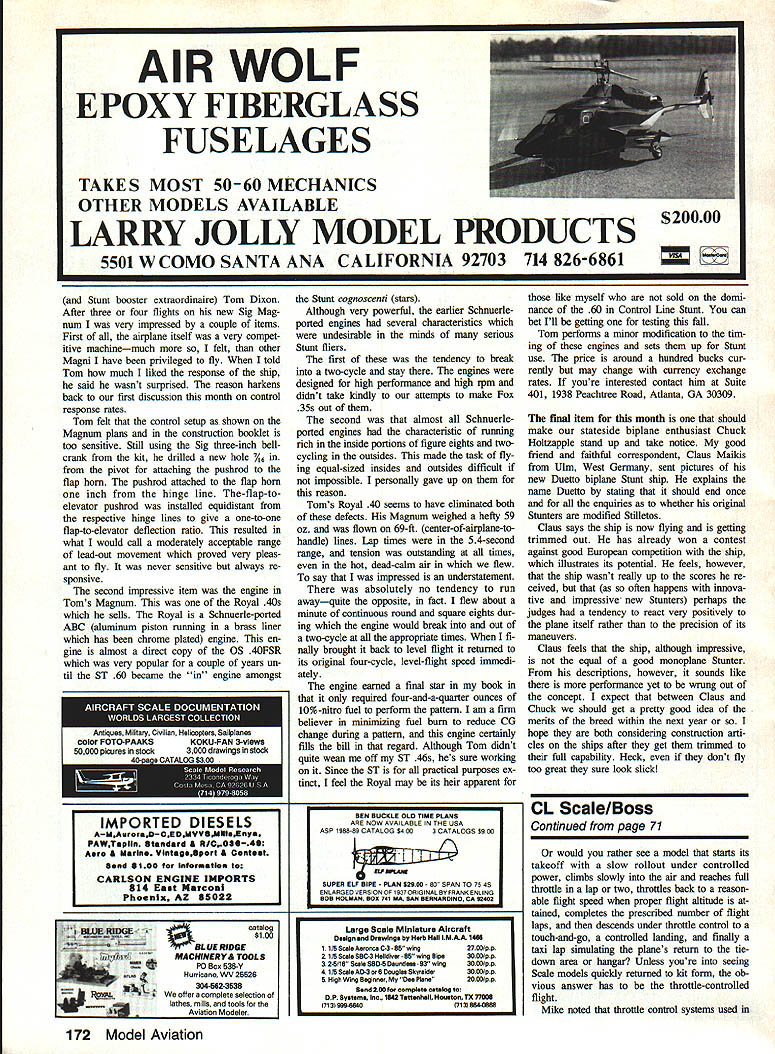
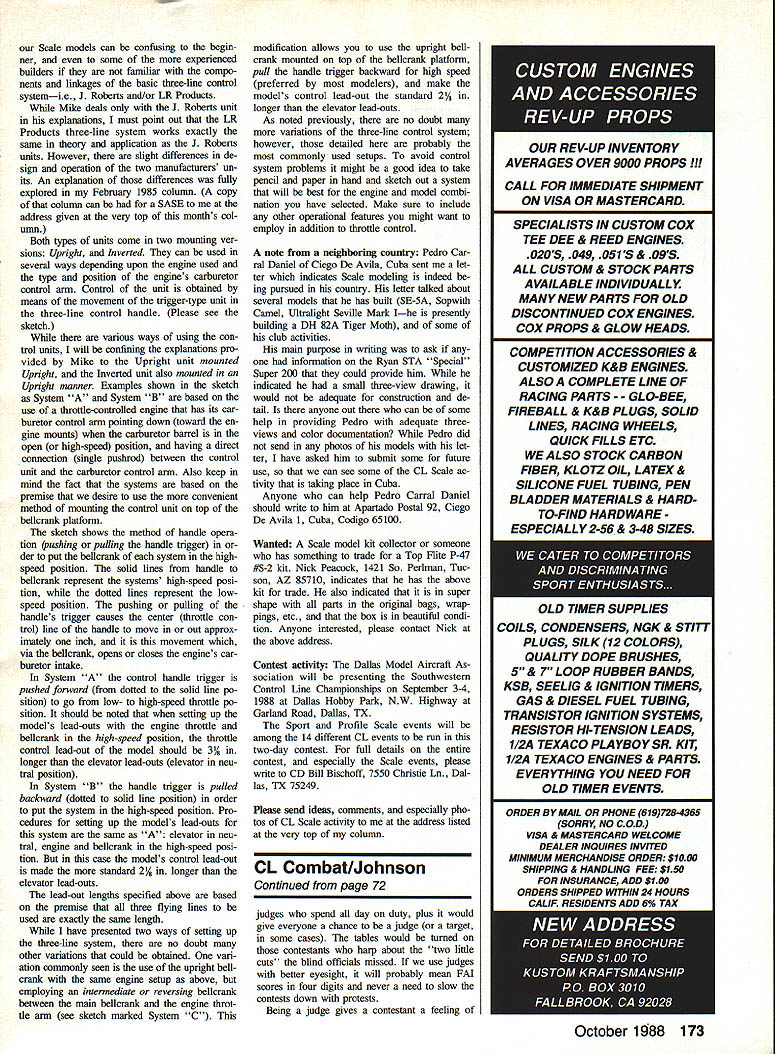
Control Line: Scale
Author
Bill Boss 77-06 269th Street New Hyde Park, NY 11040
Documentation and Flight Scoring
Documentation and its importance in the overall scoring of a Scale model was explored in the August column. Mike Welshans provided his thoughts, ideas, and some specific suggestions on how to put a documentation package together that would help obtain the highest possible static score.
While static scoring was emphasized (and it was pointed out that it accounts for 50% to 66% of scoring in the various AMA Scale events), we must not forget the other half of the scoring: the flight—and the importance of presenting a realistic flight performance. Once again, I credit Mike Welshans for the ideas on which the major portion of this month's column is based.
What would your answer be if you were asked, "What is the most important operational feature that you should employ in your Scale model?" Would it be flaps, bomb bay doors, retractable landing gear, or throttle control? Most experienced Scale modelers would answer, "Throttle control."
Throttle control allows us to fly our models in the same realistic fashion as the prototype—a necessity if we are to receive a good flight score. Which would you prefer to see?
- A Scale model that leaps off the ground on takeoff, zips around the circle at a constant speed until it runs out of fuel, and then makes a precarious, uncontrollable attempt at landing?
- Or a model that begins takeoff with a slow rollout under controlled power, climbs slowly into the air and reaches full throttle in a lap or two, throttles back to a reasonable flight speed when proper flight altitude is attained, completes the prescribed number of flight laps, and then descends under throttle control to a touch-and-go or a controlled landing, finally gliding back to the pits under control?
Unless you're into the immediate crowd-pleasing launch and fast laps, the second type of flying is the kind that will win you a good flight score.
Scale models should be trimmed to fly at the correct speed for the prototype being modeled; lap timing must be appropriate for the speed range of the class. Many judges look for a realistic throttle schedule—i.e., climb, cruise, and approach speeds that correspond to the prototype.
Throttle Systems
Throttle systems for three-line control are somewhat more complex than for two-line stunt, but many designs are available. Common types include:
- Simple bellcrank and spring systems.
- More elaborate servo-driven units.
- Pneumatic systems used by some tuners.
Bill Boss discusses setting up three-line throttle control systems. There are many variations, but the systems detailed here are among the most commonly used setups. To avoid control system problems, sketch out a system that will be best for the engine and model combination you have selected, and include any other operational features you might want in addition to throttle control.
One useful modification allows you to use an upright bellcrank mounted on top of the bellcrank platform, pull the handle trigger backward for high speed (preferred by most modelers), and make the model's control lead-out the standard 2-1/4 in. longer than the elevator lead-outs.
International Correspondence: Cuba
A note from a neighboring country: Pedro Carral Daniel of Ciego De Avila, Cuba, sent a letter indicating Scale modeling is being pursued in his country. He described several models he has built (SE-5A, Sopwith Camel, Ultralight Seaplane Mark I) and said he is presently building a DH 82A Tiger Moth. His main purpose in writing was to ask if anyone had information on the Ryan STA "Special" Super 200 that could be provided to him. While he has a small three-view drawing, it is not adequate for construction and design.
If anyone can help Pedro with adequate three-view drawings and color documentation, please write to him at: Apartado Postal 92 Ciego De Avila 1, Cuba Codigo 65100
I have asked Pedro to submit photos of his models for future use so we can share some of the CL Scale activity taking place in Cuba.
Wanted: Kit Trade
Wanted: A Scale model kit collector or someone who has something to trade for a Top Flite P-47 kit or kits. Nick Pavecek, 1421 N. Perlman, Tucson, AZ 85710, indicates that he has the above kit available for trade. It is in excellent condition with all parts still in the original bags and wrappings, and the box is in beautiful condition. Anyone interested, please contact Nick at the above address.
Contest Activity
The Dallas Model Aircraft Association will present the Southwestern Control Line Championships on September 3–4, 1988, at Dallas Hobby Park (N.W. Highway at Garland Road, Dallas, TX). The Sport and Profile Scale events will be among the 14 different CL events run over the two-day contest. For full details on the contest, and especially the Scale events, please write to: C.D. Bilboff 7550 Christie Ln. Dallas, TX 75249
Send Ideas and Photos
Please send ideas, comments, and especially photos of CL Scale activity to me at the address listed at the top of this column.
Transcribed from original scans by AI. Minor OCR errors may remain.

