

Control Line: Scale
Bill Boss 77-06 269th Street New Hyde Park, NY 11040
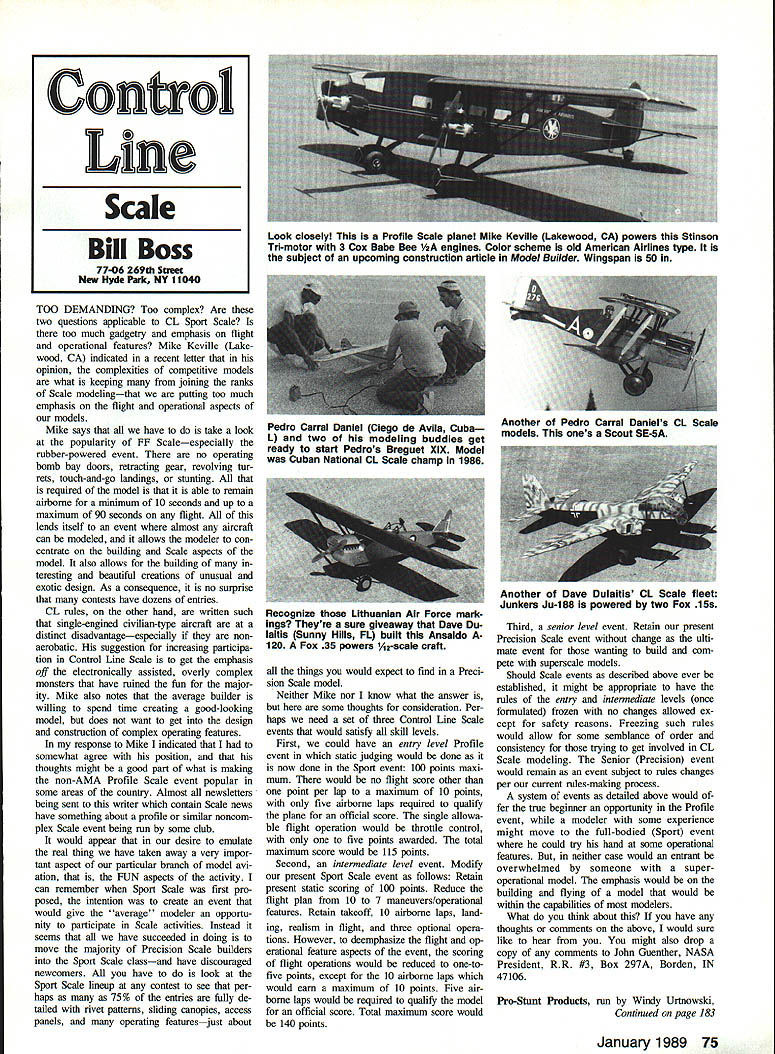
TOO DEMANDING? Too complex? Are these two questions applicable to CL Sport Scale — is there too much gadgetry and emphasis on flight-operational features? Mike Keville (Lakewood, CA) recently wrote that the complexities of competitive models are keeping many from joining Scale modeling; that putting too much emphasis on flight and operational aspects of models is discouraging newcomers.
Mike points to the popularity of free-flight (F/F) Scale — especially rubber-powered events — as an example. There are no operating bomb-bay doors, retracting gear, revolving turrets, touch-and-go landings, or stunting. The model need only remain airborne between a minimum of 10 seconds and a maximum of 90 seconds. That simplicity allows almost any aircraft to be modeled and lets the modeler concentrate on building and scale appearance. It also encourages interesting and exotic designs, which helps explain why some contests have dozens of entries under F/F rules.
By contrast, current CL rules tend to disadvantage single-engined civilian types, especially nonacrobatic designs. To increase participation in Control Line Scale, Mike suggests de-emphasizing electronically assisted, overly complex models that have taken much of the fun away for many builders. He notes the average builder is willing to spend time creating a good-looking model but does not want to get into the design and construction of complex operating features.
I somewhat agree. The rise of non-AMA Profile Scale events in some areas supports this: many newsletters now include Scale news or mention profile, noncomplex Scale events being run by clubs. In our desire to emulate the real thing we may have removed an important element of this branch of model aviation — fun.
Sport Scale was originally intended to give the average modeler an opportunity to participate in Scale activities. Instead, it appears to have pushed many Precision Scale builders into the Sport class while discouraging newcomers. At contests you will often see perhaps 75% of Sport Scale entries fully detailed with rivet patterns, sliding canopies, access panels, and many operating features — the same items expected on a Precision Scale model.
Neither Mike nor I claim to have the complete answer, but here are some thoughts for consideration. Perhaps we need three Control Line Scale events to satisfy different skill levels.
Proposed three-tier system
- Entry-level Profile event
- Static judging as at present (100 points maximum).
- No flight score except points per lap: 1 point per lap to a maximum of 10 points.
- Five airborne laps required to qualify the plane for an official score.
- One allowable flight operation: throttle control (5 points).
- Total maximum score: 115 points.
- Intermediate-level Sport event (modified)
- Retain present static scoring (100 points).
- Reduce the flight plan to 10 points (7 maneuvers/operational features).
- Retain takeoff scoring, 10 airborne laps, landing realism, and three optional operations.
- De-emphasize flight-operational feature scoring: assign 1–5 points for flight operations, except 10 airborne laps still earn the full 10 points.
- Five airborne laps required to qualify the model for an official score.
- Total maximum score: 140 points.
- Senior-level Precision event
- Retain the present Precision Scale event unchanged as the ultimate competition for those who want to build and compete with superscale models.
Rule stability suggestion
If these entry and intermediate events are established, it might be appropriate to freeze their rules (once formulated) with changes allowed only for safety reasons. Freezing those rules would provide order and consistency and help newcomers get involved in CL Scale modeling. The senior Precision event would remain subject to the current rule-making process and periodic changes.
A system like this would offer the true beginner an entry in the Profile event, allow an intermediate modeler to move up to the modified Sport event (and try some operational features), and prevent entrants from being overwhelmed by super-operational models. The emphasis would be on building and flying models within the capabilities of most modelers.
What do you think? If you have thoughts or comments, please write to me at the address above. Also send a copy of any comments to: John Geuther, NAS President R.R. #3, Box 297A Borden, IN 47106
Transcribed from original scans by AI. Minor OCR errors may remain.

