
Control Line: Scale
Bill Boss
77-06 269th Street New Hyde Park, NY 11040
Photographic equipment such as a camera and a slide projector can be useful tools for scale model building. A few months ago (December '88 issue) Dennis Patera suggested taking color pictures of photos in books as a means of obtaining documentation photos for scale model presentations. This allows us to obtain documentation without removing or otherwise damaging pages from expensive books in our aviation libraries.
Bob Furr, a member of the Orbiting Eagles of Omaha and a regular contributor to this column, takes this concept further. He suggests using a camera with a macro lens not only to copy whole pictures but also to reproduce insignias and artwork found on the nose and tail assemblies of many WW I and WW II airplanes. Instead of using the color print (negative) process, Bob recommends taking color slides of the subject so the slides can be used for projection purposes (and you can also have color prints made from them for documentation).
Using slides and projection
First, a camera with a macro-focusing lens allows you to get within inches of the subject, producing the largest possible image on the slide for maximum detail and clarity. Once you have the slide, put it in a projector and project it onto the built-but-unfinished model. Move the projector as required to obtain the proper size and location of the image on the model.
If you don't want to copy the image directly on the model surface, tape a piece of paper in place and trace the projected image. Whether on the model or paper, the traced image can then be treated as a color-by-number project. If the detail copied was photographed at an angle, the process still works—simply turn the model to the same angle as the prototype photograph before tracing.
Steps for copying insignia/artwork with slides:
- Photograph the subject with a macro lens for maximum detail.
- Make a color slide of the photograph.
- Project the slide onto the model or onto paper taped to the model.
- Move the projector to get the correct size and position.
- Trace the image on the model or paper; adjust the model angle if needed.
- Convert the traced paper image into a decal if desired (see Decal-It).
Decal-It
Bob notes you might find a product called Decal-It at hobby shops. It converts your sheet of paper into a decal that can be applied to your model.
Plans and scratch building
The slides-and-projector method also works well for producing your own plans for scratch building or for checking the scale outline of a kit plan against three-view drawings used for documentation.
One of the most time-consuming jobs for the scratch-builder is scaling up a three-view drawing to the full size desired. The time can be greatly shortened by taking slides of the three-views, projecting them onto a large sheet of paper hung on a wall, and tracing the outline. If the three-views are construction-type drawings, you also gain the advantage of knowing locations of fuselage formers, wing ribs, etc.
If you're comparing three-views to a kit plan, hang the kit plans on a wall and adjust the projected three-view slide until it overlays the plans. Any differences in the three-view image and the plans become immediately apparent, letting you see where rudder, elevator, wing, or fuselage outlines need adjustment to conform to the scale outline. I have used this process on RC sport-scale kits converted to control-line use, where tail surfaces had been enlarged beyond scale size for better RC flight characteristics.
A word of caution: if the three-view drawings occupy more than one sheet (such as some Wyman-type drawings), be sure all sheets are copied with the camera at the same distance and framing. This ensures all slides of the three-views will be the same scale for projection.
Photography tips
While I haven't covered the technical aspects of taking pictures/slides in depth because of the many camera types and techniques available, I recommend:
- Use a tripod with an oil-type camera tripod head to hold the camera steady and allow precise focusing.
- If possible, borrow a friend’s copying stand and lighting for professional-looking results.
Motor Offset Pad
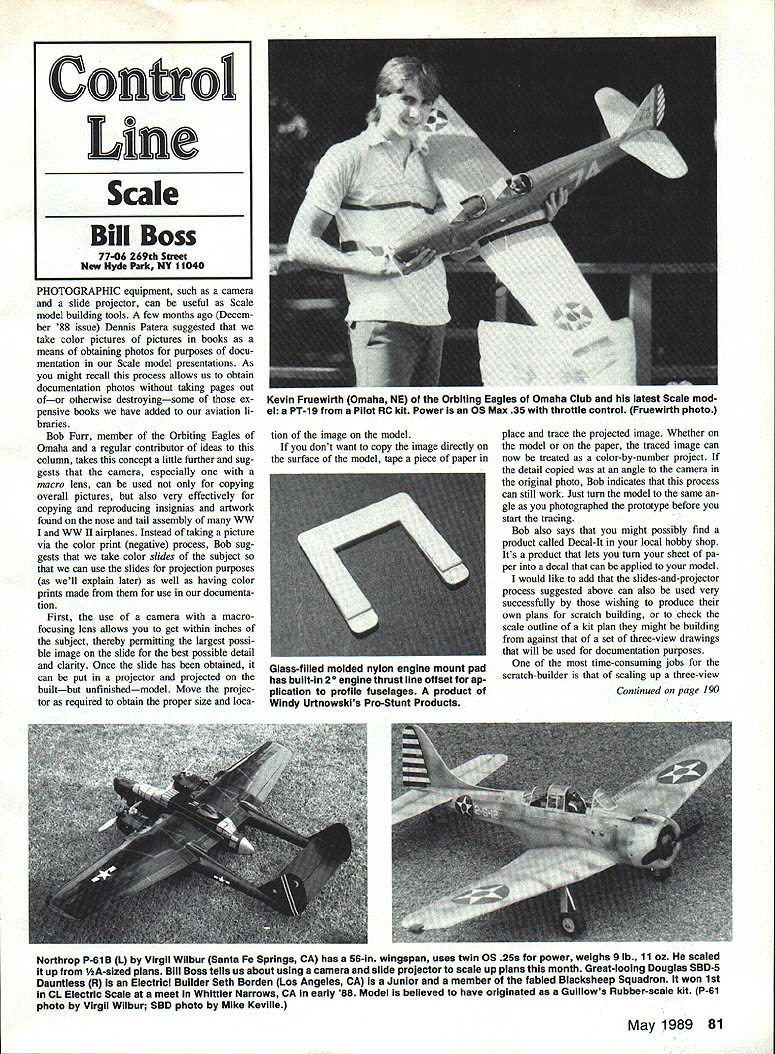
The Motor Offset Pad shown in the accompanying photo is a new product from Windy Urtnowski of Pro-Stunt Products. The pad is molded from DuPont glass-filled nylon, has a built-in 2° offset, and can be used with most .35- and .40-size engines. Pads are available in white or black to match most color schemes. Fit the pad to your engine and drill it to match the mounting-bolt hole pattern. These pads should work well on profile-scale models where vibration damping is desired.
Price and ordering:
- Pads are $1.95 each.
- Obtainable from: Pro-Stunt Products, 9 Union Avenue, Little Ferry, NJ 07643.
Mystery kit/plans
Barry Brigmon is seeking kit plans for a P-47 sold by one of the major manufacturers. He remembers the model as one that would use a .15 engine and believes it was produced by Midwest or Top-Flite. The plans had a black-and-white photograph of the P-47 in flight with "Republic Thunderbolt" written on its nose.
If you manufactured that kit or have a set of plans, please contact Barry at: Rt. 3 Box 325-2B Gadsden, AL 35901
Notes from Replica (NASA)
From Replica, newsletter of the National Association of Scale Aeromodellers (NASA): If you haven't renewed your NASA membership for 1989, now is a good time. New or renewing membership is $6 per year. Membership entitles you to:
- A newsletter published several times a year.
- A listing of scale data sources useful to all scale model builders, competitive or not.
If you want an event listed in the newsletter, notify NASA three to four months before the event to assure a listing in at least two issues. Send dues or new membership to: Burt Duggan 11090 Phyllis Dr. Clio, MI 48420
NASA needs your support, and you, the scale modeler, can benefit from NASA's efforts.
Please send ideas, comments, contest activity reports, and especially photos of control-line scale activity to me at the address at the top of this column.
Transcribed from original scans by AI. Minor OCR errors may remain.

