
Control Line: Scale
Author
Bill Boss 77-06 268th Street New Hyde Park, NY 11040
Introduction
Judging C/L Sport Scale models—both statically and in flight—was a major topic of discussion in last month's column. The discussion was based in part on comments in the January column that suggested changes in Sport Scale rules might increase participation. As you'll recall, respondents felt rules changes were not required, but that better judging in both the static and flight portions of the event was needed.
This month I follow up with a set of Sport Scale scoresheets developed by Gerald Deneau (Aurora, CO). Gerald, a modeler for over 50 years and presently a member of the Rocky Mountain Modelers, has focused on Navy Carrier (a Scale event) and Sport Scale for the past five years. He has readily recognized the problems associated with Scale judging and developed a comprehensive set of scoresheets to help judges and competitors.
Scoresheets by Gerald Deneau
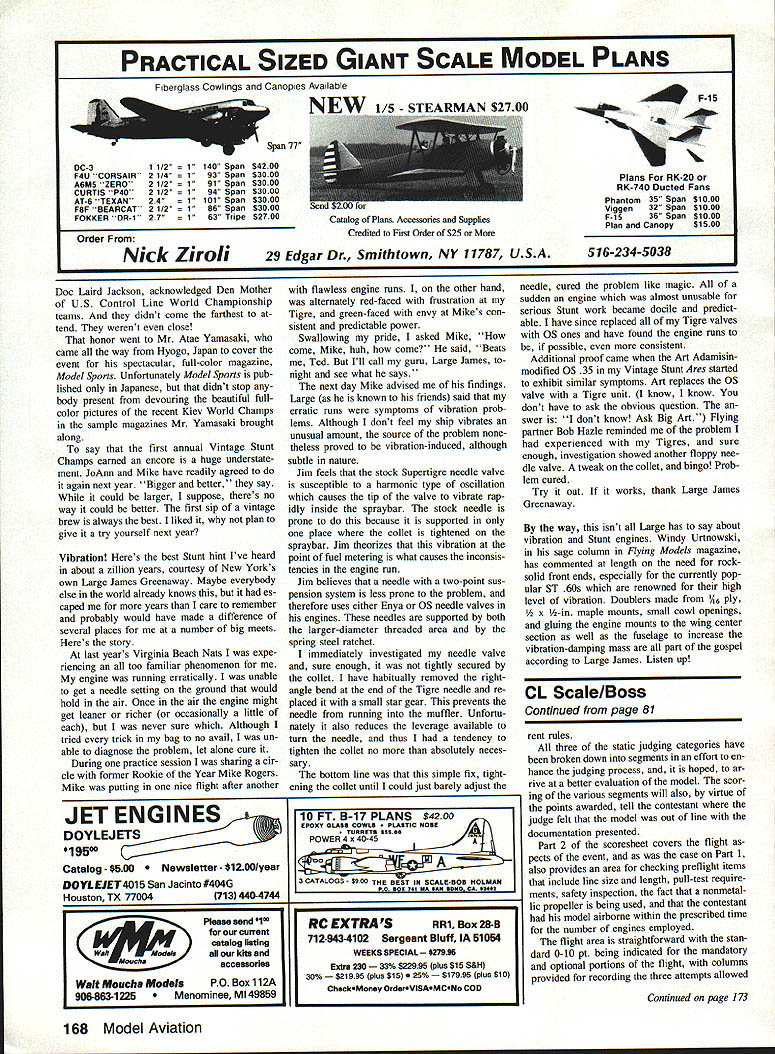
Gerald's scoresheets provide space for scores and comments and act as a checklist of virtually everything judges should consider before and during static judging, and before and during flight judging.
Worksheet Part 1
Worksheet Part 1 has three major information areas:
- Contestant information: name, age, AMA No., and classification.
- Aircraft (model) requirements: designation (name of aircraft model), weight, engine size, and checkoff boxes for engine type (two-cycle vs. four-cycle), muffler installed, and dummy pilot installed (if visible in flight).
- Static judging area: checkoffs to indicate proof of scale, color, and markings; a signed declaration of nonbuilt parts; and confirmation that inflight droppable stores are installed for static judging. Space is provided for recording scores for accuracy of outline, craftsmanship, and finish (color and markings).
Static Judging Breakdown
Gerald departed from many previous Sport Scale scoresheets by breaking down the outline accuracy (maximum = 40 pt.) and craftsmanship (maximum = 30 pt.) categories into five segments for static judging, similar to Precision Scale. The segments and point ranges are:
- Accuracy of outline (maximum = 40 pt.):
- Fuselage: 0–9 pt.
- Wings: 0–9 pt.
- Tail: 0–8 pt.
- Cowl, engine, propeller: 0–7 pt.
- Landing gear: 0–7 pt.
- Craftsmanship (maximum = 30 pt.):
- Fuselage: 0–8 pt.
- Wings: 0–7 pt.
- Tail: 0–6 pt.
- Cowl, engine, propeller: 0–5 pt.
- Landing gear: 0–4 pt.
Finish (Color and Markings)
The finish category is also broken into segments (maximum = 30 pt.):
- Degree of gloss: 0–5 pt.
- Authenticity of colors: 0–10 pt.
- Shape and style of lettering and insignia: 0–10 pt.
- Stencils and small markings: 0–5 pt.
The final item on the Part 1 scoresheet is a place for the contestant's signature certifying that he has previously test flown the aircraft and is capable of performing a safe takeoff, two-lap level flight, and a normal landing within the designated flying circle.
Flight Judging
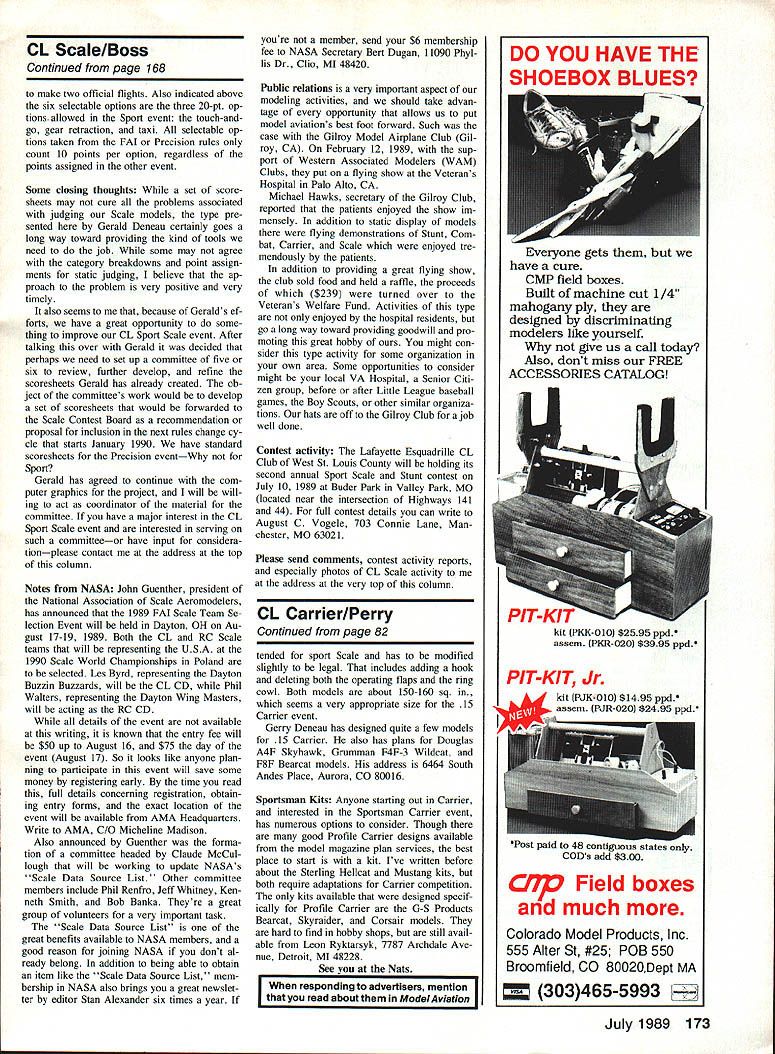
The scoresheets indicate that contestants are required to make two official flights. Above the six selectable options on the sheet are the three 20-point options allowed in the Sport event: touch-and-go, gear retraction, and taxi. All selectable options taken from the FAI or Precision rules count 10 points per option, regardless of the points assigned in those other events.
Closing Thoughts and Committee
While a set of scoresheets may not cure all the problems associated with judging our Scale models, Gerald Deneau's sheets go a long way toward providing the tools we need. Some may not agree with the category breakdowns and point assignments for static judging, but the approach is positive and timely.
After discussing this with Gerald, we decided to set up a committee of five or six to review, further develop, and refine the scoresheets. The object is to develop a set of scoresheets to forward to the Scale Contest Board as a recommendation for inclusion in the next rules change cycle starting January 1990. We have standard scoresheets for the Precision event—why not for Sport?
Gerald has agreed to continue with the computer graphics for the project, and I will act as coordinator for the committee. If you have a major interest in the CL Sport Scale event and are interested in serving on the committee—or have input for consideration—please contact me at the address at the top of this column.
Notes from NASA
John Guenther, president of the National Association of Scale Aeromodellers (NASA), announced that the 1989 FAI Scale Team Selection Event will be held in Dayton, OH on August 17–19, 1989. Both the CL and RC Scale teams that will represent the U.S.A. at the 1990 Scale World Championships in Poland are to be selected. Les Byrd, representing the Dayton Buzzin Buzzards, will be the CL Contest Director (CD), while Phil Walters, representing the Dayton Wings Masters, will be the RC CD.
Entry fees: $50 up to August 16, and $75 on the day of the event (August 17). Full details concerning registration, entry forms, and the exact location will be available from AMA Headquarters. Write to AMA, c/o Micheline Madison for information.
Also announced by Guenther was the formation of a committee headed by Claude McCullough to update NASA's "Scale Data Source List." Other committee members include Phil Renfro, Jeff Whitney, Kenneth Smith, and Bob Banka. The "Scale Data Source List" is a great benefit to NASA members. If you are not a member, send your $6 membership fee to NASA Secretary Bert Dugan, 11090 Phyllis Dr., Clio, MI 48420. Members also receive a newsletter by editor Stan Alexander six times a year.
Public Relations
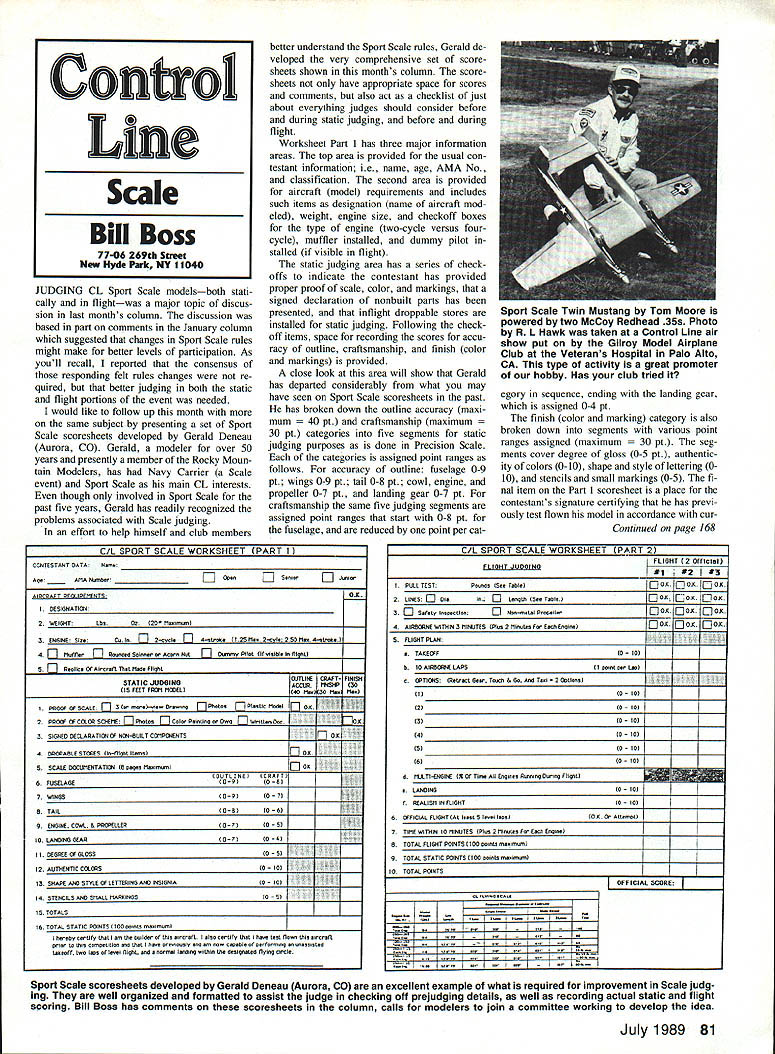
Public relations is an important aspect of our modeling activities, and we should take advantage of opportunities to put model aviation's best foot forward. The Gilroy Model Airplane Club (Gilroy, CA), with support from Western Associated Modelers (WAM) clubs, put on a flying show at the Veteran's Hospital in Palo Alto, CA on February 12, 1989.
Michael Hawks, secretary of the Gilroy Club, reported that the patients enjoyed the show. In addition to static displays, there were flying demonstrations of Stunt, Combat, Carrier, and Scale. The club sold food and held a raffle; proceeds of $239 were turned over to the Veteran's Welfare Fund. Activities of this type provide goodwill and promote our hobby. Consider similar events in your area—local VA hospitals, senior citizen groups, Little League games, Boy Scouts, or other organizations.
Our hats are off to the Gilroy Club for a job well done.
Contest Activity
The Lafayette Esquadrille CL Club of West St. Louis County will hold its second annual Sport Scale and Stunt contest on July 16, 1989 at Buder Park in Valley Park, MO (near the intersection of Highways 141 and 44). For full contest details write to:
August C. Vogele 703 Connie Lane Manchester, MO 63021
Closing
Please send comments, contest activity reports, and especially photos of CL Scale activity to me at the address at the very top of this column.
Transcribed from original scans by AI. Minor OCR errors may remain.

