
Control Line: Scale
Bill Boss 77-06 269th Street New Hyde Park, NY 11040
Three-Line-Handle Throttle Adjuster
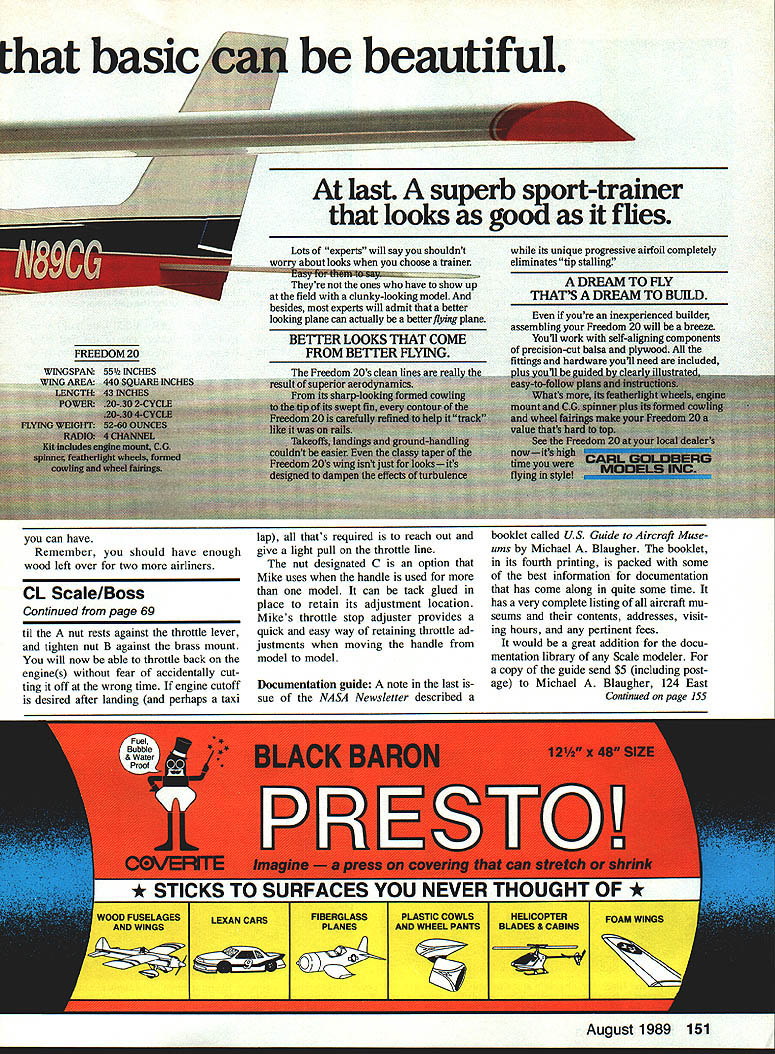
The three-line-handle throttle adjuster is an idea submitted by Mike Welshans (Ferndale, MI). Many of you will recognize Mike as a major contributor of pictures and ideas to this column. This month Mike shares his throttle-stop adjuster that can be fitted to GS/LR or Roberts-type three-line control handles.
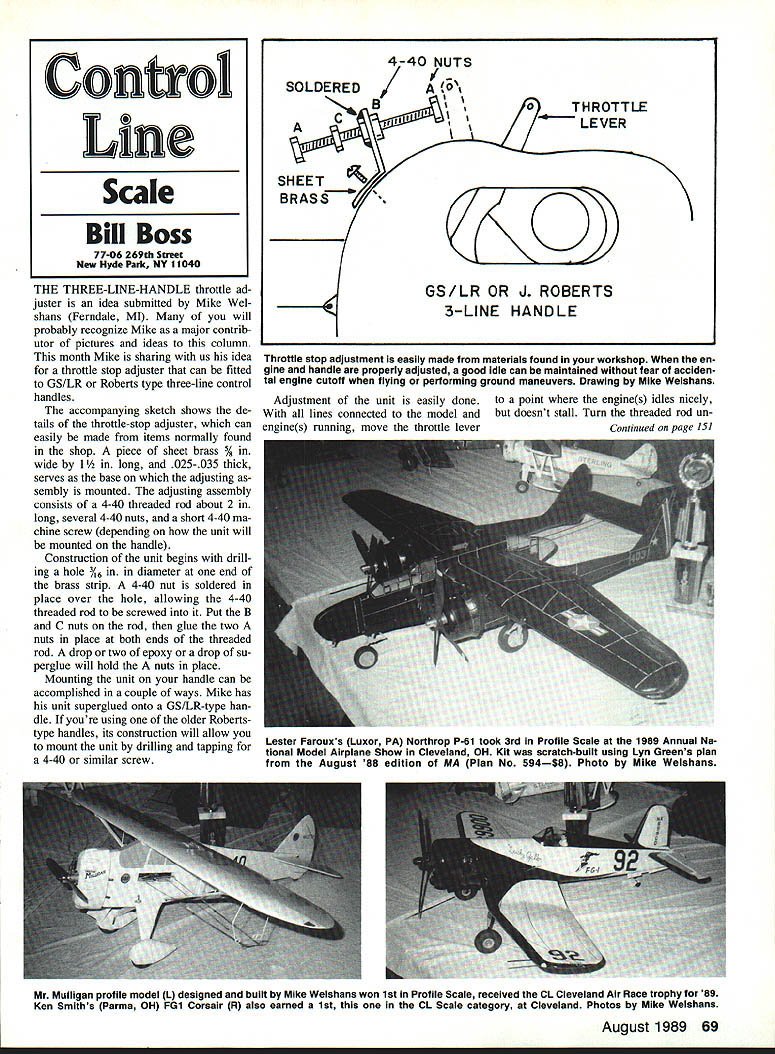
The adjuster can be made from items normally found in the shop. The base is a piece of sheet brass about 3/8 in. wide by 1-1/2 in. long and .025–.035 in. thick. The adjusting assembly consists of a 4-40 threaded rod (about 2 in. long), several 4-40 nuts, and a short 4-40 machine screw (depending on how the unit will be mounted on the handle).
Parts list:
- Sheet brass strip, ~3/8 in. x 1-1/2 in., .025–.035 in. thick
- 4-40 threaded rod, ~2 in. long
- Several 4-40 nuts (designated A, B, C in the sketch)
- Short 4-40 machine screw (if required for mounting)
- Epoxy or CA (superglue) for fixing nuts
- Solder (for one nut)
Construction steps:
- Drill a 3/16 in. diameter hole at one end of the brass strip.
- Solder a 4-40 nut in place over the hole; this nut captures the threaded rod.
- Screw the 4-40 threaded rod into the soldered nut.
- Place nuts B and C on the rod in their operating positions.
- Glue the two A nuts in place at both ends of the threaded rod (a drop of epoxy or CA will hold them).
Mounting:
- Mike superglued his unit onto a GS/LR-type handle.
- For older Roberts-type handles, mount by drilling and tapping for a 4-40 or similar screw.
Operation:
- Tighten nut B against the brass mount until the A nut rests against the throttle lever. This sets the throttle stop so you can throttle back without accidentally killing the engine.
- If engine cutoff is desired after landing (or after a taxi lap), a firm pull on the throttle line will override the stop.
- Nut C is optional; Mike tack-glues it in place when the handle is used for more than one model to retain its adjustment.
Mike’s throttle stop adjuster provides a quick, easy way to retain throttle adjustments when moving the handle from model to model.
Documentation Guide
A recent note in the NASA Newsletter described a booklet titled U.S. Guide to Aircraft Museums by Michael A. Blaugher. Now in its fourth printing, the booklet contains a very complete listing of aircraft museums and their contents, addresses, visiting hours, and any pertinent fees. It would be a great addition to the documentation library of any scale modeler. For ordering details, contact Michael A. Blaugher directly.
CL Scale / Boss
Radio Control in CL Scale Models — AMA Rules
I occasionally receive letters asking whether radio control can be used in control-line (CL) scale models — that is, using two- or three-line flight control while using radio for other functions (flaps, retracts, dropping bombs or fuel tanks, etc.). Ronald Macknet of Yulee, FL, recently asked this.
Although there may be no technical reason flight operations and other functions of CL models couldn't be radio controlled, the AMA rule book forbids it. Paragraph 2 (General) of the Control Line Rules (page 23 of the 1988–89 AMA Competition Regulations Book) states that a control line model aircraft is flown on one or more steel wire line(s) or metal line(s) of equivalent strength, attached to the model to provide aerodynamic control of elevation through manipulation of control surfaces during flight. Such manipulation may be accomplished by mechanical means or by electrical impulses transmitted through the line(s). The use of separate radio transmission for control is prohibited.
This column has previously explored mechanical and electrical impulse systems. If you have ideas along these lines, please send them in — others would be interested.
Miscellaneous — Metal Mend Tape
While browsing a local auto supply store I found a product that works well for simulating access or maintenance panels on scale models: Metal Mend Tape, available through Trimbrite Products / Spartan Plastics, Inc., P.O. Box 67, Holt, MI 48842.
Product details:
- Self-adhesive aluminum tape, 3 in. x 5 ft. roll (about 1-1/4 sq. ft.)
- Thickness about .004 in., semibright sheen
- Comes with paper backing; roll weighs about 1-1/2 oz.
Application tips:
- Best applied to a completely smooth surface free of imperfections.
- Be careful to avoid wrinkling during application.
- Smooth and work the tape with rounded soft balsa sticks or a soft cloth.
- Can be stretched slightly and worked around moderate curves.
- Once adhered, the surface can be scored to simulate dzus fasteners, rivets, etc.
- If painting, very light sanding with 400–500 grit wet/dry paper will help paint adhesion.
Trimbrite also offers a large selection of pinstripe tape (single and multistripe) originally designed for automobiles, but useful for dressing up a Sunday flier.
Publicity for CL Scale Activities
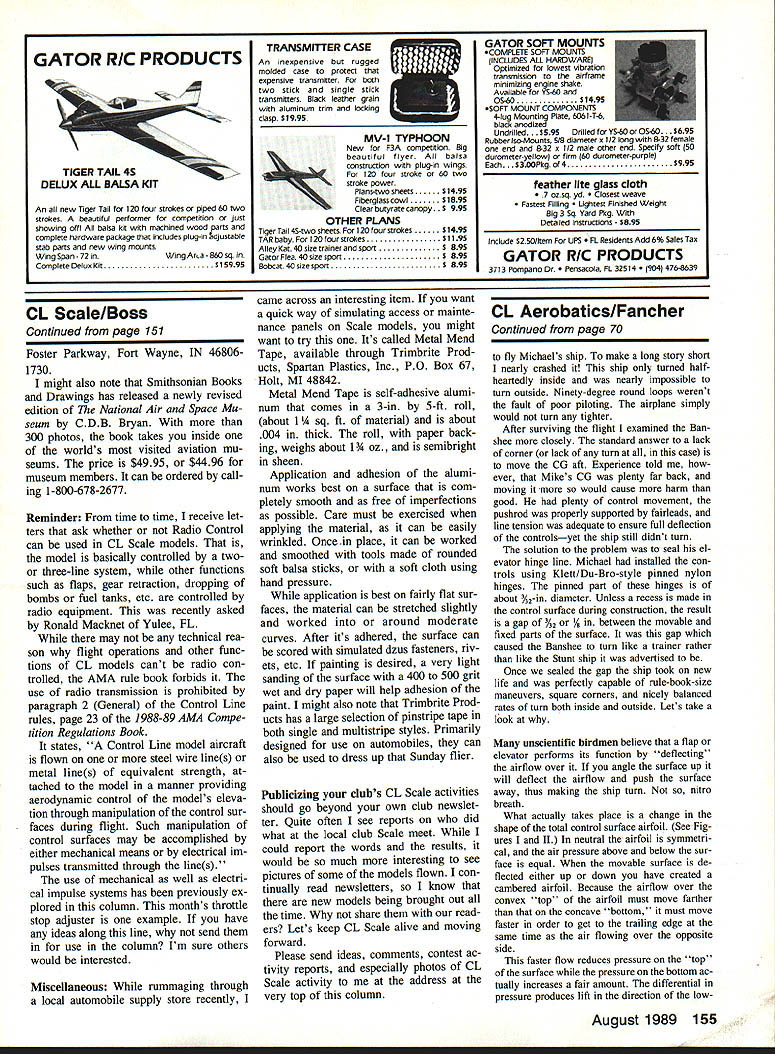
Publicizing your club’s CL scale activities should go beyond the local club newsletter. Reports are useful, but pictures of the models flown make the coverage much more interesting. I regularly read newsletters and know there are new models appearing all the time — please share photos and reports so we can keep CL scale alive and moving forward.
Please send ideas, comments, contest reports, and especially photos of CL scale activity to me at the address at the top of this column.
Transcribed from original scans by AI. Minor OCR errors may remain.

