
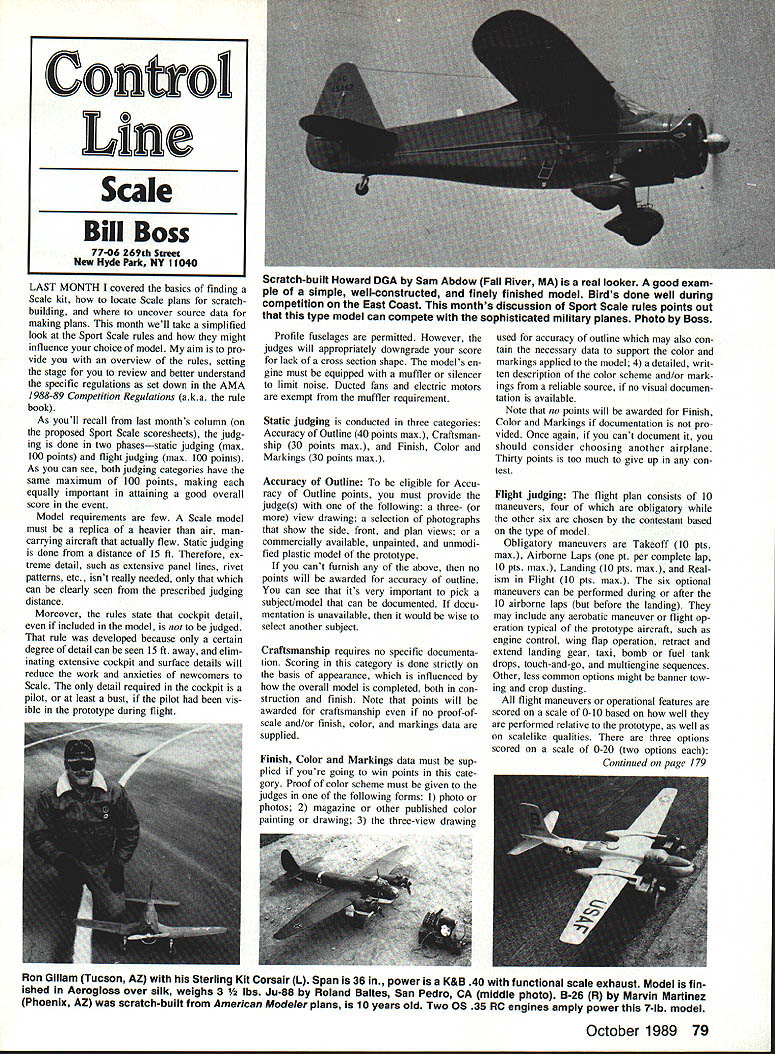
Control Line: Scale
Bill Boss 77-06 269th Street New Hyde Park, NY 11040
Last month I covered the basics of finding a Scale kit, how to locate Scale plans for scratchbuilding, and where to uncover source data for making plans. This month we'll take a simplified look at the Sport Scale rules and how they might influence your choice of model. My aim is to provide you with an overview of the rules, setting the stage for you to review and better understand the specific regulations set down in the AMA 1988–89 Competition Regulations (the rule book).
As you'll recall from last month's column (on the proposed Sport Scale scoresheet), judging is done in two phases—static judging (max. 100 points) and flight judging (max. 100 points). Both categories have the same maximum, making each equally important in attaining a good overall score.
Model requirements
- A Scale model must be a replica of a heavier-than-air, man-carrying aircraft that actually flew.
- Static judging is done from a distance of 15 ft., so extreme surface detail (panel lines, rivets, etc.) visible only up close is not necessary—only what can be clearly seen from the prescribed distance.
- Cockpit detail, even if included, is not judged. This rule reduces the work and anxieties of newcomers. The only cockpit requirement is a pilot (or at least a bust) if the pilot would have been visible in the prototype during flight.
- Profile fuselages are permitted, but judges will appropriately downgrade your score for lack of cross-section shape.
- The model's engine must be equipped with a muffler or silencer to limit noise. Ducted fans and electric motors are exempt from the muffler requirement.
Static judging
Static judging is conducted in three categories:
- Accuracy of Outline (40 points max.)
- Craftsmanship (30 points max.)
- Finish, Color and Markings (30 points max.)
Accuracy of Outline
To be eligible for Accuracy of Outline points, you must provide the judges with one of the following:
- A three-view drawing;
- A selection of photographs that show side, front, and plan views; or
- A commercially available, unpainted, unmodified plastic model of the prototype.
If you can't furnish any of the above, no points will be awarded for Accuracy of Outline. It is very important to pick a subject/model that can be documented. If documentation is unavailable, consider selecting another subject.
Craftsmanship
Craftsmanship requires no specific documentation. Scoring is based strictly on appearance, influenced by how the overall model is completed in both construction and finish. Note that points will be awarded for craftsmanship even if no proof-of-scale or finish/color/markings data are supplied.
Finish, Color and Markings
Finish, Color and Markings data must be supplied to earn points in this category. Proof of the color scheme must be given to the judges in one of the following forms:
- Photo or photos;
- Magazine or other published color painting or drawing;
- The three-view drawing used for Accuracy of Outline, which may also contain necessary data to support the color and markings applied to the model; or
- A detailed written description of the color scheme and/or markings from a reliable source, if no visual documentation is available.
No points will be awarded for Finish, Color and Markings if documentation is not provided. Thirty points is too much to give up in any contest—if you can't document it, consider choosing another airplane.
Flight judging
The flight plan consists of 10 maneuvers: four obligatory and six chosen by the contestant based on the type of model.
Obligatory maneuvers (each max. 10 points):
- Takeoff (10 pts. max.)
- Airborne Laps (10 pts. max.)
- Landing (10 pts. max.)
- Realism in Flight (10 pts. max.)
The six optional maneuvers can be performed during or after the 10 airborne laps and before landing. They may include:
- Acrobatic maneuvers
- Flight operations typical of the prototype (engine control, wing flap operation, retract/extend landing gear, taxi, bomb or fuel tank drops, touch-and-go, multi-engine sequences)
- Less common options such as banner towing and crop dusting
All flight maneuvers or operational features are scored on a scale of 0–10 based on how well they are performed relative to the prototype and on scale-like qualities. There are also three options scored on a scale of 0–20 (two options each).
CL Scale / Boss
Because the flight portion counts for half the total score, choosing a model with good flying characteristics is important. The capability and experience of the person handling the control handle also play a large part in success or failure. The key word here is practice.
Much has been said about military fighters and multiengine models having an advantage in flight. I don't think that's entirely true—many basically simple designs compete effectively against more sophisticated types. Even the simplest subjects are judged for the four obligatory maneuvers, and finding maneuvers to fill out the six optional selections should present little difficulty.
Most models are capable of:
- Taxiing (two options)
- Performing a touch-and-go (two options)
- Engine control with engine cutout (one option)
- One additional option depending on the subject (e.g., operation of wing flaps, crop dusting)
In summary: choose a model that
- can be documented for both Accuracy of Outline and Finish, Color and Markings,
- has the necessary features and options to fill out the flight plan, and
- has good flight characteristics.
If you select your subject carefully, gather the necessary data, fill out the flight plan, and learn the flight characteristics of your model, you'll be rewarded with many points, better placings in competition, many hours of good flying, and a great sense of self-satisfaction.
Once again, we must credit and thank Gerry Deneau, of Aurora, CO, for the lion's share of the ideas and thoughts in this presentation of the Sport Scale rules.
The Sport Scale Scoresheet Committee has been formed. Response to the request for help with standardizing a Sport Scale scoresheet for the competition rule book has been good.
The following will serve on the committee:
- Gerry Deneau, 6464 S. Andes Pl., Aurora, CO 80016
- Charles Bauer, 4944 N. Orange Ave., Norridge, IL 60566
- Mike Welshans, 976 Pearson, Ferndale, MI 48220
- William Rammage, 411 North 5th Ave., Tucson, AZ 85705
- William Boss (the writer), address at the top of this column
If you have any ideas or suggestions concerning the Sport Scale scoresheets that appeared in the July 1989 column, any of the above-named would be glad to hear from you. Don't miss this opportunity to be heard.
Please send ideas, contest reports, and especially photos on CL Scale to me at the address found at the very top of this column.
Transcribed from original scans by AI. Minor OCR errors may remain.

