
Control Line: Scale
Bill Boss 77-06 269th Street New Hyde Park, NY 11040
Introduction
The major topic of my October and December columns was getting started in Sport Scale. They covered the basics for selecting a model and finding documentation. Static and flight judging were also reviewed.
This month I expand on bellcrank placement, drawing on ideas from Gerry Deneau's continuing series of CL Sport Scale articles in his club newsletter, The Probable Cause. Emphasis here is on converting an RC kit to CL use and deciding whether the model's wing will be removable or permanently fixed.
Conversion considerations — overview
Trying to determine the type of bellcrank and its location is generally the first step when converting an RC kit to CL use. Key questions include:
- Should the bellcrank be installed in the fuselage or in the wing?
- Is the model a high-wing, mid-wing, or low-wing?
- Will the wing be removable or glued permanently in place?
- Will the bellcrank be upright- or inverted-mounted?
- What is the direction of travel of the engine’s throttle control arm relative to the bellcrank?
Because many Scale models built today are large, a removable wing has distinct advantages for transportation. If the wing is permanently fixed, the primary task is choosing the size and style of bellcrank (upright or inverted) to provide the proper throttle control travel. If the wing is removable, you must also consider access to the control-rod connections for throttle, elevator, and perhaps flaps.
Before moving on: my October 1988 column includes extensive information and sketches on three-line bellcrank systems; I will not re-cover those technical details here. For this column I assume models use throttle control operated via a three-line bellcrank system since throttle control is important both for competition points and for flying enjoyment.
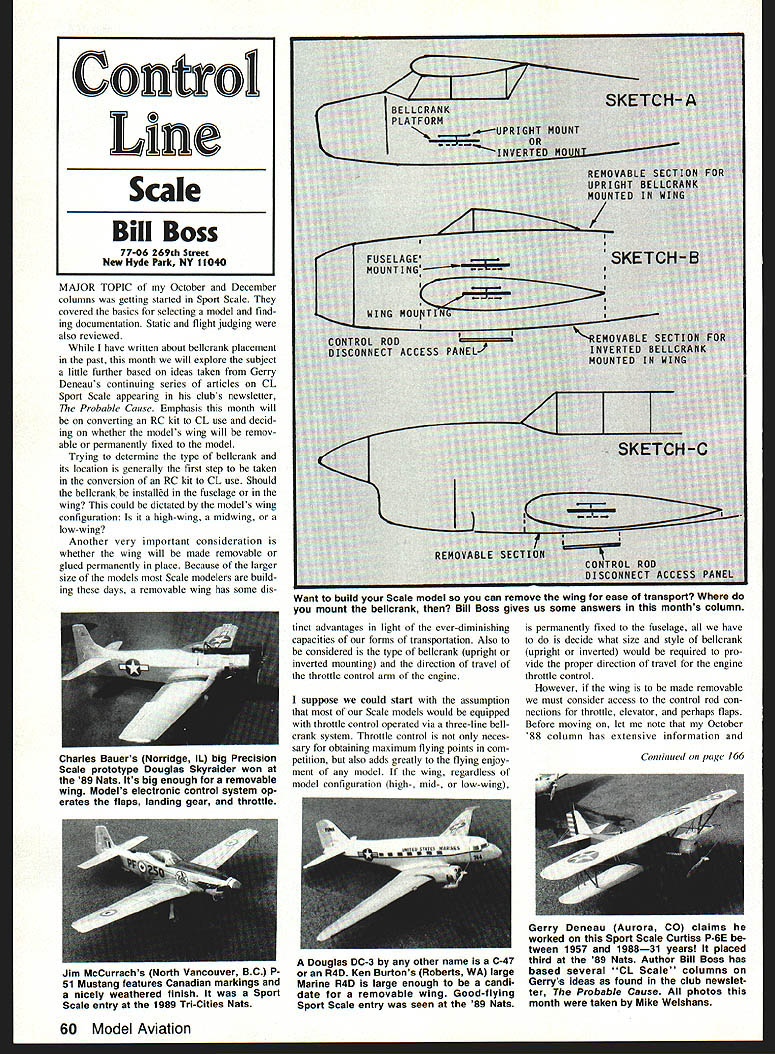
High-wing models (Sketch A)
- If the wing is mounted at the top of the fuselage, place the bellcrank in the fuselage. The vertical center of gravity will be below the wing; placing the bellcrank in the wing can cause the model to roll toward the center of the circle during flight.
- As Gerry Deneau warns, "This is a no-no; since drooping control lines tend to make the higher turn prematurely and cause the life expectancy of the model to be extremely short."
- For high-wing models, special lead-out guides must be located near the inboard wing tip.
- Making the wing removable on a high-wing model generally does not create control-rod disconnection problems unless the wing has operational flaps.
- If flaps are mechanically operated (bellcranks and pushrods), make special arrangements for disconnecting control rods for wing removal.
- If flaps are operated by a servo mounted in the wing, disconnection of wiring may be as simple as unplugging a Deans-type connector.
- Note: For full points in AMA Scale competition, flaps must operate independently of throttle control.
Midwing models (Sketch B)
If the wing is removable on a midwing model, you generally have two bellcrank mounting choices:
- Bellcrank in the fuselage above the wing
- Avoids disconnect problems for throttle and elevator control rods.
- If flaps are operational, the flap operating rod could be disconnected during wing removal; electrically operated flaps may require only a wire disconnect.
- Bellcrank in the wing
- Creates a control-rod disconnect problem when removing the wing.
- Allows lead-out wires to be enclosed in the wing for a more realistic scale appearance.
Other tips:
- You can make an upper or lower portion of the fuselage removable to facilitate disconnects, but it is usually best to make the lower fuselage and wing removable as a unit. This is less conspicuous and preserves the model’s appearance.
- Access to control-rod disconnect depends on upright or inverted bellcrank mounting:
- Upright bellcrank: access via the cockpit and an operational canopy is acceptable and adds realism.
- Inverted bellcrank: access via a small removable panel below the bellcrank is typical.
Low-wing models (Sketch C)
- Many WWII fighters use the low-wing configuration.
- As with midwing models, the bellcrank may be installed upright or inverted.
- Access for control-rod disconnect:
- Upright mount: via the cockpit.
- Inverted mount: via a small access panel on the bottom of the wing directly below the bellcrank.
- Working flaps and retractable gear systems usually do not pose significant disconnect problems when making the wing removable on low- or mid-wing models. Most mechanical and electric flap systems are contained within the wing structure; the most likely need is an electrical connector disconnect.
Lead-outs and further reference
I have purposely omitted detailed discussion of bellcrank lead-outs in this column. For information on lead-outs see my September 1986 column, which covered the subject in great detail. If you are a new reader and would like copies of the October ’88 or September ’86 columns mentioned here, send a SASE to the address above.
1989 Directory of CL Scale Items in Model Aviation
January
- Discussion of complexities of Sport Scale event based on comments by Mike Keville.
- Pro-Stunt Products: line reels and other supplies.
- Trophies by Jennings.
- 1988 Directory of CL Scale Items in Model Aviation.
February
- Review of CL Scale rules change proposal for 1990–91 rule book.
- Removing old silkspan by Gerry Deneau.
- Return of Sterling C-size Scale kits.
- Contest report — GSCB annual Scale meet.
March
- Report on College of Aeronautics (Flushing, NY) open house and static show.
- Workshop hint by Bob Furr: airfoiled bicycle spokes as wing struts and wires.
- Visit to USAF Museum (Wright-Patterson AFB) by Stan Alexander.
- Documentation source: Scale Plans and Photo Service.
April
- Construction of three- and four-...
Transcribed from original scans by AI. Minor OCR errors may remain.

