
Control Line: Scale
Bill Boss 77-06 269th Street New Hyde Park, NY 11040
CONTROL RODS
Control rods (pushrods) will be the major topic of discussion in this edition of our continuing series on improving, building, and flying Control Line Scale models. Proper installation of control rods is important for two reasons: first, you want the model free of control‑system problems; second, you want easy maintenance if something should go wrong.
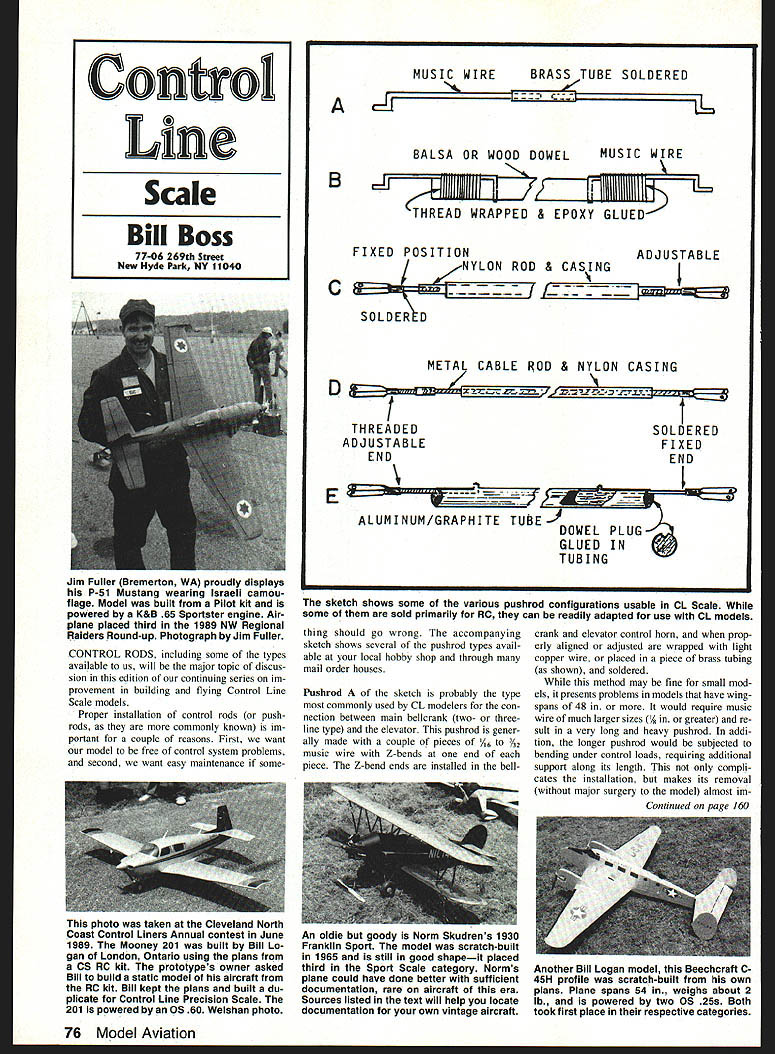
The accompanying sketch (not shown here) illustrates several pushrod configurations usable in CL Scale. While some are sold primarily for RC, they can be readily adapted for CL models. The following descriptions summarize common types, materials, installation methods, and practical tips.
Pushrod Types
- Type A — Music wire pushrod
- Usually made from two pieces of 1/16" to 3/32" music wire with Z‑bends at the ends.
- Z‑bend ends are installed in the bellcrank and elevator control horn, wrapped with light copper wire or placed in a short piece of brass tubing, and soldered.
- Fine for small models, but for wingspans of 48" or more it requires much larger (heavier) wire (e.g., 1/8") that is long and prone to bending under control loads. Long heavy rods complicate installation and removal and add undesirable tail weight.
- Type B — Lightweight rigid rod (wood or balsa core)
- Uses a rigid lightweight material for most of the length (1/8" hard balsa or 1/4"–3/16" hardwood dowel).
- Ends use music wire, threaded rod, or quick‑link attachments for hookup to the elevator, bellcrank, throttle, etc.
- To install, drill a hole about 1–2" from the end of the rod, insert the 90° bend of the connector, wrap with thread (or similar) and epoxy. Threaded quick‑connect links can be used for adjustability.
- Provides good rigidity and is lighter than large‑diameter music wire pushrods, though it requires more fuselage room.
- Type C — Nylon‑sheathed flexible pushrod (inner rod in nylon tubing)
- Uses nylon tubing as an outer casing with threaded rods/quick‑connect links for end fittings. Available in lengths from ~30 to 48" depending on manufacturer.
- One or both ends can be made adjustable.
- Light and fairly rigid; a 36" unit with connectors weighs about 1/2 oz (compare: 36" of 1/8" music wire ≈ 2 oz). Some support along its length is recommended.
- Type D — Flexible stranded metal cable in nylon tube
- Uses a stranded metal cable (~1/16" diameter) sheathed within a nylon tube; lengths typically 20–48" depending on manufacturer.
- End connectors are soldered in place and can be stationary or threaded adjustable.
- Very flexible and useful where routing must bypass obstructions (e.g., throttle around a fuel tank). A 36" length with connectors weighs a bit over 1/2 oz. Requires considerable support in long runs and avoid sharp bends (friction increases with bend tightness).
- Type E — Rigid tube pushrod (aluminum/graphite/fiberglass)
- Can be made from arrow shafts (aluminum), graphite tubes (e.g., Sig), or fiberglass tubes (e.g., Dave Brown Products). Arrow shafts are strong, light, and resist buckling in compression; graphite is very light and stiff.
- Typical construction: cut tube and connector rods to length, drill a 1/16" hole in the tube wall about 1–2" from each end, insert a connector rod with a 90° bend through the hole, and epoxy a dowel plug into the tube to secure the connector permanently.
- Fiberglass kits often include multiple end fittings for piano wire, Kwik‑Link rods, or Y‑type pushrods.
Installation Details and Tips
- Save weight toward the tail: most Scale models tend to be tail‑heavy, so minimize rearward weight when selecting pushrod type and materials.
- Support long pushrods: longer rods (especially flexible types) should have intermediate supports to prevent excessive bending and friction.
- Avoid sharp bends: especially for cable‑in‑tube types, tight bends increase friction and reduce smoothness of control operation.
- Use protective retainers on quick‑link connectors: always put plastic or rubber tubing, or a spring retainer, over quick‑link/wishbone‑type connectors to prevent them from opening in flight and allowing a control horn to slip off.
- Make controls smooth and maintenance friendly: the objective is a system that operates effortlessly and allows easy servicing.
Manufacturers and Sources
- Nylon and metal cable‑type pushrods: Du‑Bro, Sullivan Products.
- Graphite pushrods (with end fittings): Sig (32" lengths).
- Fiberglass pushrods and fittings: Dave Brown Products.
- Arrow shafts: available from archery supply shops.
SCALE DOCUMENTATION SOURCES
I recently became aware of two journals that are excellent documentation sources for aircraft manufactured from the early 1900s to about 1940:
- WW I Aero — covers planes from 1900 to 1910.
- Skyways — covers planes from 1920 to about 1940.
Both journals are published quarterly by World War I Aeroplane, Inc., 15 Crescent Road, Poughkeepsie, NY 12601. They are intended for aviation enthusiasts, full‑scale builders, historians, museum curators, collectors, restorers, and modelers who need good vintage aircraft documentation.
World War I Aeroplane also publishes a 40‑page Master Materials List that tabulates an inventory of full‑scale plans (planes and engines). Some plans are copies of originals (full or partial), some are redrawn originals, and others are reconstructed from drawings, manuals, and photographs.
The journals contain technical drawings, scanned photographs, scale‑modeling material, paint/color information, historical research, and other features useful to anyone deeply interested in vintage aircraft. For membership or subscription details, write to World War I Aeroplane, Inc. at the address above.
Model Aviation — Control Line: Scale Bill Boss 77‑06 269th Street New Hyde Park, NY 11040
Transcribed from original scans by AI. Minor OCR errors may remain.

