
Control Line: Scale
Bill Boss 77-06 269th Street New Hyde Park, NY 11040
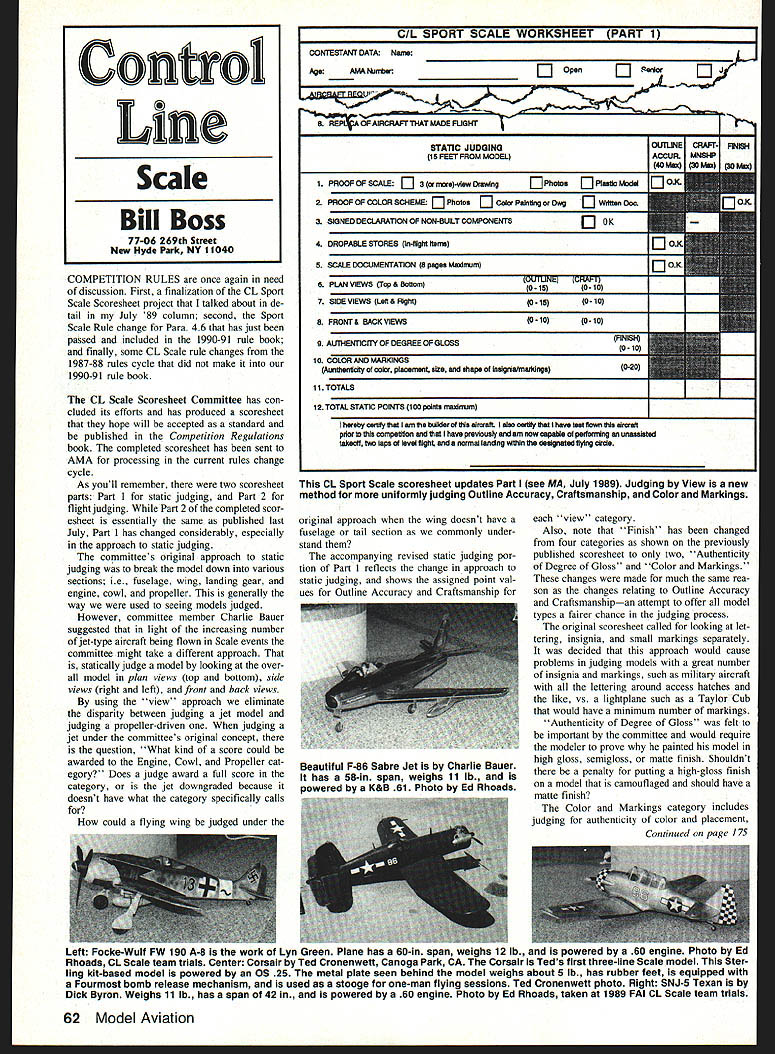
CL Sport Scale Scoresheet
COMPETITION RULES are once again in need of discussion. First, a finalization of the CL Sport Scale Scoresheet project that I talked about in detail in my July '89 column; second, the Sport Scale Rule change for Para. 4.6 that has just been passed and included in the 1990-91 rule book; and finally, some CL Scale rule changes from the 1987-88 rules cycle that did not make it into our 1990-91 rule book.
The CL Scale Scoresheet Committee has concluded its efforts and has produced a scoresheet that they hope will be accepted as a standard and be published in the Competition Regulations book. The completed scoresheet has been sent to AMA for processing in the current rules change cycle.
As you'll remember, there were two scoresheet parts: Part 1 for static judging, and Part 2 for flight judging. While Part 2 of the completed scoresheet is essentially the same as published last July, Part 1 has changed considerably, especially in the approach to static judging.
The committee's original approach to static judging was to break the model down into various sections, i.e., fuselage, wing, landing gear, engine, cowl, and propeller. This is generally the way we were used to seeing models judged.
However, committee member Charlie Bauer suggested that, in light of the increasing number of jet-type aircraft being flown in Scale events, the committee might take a different approach: statically judge a model by looking at the overall model in plan views (top and bottom), side views (right and left), and front and back views.
By using the "view" approach we eliminate the disparity between judging a jet model and judging a propeller-driven one. Under the committee's original concept, when judging a jet the question is, "What kind of a score could be awarded to the Engine, Cowl, and Propeller category?" Does a judge award a full score in the category, or is the jet downgraded because it doesn't have what the category specifically calls for?
How could a flying wing be judged under the original approach when the wing doesn't have a fuselage or tail section as we commonly understand them?
The accompanying revised static judging portion of Part 1 reflects the change in approach to static judging, and shows the assigned point values for our Outline Accuracy and Craftsmanship for each "view" category.
Also note that "Finish" has been changed from four categories as shown on the previously published scoresheet to only two: "Authenticity of Degree of Gloss" and "Color and Markings." These changes were made for much the same reason as the changes relating to Outline Accuracy and Craftsmanship—an attempt to offer all model types a fairer chance in the judging process.
The original scoresheet called for looking at lettering, insignia, and small markings separately. It was decided that this approach would cause problems in judging models with a great number of insignia and markings, such as military aircraft with all the lettering around access hatches and the like, versus a lightplane such as a Taylor Cub that would have a minimum number of markings.
"Authenticity of Degree of Gloss" was felt to be important by the committee and would require the modeler to prove by the painting of his model in high gloss, semigloss, or matte finish. There should be no penalty for putting a high-gloss finish on a model that is camouflaged and should have a matte finish.
The Color and Markings category includes judging for authenticity of color, placement, size, and shape of insignia/markings.
I urge you to review the proposed scoresheets and direct any comments you might have to your AMA District Scale Contest Board member for his evaluation. His name and address appear in the "Competition Directory" item in the "Competition Newsletter" section of this magazine. I believe the scoresheets, as proposed, are a significant step toward better judging of the CL Sport Scale event.
A rambling thought: If the "view" approach to static judging is accepted for the Sport event and works well — shouldn't we consider revision of our Precision Scale rules in the future?
Rule Change: Para. 4.6
The last item changed on this section of the scoresheet is on Line 3: "Declaration of Non-Built Components." Note that a minus sign appears on Line 3 under the "Craftsmanship" column, and relates to a change made in CL Sport Scale Rule 4.6. The new rule requires a copy of the Declaration shown on Page 109 of the 1990-91 Competition Regulations to be filled out, signed, and submitted by the contestant with his model. The declaration lists negative point adjustments for purchased or supplied components on the model.
This rules change appeared in the last rules change cycle as an RC rules change, when in fact it was intended for both RC and CL. Discussions with Dave Platt (originator of the rules change) indicated that from his inception the proposal was meant for both RC and CL Sport Scale events. Somehow it got interpreted for magazine publication as RC only. When Platt reviewed the changes for the new rule book, he included the change for CL based on his original proposal which was passed by the Scale Contest Board.
Regardless of where the error was made, we now have a rule that could lose a contestant 3.95 points off his total score if he used and declared all the components listed on the declaration.
While both the old and new versions of Rule 4.6 depend on the honesty of the contestants, the new rule does provide judges with some guidelines. It would appear that the burden of proof would be with the contestant in any item that might be questioned.
Missed Rule Changes from the 1986-87 Cycle
A couple of rules changes from the 1986-87 rules change cycle that missed being put in the 1988-89 rule book also missed the 1990-91 book. They are as follows:
- The total score in the Precision Scale event should be 665 points.
- CL Sport Scale Para. 4.2.a should state that the three-view drawing can be up to a maximum size of 24 x 36 in.
- CL Sport Scale rule 5.5 should have a new paragraph marked "f." This paragraph indicates that parts that will not fly with the model cannot be added during static judging; i.e., a display of ordnance on the ground, wheel chocks, boarding steps, etc.
Exact wording for these changes can be found on page 120 of the May '88 issue of MA. AMA Technical Director Bob Underwood is aware of the omissions and is working toward official publication of the changes. (Editor's note: Unknown to Bill Boss at the time he wrote this column, these Scale items had been published in the April '90 edition of the "Competition Newsletter," page 134. — RCMcM)
Scoresheet Committee
Before leaving the discussion on rules, I would like to thank the members of the Scoresheet Committee for their cooperation, and for a job well done. Committee members were:
- Charlie Bauer
- Mike Welshans
- Bill Rammage
- Gerry De (who started the whole thing by sending in his scoresheet idea for use in this column)
I had the pleasure of coordinating the correspondence and being able to put in my two cents' worth. Thanks again to all.
Workshop Hints
This month we continue our trip through the hardware store with Bob Furth and visit the Lumber and Nuts and Bolts departments.
#### Lumber Department
- Wing leading edge stock can be found here. Just look for quarter-round moldings that come in a number of sizes. The smaller sizes add little weight but give a significant increase in strength when incorporated into a D-tube-structured wing. Some stores will even have outside corner molding shaped like hollowed leading edge stock.
- Dowel rods in sizes from 1/8 to 1/2 in. are also generally found in most lumber departments. The thinner dowels make outstanding reinforcement of leading and trailing edges. The heavier dowels can be used for repairs, interplane struts on biplanes, tail skids, and an assortment of other applications.
#### Nuts, Bolts, and Screws Department
- A good hardware store will generally have a variety of many odd-size nuts, bolts, and screws. For example, Cox .049s use 4-40 bolts to attach the prop. If you have ever bent one, you know how hard it is to find a replacement in a hobby shop. Without too much looking you should be able to locate 5-40 pan head bolts and other commonly used sizes (such as 4-40 and 6-32) at most hardware stores.
- Many wheel types and nuts and bolts we use may be found in hardware stores; we should use some caution in their selection. The quality of some nuts and bolts offered for general household use may not be as high as what is available through a hobby shop.
Something from the Past
Have you ever wondered how you could get your hands on plans for one of those Koyo or Eureka Scale kits of the early Sixties? Well, it appears that not only can you get plans for some of those old models, but you can obtain the plans with full sets of templates, nervures, formed canopies and gun blisters, and newly produced spring landing gear and wheels similar to those included in the original kits.
These semikits, which include the B-29, B-36, C-46 Commando, C-69 Constellation, and C-124 Globemaster, are being provided by John Murphy, 29 Cheryl Dr., Attleboro, MA 02703. If you're interested in any of these Scale models, write to John for details. He'll be glad to supply you with a listing of the semikits and their cost.
Contact
Please send comments, contest activity reports, and especially photos on CL Scale activity to me at the address at the very top of this column.
Transcribed from original scans by AI. Minor OCR errors may remain.

