
Control Line: Scale
Bill Boss 77-06 269th Street New Hyde Park, NY 11040
AESOP models (Ronald Kirchner, Encino, CA)
AESOP stands for Almost Exact Scale Only Profile (1/2-A) models. Ron Kirchner has a fleet of seven AESOP models:
- P-51B Mustang
- P-39 Airacobra
- Spitfire
- Corsair
- Zero
- Wildcat
- Hellcat
Ron scales up the models by tracing the outline of 1/8-scale Monogram plastic kit parts on 1/4-in. graph paper, then enlarging the outline by copying it to 1/2-in. graph paper. This produces an outline twice the size of the plastic model, which he uses for his flying version. Larger models can be obtained by starting with a larger-scale plastic model (for example, 1/32 or 1/24).
Construction details
- Fuselage: 1/4-in. sheet balsa.
- Wings and tail surfaces: 1/8-in. balsa. Note: the wings have no dihedral to keep construction simple and maintain wing strength.
- Exception: Corsair — Ron used 1/4-in. balsa for the inner wing panels and 1/8-in. for the outer panels because “a Corsair wouldn't be a Corsair without a bent wing.”
- Engine mounts: L-shaped, made from .030-in. soft sheet aluminum (can be bent to 90°).
- Landing gear: for simplicity and strength, piano-wire gear is mounted using the bolts that hold the engine or engine mounts in place (this is the only departure from strict scale location).
- Cowls: made from aluminum soft-drink cans.
- Color/markings: either follow the plastic kit scheme or use your own paint scheme.
Flight characteristics: Ron reports the models fly fairly well and will do loops and wingovers. They are inexpensive to make, provide a lot of fun, and are an easy way for beginners to learn about building and flying control-line ships — a good club project for youngsters.
Sam Abdow — Stearman tips (Fall River, MA)
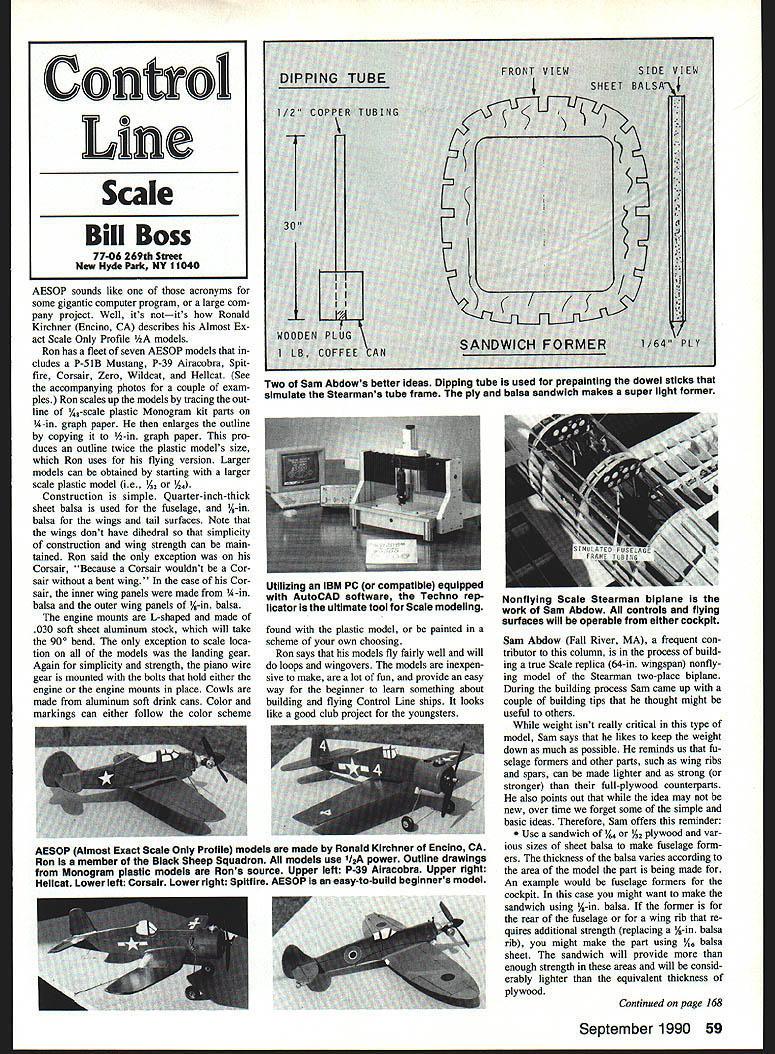
Sam Abdow is building a true-scale replica (64-in. wingspan) — a Stearman two-place biplane. During construction he developed a couple of useful building tips.
- Sam's controls and flying surfaces will be operable from either cockpit.
Tip 1 — Sandwich formers and lightweight parts
While absolute weight isn't critical for a display model, Sam prefers to keep weight down. He suggests making fuselage formers, wing ribs, spars, and similar parts lighter (and often stronger) than full-plywood counterparts by using a ply-and-balsa sandwich.
- Use 1/32- or 1/16-in. plywood with various thicknesses of sheet balsa to make formers.
- Example: near the cockpit use thicker balsa (for example, 3/32-in.); for the rear fuselage or wing ribs that need extra strength, use a 1/16-in. balsa sandwich instead of full 1/8-in. balsa.
- Assembly: spread CA glue (cyanoacrylate) over the balsa to join the sandwich, then weight the sandwich for a couple of minutes to assure good adhesion.
Advantages:
- Very light construction.
- Allows creation of small, intricate parts that are strong and less prone to chipping than some plywood grades.
- Parts are easy to sand and finish.
Tip 2 — Dipping tube for prepainting dowels and stringers
Sam simulates the Stearman's chromed fuselage tubing using 1/8-in. wooden dowel that he prepaints with a simple dipping tool made from common shop materials:
Materials:
- Empty one-pound coffee can
- Wood screw
- 3-in. length of 1/4-in. copper tubing
- Small wooden peg to fit one end of the tubing
- Thinned lacquer or other heavy paint
Construction and use:
- Make a small hole in the center of the coffee-can bottom and fasten the copper tube to the center with the wood screw.
- Fill the coffee can with thinned lacquer or another heavy material so it will stand upright and steady.
- Fit the tube with the appropriate color paint, then dip the dowels or stringers into the tube.
- Allow excess paint to drip off, hang the pieces to dry (Sam used spring-loaded clothespins to hold painted dowels).
- When finished, clean the dipper tube with an appropriate paint cleaner (thinner) and reuse.
Techno Replicator (AutoCAD interface)
Utilizing an IBM PC (or compatible) equipped with AutoCAD software, the Techno Replicator is presented as a powerful tool for scale modeling and prototyping.
Overview:
- A computer-controlled replicator that produces prototype models from AutoCAD output.
- Applications include printed-circuit-board drilling, wood routing, metal milling, and production of cardboard patterns—tasks that otherwise require expensive numerical-control machinery.
Package and cost:
- Compact desktop system including a 20 x 20 x 4-in. Techno XYZ table, a multitask controller, and connecting cable, plus the AutoCAD interface software.
- Total package cost under $5,500 (smaller XYZ stages available to reduce cost).
Items not included:
- IBM PC (or compatible)
- AutoCAD software
- Z-axis work tool (drill, router, end mill, etc.)
- Optional variable-speed drills (600 to 25,000 rpm) are available
Features:
- Three-axis step-motor-drive table with accuracy of .0003 in.
- Menu-driven software that requires no programming.
- Color depth control for relief so you can see cutting depth at a glance.
- Runs on MS-DOS or IBM-PC/XT/AT compatibles; requires 640K memory, a hard disk, and an internal printer or plotter (pen plotter recommended).
Further information:
- Bulletin TI-831 is available free from Techno, 2101 Jericho Turnpike, New Hyde Park, NY 11040.
Additional resources (books)
- Handbook of Small Standardized Components, Master Catalog 757
- Contains over 24,000 off-the-shelf inch and metric components (belt and chain drives, wire ropes, bearings, gears, springs, pulleys, clutch drives, servo connectors, special-purpose fasteners, etc.).
- 786 pages. Price: $5.95 postpaid.
- Available from Stock Drive & Gear Co. (a DSG company) at the Techno company address above.
- Design and Application of Small Standardized Components, Data Book 757, vol. 2
- Covers selection, design, and application of small components described in the Master Catalog.
- 784 pages (paperback). Price: $7.95 postpaid.
- Obtainable from Design 757, P.O. Box 606, Mineola, NY 11501.
Closing
Please send ideas, notices of upcoming CL Scale events, contest reports, and especially photos of exceptional models to:
Transcribed from original scans by AI. Minor OCR errors may remain.

